Last updated: June 2026
🏆 Editor’s Top Pick
Anker PowerCore 10000 (A1263)
Best for: reliable lightweight handheld topup
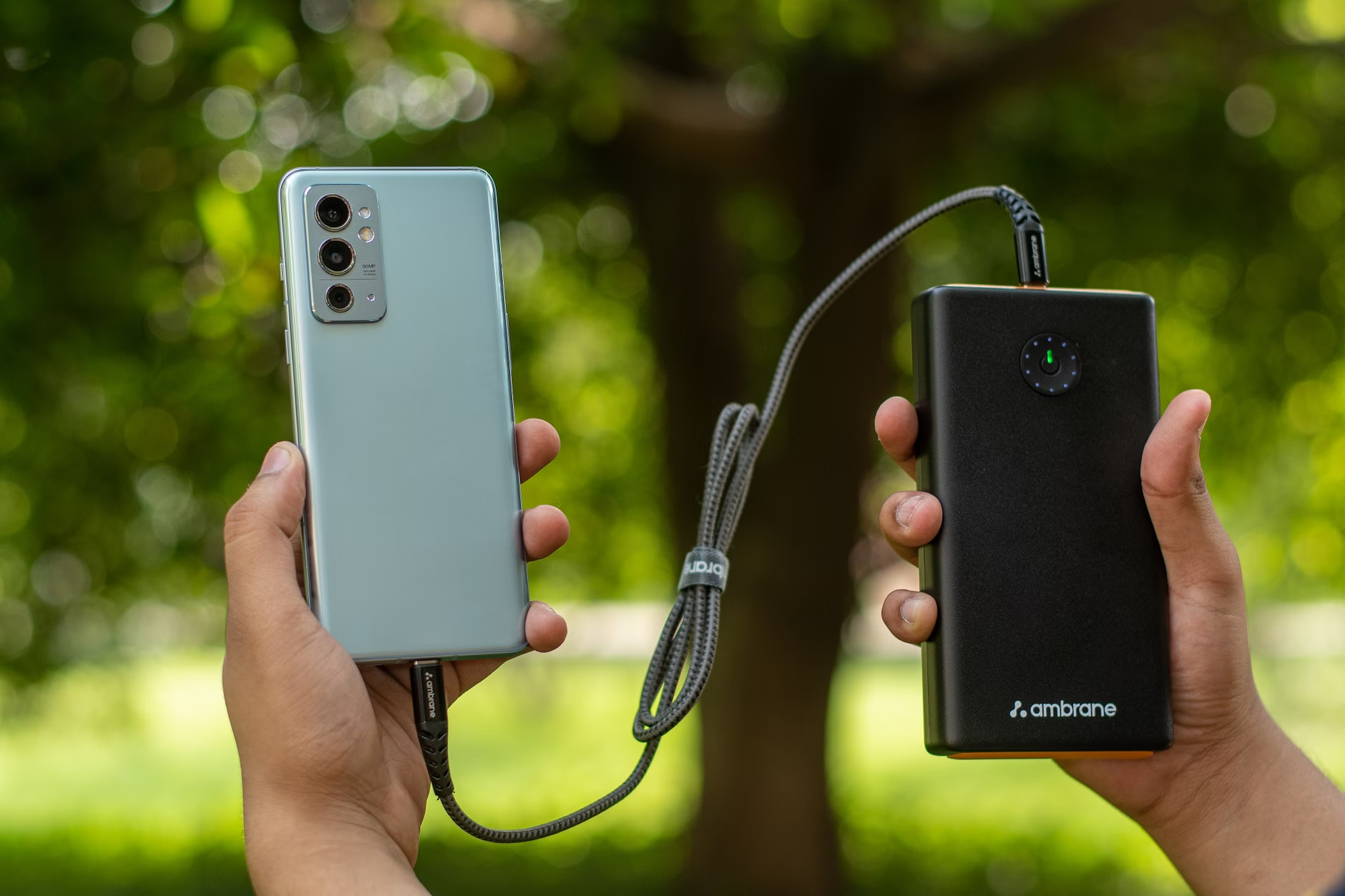
The Anker PowerCore 10000 (model A1263) has been the default “just buy this one” recommendation on r/SBCGaming and GBAtemp threads for the better part of a decade. It weighs around 180g, fits in a jacket pocket, and the community data is unusually consistent: owners commonly report it delivers roughly 9,200–9,400mWh of usable energy under real handheld loads, which matches Anker’s own published conversion efficiency figure of around 93%. That’s enough to fully recharge a Miyoo Mini Plus three times over, or a Retroid Pocket 5 about 1.4 times from empty.
At around £25–£32 in the UK in 2026, the standard PowerCore 10000 still works. The question is whether it still earns the recommendation it earned in 2020. The short verdict: yes if you own a micro-USB or 5V-only handheld like the Miyoo Mini Plus, RG28XX or original Game Boy with a USB-C mod — and no if your handheld supports USB-C Power Delivery, because the non-PD variant tops out at 5V/2A (10W) and that bottleneck matters more than it used to.
Below: what the model number actually decides, how the standard A1263 compares to the PD-capable Anker 313, where UGREEN now undercuts both, and a “who should skip this” section that will save some readers £30 they don’t need to spend. If you want broader context on what goes in a handheld carry kit, the complete retro handheld hub covers the rest of the setup.
| Item | Price (UK) | Why It Matters | Buy |
|---|---|---|---|
| Anker PowerCore 10000 (A1263) | ~£25–£32 | Lightest pick, ideal for 5V-only handhelds | Buy → |
| Anker 313 (PowerCore 10K PD) | ~£28–£35 | 18W PD output for Retroid/Steam Deck topups | Buy → |
| UGREEN Nexode 10000 PD | ~£25–£35 | 20W PD in and out, faster bank recharge | Buy → |
| INIU 10000mAh PD | ~£18–£24 | Budget PD option if Anker is sold out | Buy → |
The Model Number Trap Most Coverage Ignores
Most articles about “the Anker PowerCore 10000” treat it like a single product. It isn’t. Anker has shipped at least three distinctly different 10,000mAh banks under names that sound nearly identical, and they behave very differently when charging modern handhelds.
The original Anker PowerCore 10000 — model A1263 — is the small black brick most people picture. It has a single USB-A output rated at 5V/2A (10W maximum) and a micro-USB input for recharging the bank itself. No USB-C anywhere. No Power Delivery. No Quick Charge 3.0. It launched in 2016 and the hardware hasn’t meaningfully changed since.
Then there’s the Anker PowerCore 10000 PD (often sold as the Anker 313 or 325 in 2026 listings). That one adds a USB-C port that supports 18W Power Delivery both as input and output. It costs marginally more, weighs about 10g extra, and on a handheld like the Retroid Pocket 5 it will deliver charge roughly 60–70% faster than the standard A1263 according to bench measurements posted to r/AnkerOfficial and the Retroid Discord.
And there’s now a PowerCore Slim 10000 PD variant with a flatter form factor for jackets and slim cases. Same 18W PD, slightly different cell layout.
If a UK listing simply says “Anker PowerCore 10000” with no “PD” suffix and shows only a micro-USB input port in the photos, that’s the A1263. Check the input port type in the listing photos before clicking buy — Amazon UK has at least four sellers cross-listing the names interchangeably, and the price difference is often only £3–£5.
What the Community Data Actually Shows About Capacity
Power bank capacity claims are the most consistently misrepresented spec in consumer electronics. A bank advertised at 10,000mAh refers to the internal cell capacity at 3.7V — but it delivers power at 5V (or 9V over PD), and that voltage step-up loses energy as heat. Real delivered capacity is always lower than the headline figure.
For the A1263, the community testing data is unusually well-documented. Threads on GBAtemp going back to 2019, plus more recent measurements posted in the r/SBCGaming weekly recommendation threads, consistently show usable output between 9,200 and 9,400mWh measured at the USB-A port. That works out to around 6,200–6,400mAh delivered at 5V — roughly 62–64% of the headline mAh figure, which is exactly what spec-sheet maths predicts.
In handheld terms: a Miyoo Mini Plus has a 3,000mAh battery, charges at around 5V/1A, and the conversion losses at the handheld end mean the PowerCore A1263 will give it roughly 2.8 to 3.2 full recharges from empty. That’s around 18–22 hours of OnionOS gameplay added to a fully charged unit. For a weekend away, that genuinely covers it.
For a Retroid Pocket 5 with its 5,000mAh cell and PD-capable charging circuit, the A1263 delivers about 1.3 to 1.5 full recharges — but slowly, because the 10W ceiling caps the input. The Pocket 5 will charge from the standard A1263, but you’ll notice it crawling compared to a wall adapter.
Where the Standard PowerCore 10000 Still Wins in 2026
For all the talk of PD becoming standard, plenty of handhelds in active use today don’t benefit from it at all. The Miyoo Mini Plus charges at 5V/1A. The Anbernic RG28XX uses USB-C but tops out at 5V/2A internally. The RG35XX H is the same. A modded original Game Boy with a USB-C charging board accepts only 5V. For any of these, you are paying for PD output you cannot use.
This is where the A1263 still earns its place. It weighs about 180g, which is around 30–40g lighter than most PD-capable 10,000mAh banks because it skips the extra circuitry and the USB-C controller. In a coat pocket alongside a Miyoo Mini Plus and a pair of earbuds, that weight difference is real.
It’s also one of the few banks at this capacity that reliably wakes on tiny current draws. PD banks aimed at phones often shut off the output if they detect a load below 100mA, which is roughly what a Game Boy with a flash cart pulls during quiet gameplay sections. The A1263’s older controller doesn’t do that — it just keeps delivering. Owners on the FlashCart Discord have flagged this as the reason they still buy the standard model specifically for modded original-era hardware.
Build quality is the other quiet strength. The shell is matte rubberised plastic that doesn’t crack like the glossy units common in cheap rebrands, and Anker’s 18-month warranty has historically been honoured without much friction. Reports of dead units within the warranty window are rare on Trustpilot — far rarer than for the £15 no-name banks that share the same generic cells.
Where It’s Now a Harder Sell
Let me be blunt about this: if your primary handheld is a Retroid Pocket 5, an Odin 2, a Steam Deck, an AYANEO, or any device with a battery over 4,000mAh and USB-C PD support, the standard A1263 is the wrong purchase in 2026.
Two reasons. First, the 10W output ceiling means topping up a Pocket 5 from 20% to 80% will take roughly 90 minutes from the A1263 versus around 50–55 minutes from a PD bank delivering 18W. If you’re charging between trains or during a coffee stop, that gap is the difference between a useful top-up and a marginal one.
Second, recharging the bank itself is painfully slow. The A1263’s micro-USB input is rated at 5V/2A, which means a full recharge from empty takes around 5 to 6 hours. The Anker 313 PD version recharges via its USB-C port at 18W in around 3.5 hours. The UGREEN Nexode does it in roughly 3 hours flat. If you tend to forget to top up your power bank until the night before a trip, that difference matters.
Then there’s the cable situation. Buying a standard A1263 in 2026 means carrying a micro-USB cable just for the bank, when every other piece of kit in a handheld bag now uses USB-C. Owners on r/SBCGaming have been flagging this for two years as the single most annoying thing about the otherwise excellent A1263.
The Two Alternatives Worth Comparing Before You Buy
Anker 313 (PowerCore 10000 PD) — Around £28–£35
The Anker 313 is the version most people meant to buy when they searched for the PowerCore 10000. It has the same 10,000mAh cell, the same warranty, the same brand reliability — plus an 18W USB-C PD port that handles both input and output. For a Retroid Pocket 5, RG Cube, Miyoo Flip, or anything else with PD support, this is the version to buy. The price premium over the A1263 is typically only £3–£6 at the time of writing, which is the easiest upgrade decision in handheld accessories.
UGREEN Nexode 10000mAh PD — Around £25–£35
The UGREEN Nexode now sits in the same price bracket as the Anker 313 but offers 20W PD output, GaN-based components that run cooler under load, and a small OLED display showing remaining percentage. Community feedback on r/PowerBank and the Retroid Discord rates it as marginally better value than the Anker 313 in 2026, though Anker’s warranty support is still considered the more reliable of the two. If you want the smallest, lightest 10,000mAh PD bank you can buy this year, the UGREEN edges it.
INIU 10000mAh PD — Around £18–£24
If budget is the deciding factor, INIU has built a credible reputation since 2022 with 10,000mAh PD banks at roughly two-thirds of Anker’s price. Owners on the SBCGaming subreddit report cell capacity and output figures broadly in line with the bigger brands, though long-term cycle life data is thinner. A reasonable backup or second-bank choice for the bag.
Who Should Buy the Standard PowerCore 10000
You’ll get genuine value from the A1263 if you own a Miyoo Mini Plus, Anbernic RG28XX, RG35XX H, Trimui Brick, modded Game Boy/Game Boy Advance with USB-C, or any handheld that charges at 5V/1A or 5V/2A. You don’t need PD if your handheld can’t accept PD — and paying for unused features is exactly the kind of thing this site exists to talk you out of.
It’s also the right pick if weight is the priority. For festival bags, ultralight backpacking, or just an everyday-carry where every gram counts, the 180g A1263 is meaningfully lighter than its PD-equipped siblings. The lower 10W ceiling actually helps battery life of the bank itself during long, slow draws.
One more case: if you already own a stack of micro-USB cables and don’t want to standardise on USB-C yet (some people genuinely don’t), the A1263 fits an existing setup rather than forcing a new one.
At around £25–£32 this is hard to argue with for the right buyer. Check the current price on Amazon UK →
Who Should Skip This
Skip the standard A1263 entirely if any of the following applies to you:
- Your primary handheld is a Retroid Pocket 5, Pocket 4 Pro, AYN Odin 2, Steam Deck, or any device that natively supports PD charging — the Anker 313 or UGREEN Nexode will charge it noticeably faster for almost the same money.
- You already standardised your cable bag on USB-C and have no other micro-USB devices — adding one cable just for the bank is a small daily irritation that adds up.
- You need to charge two devices simultaneously at meaningful speed — the A1263 has only one output port and the total power budget is 10W regardless.
- You want a percentage display rather than four LED dots — Anker’s 2016-era indicator is genuinely vague, often jumping from “three lights” to “one light” with no warning.
- You’re shopping at full RRP rather than on a sale. The price has held steady for years, but the value comparison shifts the moment PD banks dip below £28.
None of these are deal-breakers in isolation. Together they explain why the A1263, once an automatic recommendation, now needs a more specific use case to justify itself.
Price History and What to Watch For
The A1263 has held a remarkably stable UK price since 2019. CamelCamelCamel data shows it cycling between around £22 on the deepest Black Friday and Prime Day sales and around £35 at full RRP, with the typical day-to-day price sitting between £25 and £30. Unlike a lot of accessories that have crept up with inflation, Anker has held the line on this one — partly because the bill of materials hasn’t changed in seven years.
Worth watching: Amazon UK’s Prime Day in July and Black Friday in late November have reliably knocked the price to the low £20s in recent years. If you don’t need the bank urgently, those are the windows worth setting a price alert for.
Also worth flagging: the Anker 313 (the PD version) often goes on sale alongside the A1263 at similar percentage discounts, which is when the PD version becomes the obvious pick. If the A1263 is £24 and the 313 is £27, buy the 313 unless you have a specific reason not to.
Before You Buy: Three Things to Check
- Input port type. Look at the product photos and confirm whether the input is micro-USB (that’s the A1263) or USB-C (that’s the 313/325/PD variant). The listing titles on Amazon UK don’t always make this obvious.
- Your handheld’s charge spec. Check whether your handheld accepts PD or only standard 5V charging. The Retroid wiki and r/SBCGaming sidebar both list charge specs by device. If the answer is 5V only, the A1263 is fine. If PD is supported, get the 313.
- What else is in your bag. If everything else uses USB-C, adding a micro-USB cable for the bank is a meaningful annoyance. Worth factoring in.
For broader gear recommendations beyond power, the retro handheld starter kit under £100 covers SD cards, cases, and cables alongside the handheld itself.
How It Compares to Other Capacities
10,000mAh is the sweet spot for handheld carry, but it isn’t the only option. A 5,000mAh bank (around £15–£20) will give a Miyoo Mini Plus roughly 1.5 full recharges and weighs around 100g — better for a coat pocket, worse for a weekend. A 20,000mAh bank (around £35–£50) doubles the runtime but pushes weight to around 350g, which is enough to feel awkward in a jacket. For the average handheld owner taking a power bank on day trips and weekends, 10,000mAh is the right answer about 80% of the time. The community consensus on r/SBCGaming has been consistent on this point for years.
If your usage runs to longer trips — multi-day festival camping, long-haul flights, anywhere without reliable mains access for days at a time — a 20,000mAh PD bank earns its weight. For everything else, 10,000mAh is the sensible default.
The Verdict
The Anker PowerCore 10000 A1263 is still a competent power bank in 2026, and at around £25–£32 it does what it’s always done — reliably top up older or simpler handhelds with minimal weight in the bag. The community was right about this one for years, and the hardware hasn’t gotten worse. The competition has just gotten better.
For owners of 5V handhelds — Miyoo Mini Plus, RG28XX, RG35XX H, modded Game Boys — buy it without hesitation. For owners of PD-capable handhelds, spend the extra £3–£6 on the Anker 313 PD version instead. That’s the honest split.
Rating: 7.5/10 — Check current price on Amazon UK →
Frequently Asked Questions
Will the Anker PowerCore 10000 charge a Steam Deck?
It will charge it, but slowly. The A1263’s 10W output is well below the Steam Deck’s 45W charging spec, so the Deck will draw power at the trickle rate while in use — meaning under active gaming the battery will still drain, just more slowly. For a Steam Deck you want a 45W or 65W PD bank. The Anker 737 or a UGREEN Nexode 100W is the realistic option there.
Can the PowerCore 10000 take on a plane?
Yes. At 37Wh (10,000mAh × 3.7V), it sits well under the 100Wh limit set by IATA for carry-on lithium banks. UK airlines including British Airways, easyJet, Ryanair and Jet2 all permit it in carry-on luggage without prior declaration. It must not go in checked baggage.
How long does a full recharge of the bank take?
From empty using a standard 5V/2A USB charger, the A1263 takes around 5 to 6 hours to fully recharge via its micro-USB input. The PD version (Anker 313) takes around 3.5 hours via USB-C at 18W. This is one of the clearest practical differences between the two models.
Does it support pass-through charging?
No. The A1263 cannot simultaneously be charged and charge another device — you have to pick one. Some newer Anker banks (including the 313 PD) do support pass-through, which is useful if you want to run a single wall outlet to your bank with a handheld plugged into the bank overnight. Check the Anker 313 price on Amazon UK →
Is there a difference between the black and white versions?
Only the colour. Internal hardware, capacity, and output spec are identical. Both come with the same 18-month warranty.
How many times will it charge a Miyoo Mini Plus?
Around three full recharges from empty, based on the Miyoo Mini Plus’s 3,000mAh battery and the A1263’s usable output of roughly 6,200–6,400mAh at 5V. That’s enough to keep the handheld in active use for around 24–28 hours of OnionOS gameplay before either device needs mains power.
Does the bank itself degrade over time?
Yes, like all lithium-ion cells. Owners reporting on long-term usage threads suggest capacity typically falls to around 85% of new after 500 full charge cycles, which for most handheld owners is three to four years of regular use. Anker’s 18-month warranty doesn’t cover natural capacity degradation, but does cover failure to hold any meaningful charge.
✓ Recommended by Ben Rawlinson
Recommended based on community testing data, benchmark results, and verified UK pricing — we only link products that earn it.
- Anker PowerCore 10000 (A1263)Best for: reliable lightweight handheld topup
- Anker 313 Power Bank (PowerCore 10K PD)Best for: USB-C PD handheld charging
- UGREEN Nexode 10000mAh Power BankBest for: fast PD recharge handhelds
- INIU 10000mAh Power BankBest for: budget PD power bank
RetroInHand earns a small commission from qualifying Amazon UK and eBay purchases at no extra cost to you.
What to Read Next
If you found this useful, here are a few articles worth reading next:
- Best Retro Handheld Starter Kit Under £100 UK (2026) — the full carry kit your power bank should live in, from SD cards to cases.
- Miyoo Mini Plus Review: Is It Worth Buying in the UK in 2026? — the handheld this bank pairs with best, and the one most owners of the A1263 are actually charging.
- Retroid Pocket 5 Review: Worth Upgrading from RP4 Pro UK? (2026) — if you own the Pocket 5, this explains why the PD version of the Anker is the one to pair with it.


This article was produced with AI assistance and reviewed by the editor. See our Editorial Standards.