Last updated: May 2026
🏆 Editor’s Top Pick
Game Boy Advance SP AGS-101
Best for: The best official screen
Buying original Nintendo hardware in 2026 can feel like a minefield. Prices for retro gear have climbed steadily, and the Game Boy family, with its seven distinct models released over 16 years, presents a particularly confusing landscape for UK buyers. Do you go for the pure nostalgia of the 1989 original, or hunt down the vastly superior screen of a Game Boy Advance SP AGS-101? The answer depends entirely on your budget, your tolerance for screen ghosting, and whether you plan to play in the dark.
This guide is designed to cut through the noise. We’re not just looking back fondly; we’re giving practical, direct advice on which Game Boy model is worth your hard-earned cash today. We’ll examine the real-world cost of getting one in the UK, the quality of the out-of-the-box experience, and the potential for upgrades. Many will argue that a modern device is the better choice. But for those who want the authentic feel of a Nintendo portable, choosing the right one is critical.
We will break down the entire lineage, from the iconic grey brick to the elusive Game Boy Micro. Each has its own quirks, price point, and ideal owner. Whether you’re a collector looking for a display piece or a player wanting the definitive way to experience Link’s Awakening DX, this guide will give you a clear verdict.
| Product | Price (UK) | Best For | Score | Buy |
|---|---|---|---|---|
| Game Boy (DMG-01) | £40-£70 | Nostalgia, collectors, modders | 5/10 | Buy → |
| Game Boy Color | £50-£80 | Budget entry into colour games | 6/10 | Buy → |
| Game Boy Advance (AGB-001) | £45-£75 | Modding projects, comfort | 7/10 | Buy → |
| Game Boy Advance SP (AGS-101) | £100-£150 | Best official screen, portability | 9/10 | Buy → |
| Game Boy Micro | £120-£200 | Collectors, GBA purists | 7/10 | Buy → |
Nintendo’s portable lineage runs from 1989 to 2005, and most of it is still buyable on UK eBay for under £60. Only one model is worth buying without hesitation.
The Game Boy Advance SP — specifically the AGS-101 backlit revision — plays every Game Boy, Game Boy Color, and Game Boy Advance cartridge ever made, fits in a jacket pocket, and has a proper backlit screen driven by a built-in rechargeable battery. Clean examples cost £30–50 on UK eBay as of May 2026. Hard to argue with at that price.
This guide covers every model in the lineage: the original DMG through to the Micro. Each one has its place — some for collectors, some for modders, some purely for nostalgia — and each has cases where it’s the wrong buy. Here’s the honest breakdown, with current UK prices and clear verdicts.
The Original Brick: Game Boy (DMG-01) Review
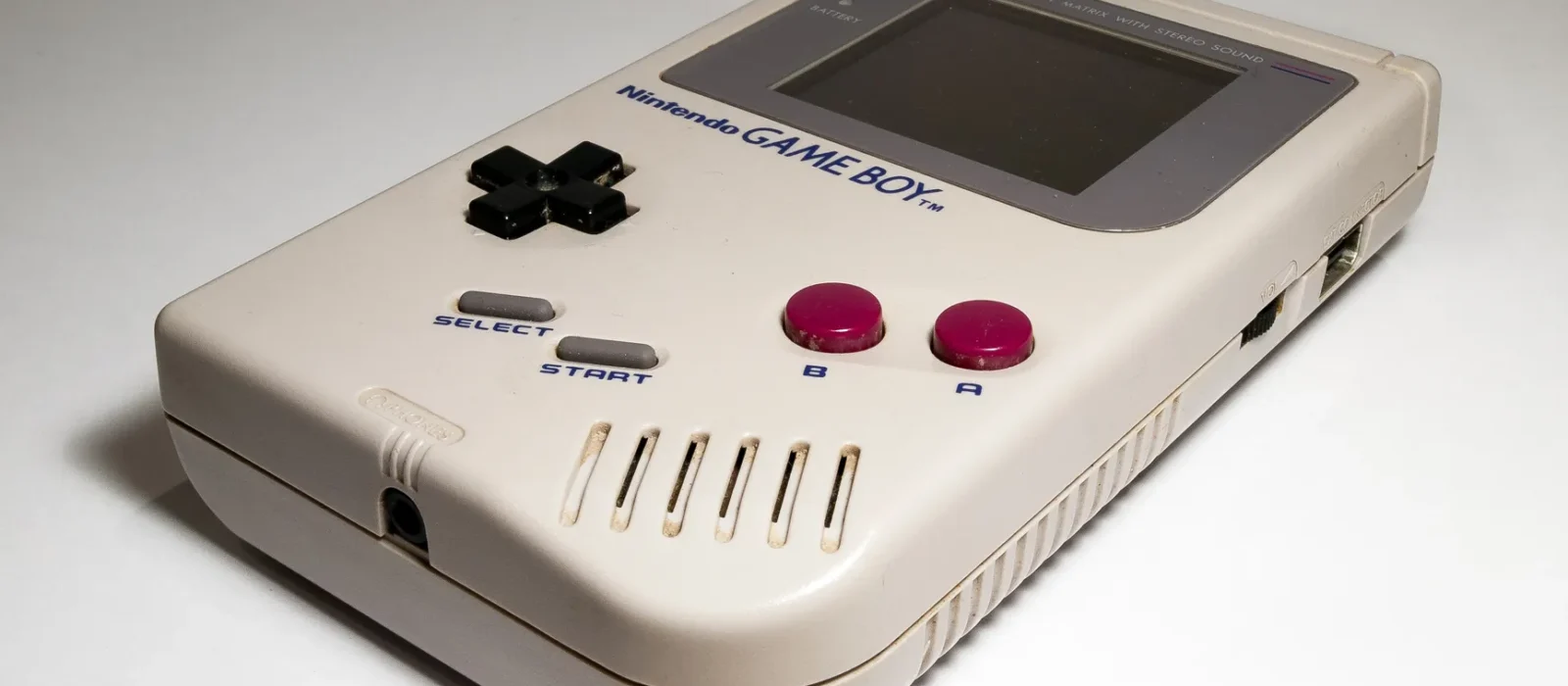
This is where it all began. The original 1989 Game Boy (DMG-01) is an icon of industrial design, a grey plastic slab that defined a generation. In 2026, its primary value is nostalgia. As a gameplay device, it is severely compromised by modern standards, and anyone telling you otherwise is misremembering their childhood.
The biggest issue, by a huge margin, is the screen. The 2.6-inch dot-matrix display is a smeary, ghosting mess with a sickly green-and-grey palette. It has no backlight, meaning you can only play it in direct, bright light. The contrast dial on the side is less of a feature and more of a constant battle, as you tweak it endlessly to find a barely-visible sweet spot. Compared to even the cheapest modern retro handheld, it’s an atrocious viewing experience. It eats four AA batteries in about 15-20 hours, which felt eternal in 1991 but is a costly inconvenience today.
Despite these flaws, the DMG has its charms. It is built like a tank; many original units still work perfectly over 35 years later. The audio, piped through headphones, is surprisingly punchy and bassy, giving the chiptune soundtracks a real presence. Its D-pad and buttons are classics for a reason—they feel mushy by today’s standards but are comfortable for long sessions. The sheer history of the device is palpable when you hold it.
UK prices for a DMG-01 in good working condition typically range from £40 to £70 on eBay, depending on condition and whether it comes with its original box. Anything cheaper is likely sold for parts. It’s also a favourite in the modding scene, with countless options for IPS backlit screens, rechargeable batteries, and new shells. A fully modded DMG can be a superb device, but at that point, you’re often spending over £120 for a project, not just a console.
Who Should Buy a Game Boy DMG-01?
You should only buy an original, unmodded DMG-01 for two reasons: pure collection purposes or as a base for a modding project. If you want a shelf piece that represents the birth of handheld gaming, it’s a must-have. If you enjoy tinkering and want to build the ultimate sleeper Game Boy, it’s a great starting point. As a practical device to actually play games on in 2026, it’s a terrible choice. The screen is just too poor to be enjoyable. Verdict: 5/10 — Check prices on eBay UK →
Pocket and Light: The First Refinements
Nintendo quickly identified the DMG’s shortcomings, leading to two key revisions in the 90s: the Game Boy Pocket (MGB-001) in 1996 and the Japan-only Game Boy Light (MGL-101) in 1998. These are often overlooked but represent significant steps forward.
The Game Boy Pocket is, for many, the perfection of the monochrome Game Boy design. It’s significantly smaller and lighter than the DMG and runs on just two AAA batteries for about 10 hours. The biggest improvement is the screen. Whilst still unlit, it’s a true black-and-white display, ditching the green tint of the original. The ghosting is massively reduced, making fast-paced games like Super Mario Land 2 far more playable. It feels like what the Game Boy should have been from the start. In the UK, a Pocket will set you back around £40-£60, making it a very affordable and superior alternative to the DMG for actual gameplay.
The Game Boy Light is the holy grail for monochrome collectors. Released only in Japan, it was a short-lived model that took the Pocket’s form factor and added an electroluminescent backlight—the first of any Nintendo handheld. With the flick of a switch, the screen glows with a pleasant, soft greenish-blue light. It runs on two AA batteries, providing a decent lifespan even with the light on. The problem is scarcity and price. Being a Japanese exclusive, you’ll be importing one, and prices in 2026 are rarely below £150 for a unit in decent condition, often reaching over £200. It’s a fantastic piece of history, but the value proposition is questionable when a modern IPS mod offers a far superior backlit screen for less money.
Who Should Buy a Pocket or Light?
The Game Boy Pocket is for the player who wants the authentic monochrome experience without the awful screen of the DMG. It’s cheap, portable, and has a much-improved display. It’s an excellent, practical choice. The Game Boy Light is for the serious collector with deep pockets. It’s a fascinating piece of Nintendo history, but financially, it makes little sense for a player when a modded Pocket or Color offers a better screen for a similar total cost. Verdict (Pocket): 7/10. Verdict (Light): 6/10 (for value).
Adding Colour: Is the Game Boy Color Worth It Today?
Released in 1998, the Game Boy Color (CGB-001) was a huge leap forward, bringing a palette of 32,768 colours to Nintendo’s handheld line. It’s backward compatible with the entire monochrome Game Boy library, enhancing many older games with basic colour palettes. It also has its own library of excellent GBC-exclusive titles like the Zelda Oracle games and Pokémon Crystal.
However, it inherited one massive flaw from its predecessors: the screen is not backlit. The reflective TFT display is slightly better than the Pocket’s in bright light, but trying to play it indoors or in the evening is an exercise in frustration. The colours can appear washed out unless you have a direct light source pointed at the screen. This is the single biggest reason why using an unmodded Game Boy Color in 2026 feels like a step back in time. It runs on two AA batteries for a respectable 20+ hours, and its form factor is comfortable and durable, sitting nicely between the Pocket and the DMG in size.
The Game Boy Color is another hugely popular candidate for modification. IPS screen kits for the GBC are widely available and relatively easy to install. A modded GBC with a modern backlit screen is a spectacular device, offering a crisp, vibrant way to play two generations of games. The cost of this route is the main consideration. An unmodded GBC costs between £50-£80 in the UK. Add another £50-£60 for a good screen kit, and you’re looking at a total investment of £100-£140. At this price point, you are starting to compete with excellent modern handhelds that can emulate GBC and much more, which is an important factor to consider.
Who Should Buy a Game Boy Color?
An unmodded Game Boy Color is a tough sell as a primary gaming device due to its dim screen. It’s best for collectors or as a budget-friendly entry point if you find one for under £50 and plan to play exclusively in well-lit environments. Its real potential is unlocked through modding. If you’re willing to either perform the upgrade yourself or buy a pre-modded console, a backlit GBC is one of the best ways to experience the 8-bit Game Boy library. Verdict (Unmodded): 6/10. Verdict (Modded): 8.5/10 — Check prices on eBay UK →
The GBA Generation: Advance vs. SP
The release of the Game Boy Advance in 2001 marked the single biggest technological leap in the Game Boy’s history. This 32-bit powerhouse brought SNES-level graphics to a handheld, and its library is legendary. It also plays original Game Boy and Game Boy Color cartridges, making it an all-in-one solution for three generations of Nintendo handhelds. However, Nintendo released two very different models: the original Advance and the later SP.
Game Boy Advance (AGB-001): Comfort King
The first model, the Game Boy Advance (AGB-001), adopted a wide, landscape orientation. Ergonomically, it is arguably the most comfortable Game Boy ever made. Your hands sit naturally on either side of the screen, and the shoulder buttons are perfectly placed. It feels fantastic for long play sessions. Unfortunately, it launched with a screen so dark and unlit that it made the Game Boy Color look radiant. It’s almost impossible to use without direct, overhead lighting. For this reason alone, an unmodded AGB-001 is functionally useless in most modern settings.
Like the GBC, its saving grace is the modding community. The AGB is the easiest and most popular Game Boy to mod. IPS screen replacements are plentiful and transform the device into something spectacular. Adding a modern screen and a rechargeable USB-C battery pack turns the AGB into the ultimate retro machine for many enthusiasts. You can pick up a used AGB for around £45-£75, with the total cost after mods rising to £110-£140. Our full guide to the top ways to play GBA games explores this in more depth.
Game Boy Advance SP (AGS-001 vs. AGS-101): The Great Divide
In 2003, Nintendo addressed the screen issue with the Game Boy Advance SP. This new clamshell model was compact, stylish, and had two revolutionary features: a built-in rechargeable battery and a lit screen. However, not all SPs are created equal. There are two models:
- AGS-001: The original model. This has a frontlit screen. A light shines onto the screen from the front, which is a huge improvement over no light at all, but it can look washed out and uneven. Colours are muted.
- AGS-101: Released later in 2005. This model has a proper backlit screen, similar to a modern LCD. It is bright, vibrant, and looks fantastic. This is, without question, the best screen ever put on an official Game Boy.
The difference is night and day. The AGS-101 is the model everyone wants, and the price reflects that. In the UK, a standard AGS-001 costs £60-£90. An AGS-101, by contrast, regularly sells for £100-£150, sometimes more for special editions. You can identify a 101 by checking the model sticker on the bottom of the console. The ergonomics of the SP are a step down from the original AGB; its small, square shape can cause hand cramps during long sessions, and it requires an adapter for headphones. But for many, the superb screen and portability of the AGS-101 make it the definitive choice. We have a detailed article looking at the GBA vs GBA SP from a modding perspective, which is worth a read if you’re considering upgrades.
Who Should Buy a GBA or GBA SP?
If comfort is your top priority and you plan to install a new screen yourself, the original AGB-001 is the best choice. For everyone else, the Game Boy Advance SP is the one to get. If your budget is tight, the AGS-001 is a serviceable, portable GBA. But if you can afford it, the AGS-101 is the best official hardware for playing GBA, GBC, and GB games out of the box. It requires no mods to be brilliant. Verdict (AGB-001 unmodded): 4/10. Verdict (AGS-001): 7/10. Verdict (AGS-101): 9/10 — Check AGS-101 prices on eBay UK →
The Tiny Marvel: Is the Game Boy Micro a Collector’s Folly?
The final entry in the line, the Game Boy Micro (OXY-001) from 2005, is an oddity. Released after the Nintendo DS, it was a boutique product aimed at a style-conscious audience. It is astonishingly small—about the size of a credit card—and beautifully constructed with a metal body and interchangeable faceplates. Its 2-inch screen is tiny but incredibly sharp and brightly backlit, arguably even better than the AGS-101’s screen in terms of pixel density and colour.
The Micro’s biggest selling point is its extreme portability. It disappears into a pocket like no other Game Boy. However, this comes with major compromises. Its single biggest drawback is that it only plays Game Boy Advance cartridges. There is no backward compatibility for original Game Boy or Game Boy Color games, which immediately limits its library and makes it a less versatile machine than the GBA SP. The small size, whilst a novelty, can be uncomfortable for anyone with average-to-large hands. The proprietary charging port and headphone jack (requiring an adapter) are also annoyances in 2026.
The Game Boy Micro was not a commercial success, meaning it’s relatively rare today. This rarity, combined with its unique design, has made it a highly sought-after collector’s item. In the UK, you’ll be lucky to find a used Micro for less than £120. Boxed units or special editions, like the Famicom version, can easily exceed £200-£250. It’s a huge amount of money for a device that exclusively plays GBA games.
Who Should Buy a Game Boy Micro?
The Game Boy Micro is not a practical choice for most people. It’s for collectors who appreciate its unique design and build quality, or for GBA purists who want the absolute sharpest screen for GBA games and value pocketability above all else. For the price, a GBA SP AGS-101 offers far better value and a much larger playable library. The Micro is a beautiful, expensive curiosity. Verdict: 7/10 — Check prices on eBay UK →
Modding Your Game Boy: The Best Way to Play in 2026?
Throughout this guide, a common theme has emerged: many original Game Boy models are compromised by their screens, but can be saved by modern modifications. The Game Boy modding scene is enormous and offers a path to creating a “perfect” version of this classic hardware. For many, a modded Game Boy is the ideal way to play.
The most common and impactful upgrade is a new screen. Modern IPS (In-Plane Switching) LCDs offer bright, crisp, and colourful images with wide viewing angles that are orders of magnitude better than the original hardware. Kits are available for every model from the DMG to the GBA, with features like adjustable brightness levels and pixel grid effects. Installing an IPS screen kit can turn a nearly unplayable GBA into a premium device.
Beyond screens, other popular mods include:
- Rechargeable Batteries: Swapping out AAs for a modern Li-Po battery with USB-C charging is a huge quality-of-life improvement. Kits are widely available, especially for the GBA and GBC.
- New Shells and Buttons: If the original plastic is yellowed or scratched, you can replace it entirely with a new shell in almost any colour or design imaginable. This is a great way to personalise your console.
- Audio Amplifiers and Dehiss Kits: For audiophiles, installing a small amplifier can make the Game Boy’s speaker much louder and clearer, while a dehiss kit can clean up the audio signal for a purer sound through headphones.
The modding route offers the best of both worlds: authentic hardware running original cartridges, but with the modern conveniences we’ve come to expect. However, it’s not for everyone. It requires an investment of both time and money. If you’re not comfortable with small electronics, you’ll need to buy a pre-modded console, which carries a significant premium. For those interested, our mods and upgrades hub is a great place to start your research.
Who Should Consider Modding?
Modding is for the enthusiast who wants the ultimate version of the original hardware and is willing to pay for it. If the thought of a GBA with a screen better than the Switch Lite’s and USB-C charging appeals to you, this is the path. The Game Boy Advance (AGB-001) is the best starting point due to its comfort and the wide availability of parts. The Game Boy Color is also a fantastic candidate. If you just want to play games with minimal fuss, buying a GBA SP AGS-101 is the simpler and often cheaper option.
Verdict: Which Game Boy Should You Actually Buy in 2026?
After reviewing the entire line-up, from the humble DMG to the pricey Micro, we can provide some clear recommendations for UK buyers in 2026. Your choice will depend on your budget and what you value most: authenticity, screen quality, or library access.
The Best Overall Choice: Game Boy Advance SP (AGS-101)
For the vast majority of people, this is the one to buy. The GBA SP AGS-101 is the complete package right out of the box. Its screen is bright and vibrant, making every game look fantastic. It plays three entire generations of games—GBA, GBC, and original GB. It’s portable, has a rechargeable battery, and requires no modification to be a joy to use. While it commands a premium price (around £100-£150), that investment gets you the best official Nintendo experience without any extra work. Its only real drawback is its slightly cramped ergonomics. 9/10 — Check prices on eBay UK →
The Best for Modders: Game Boy Advance (AGB-001)
If you want the most comfortable form factor and are willing to do some work (or pay for it), the original GBA is the king. Its landscape design is superior for long play sessions, and it’s the easiest model to upgrade. A fully modded AGB with an IPS screen and USB-C battery is arguably the best Game Boy that can exist, surpassing even the AGS-101 in screen quality and comfort. The initial cost is low (£45-£75), but be prepared to spend another £60-£80 on parts. 7/10 (Modded: 9.5/10) — Check prices on eBay UK →
The Best Budget Option: Game Boy Pocket
If you just want to play original monochrome Game Boy games and have a tight budget, the Game Boy Pocket is a superb choice. For around £40-£60, you get a much-improved screen over the DMG in a smaller, more efficient package. It’s a simple, reliable, and authentic way to experience the classics without breaking the bank. Just remember you’ll need good lighting. 7/10 — Check prices on eBay UK →
For Collectors Only: Game Boy (DMG-01) and Game Boy Micro
These two models sit at opposite ends of the timeline and are best suited for those who prioritise collecting over playing. The DMG is an essential piece of gaming history, but its screen makes it a chore to use. The Micro is a beautifully engineered but functionally limited device with an inflated price tag. Buy them for your shelf, not for your daily commute. DMG: 5/10, Micro: 7/10 (for design).
Ultimately, navigating the world of retro hardware is a personal journey, but the GBA SP AGS-101 remains the safest and most satisfying bet for most players in 2026. For those wanting more options, our complete list of retro buying guides covers everything from home consoles to accessories.
Frequently Asked Questions
Is the Game Boy AGS-101 really worth the high price in the UK?
Yes, for most people it is. Whilst the £100-£150 price tag seems high, you are paying for the best official screen Nintendo ever produced for the Game Boy line. It requires no extra work or money to be an excellent gaming device for GBA, GBC, and GB games. When you factor in the cost of buying a cheaper model like an AGB-001 (£50) and adding an IPS screen kit (£50-£60), the total cost is very similar, but the AGS-101 is an authentic, unmodified unit which holds its value better. If you want a simple ‘buy it and play’ solution, the AGS-101 is worth the premium.
Can you play original Game Boy games on a Game Boy Micro?
No, you cannot. This is the biggest weakness of the Game Boy Micro. It is only compatible with Game Boy Advance cartridges. The hardware lacks the necessary processor and physical switch that the GBA and GBA SP used to enable backward compatibility with monochrome Game Boy (DMG) and Game Boy Color (GBC) games. If you want to play the entire Game Boy library on one device, you need a Game Boy Advance or Game Boy Advance SP.
How much does a fully modded Game Boy cost in the UK in 2026?
The price for a pre-modded Game Boy varies wildly depending on the model and the extent of the modifications. For a Game Boy Color or original GBA with a modern IPS backlit screen and a new shell, you can expect to pay between £130 and £180 from reputable sellers on platforms like Etsy or eBay. If you add further upgrades like a USB-C rechargeable battery, audio amplifier, and custom buttons, the price can easily exceed £200. It’s a significant investment, but you are getting a handcrafted, premium version of the classic hardware.
Are original Game Boy game cartridges expensive to buy?
It depends entirely on the game. Common, mass-produced titles like Tetris, Super Mario Land, or Dr. Mario can be found for as little as £5-£10 on eBay. However, the big-name titles and RPGs have become very expensive. A loose copy of Pokémon Red/Blue/Yellow will typically cost £30-£40, whilst Pokémon Crystal can fetch over £70. Rare GBA games like Castlevania: Aria of Sorrow can sell for £80-£100 or more. Building a physical collection can be a costly hobby, which is why many players turn to flash carts like the EverDrive.
What is the rarest Game Boy model?
Excluding limited-run special editions, the rarest standard model is the Game Boy Light. It was only officially released in Japan in 1998 and had a very short production run before being replaced by the Game Boy Color. Its unique combination of the Game Boy Pocket form factor and an electroluminescent backlight makes it highly sought after by collectors. Finding one in good condition in the UK almost always requires importing, and prices are consistently high, often fetching £150-£250 depending on condition. It is significantly rarer than any other standard model.
Should I just buy an Analogue Pocket instead?
The Analogue Pocket is a modern, high-end alternative that plays original Game Boy, GBC, and GBA cartridges using FPGA technology, which simulates the original hardware with near-perfect accuracy. It has a phenomenal 1600×1440 display, USB-C charging, and can play many other systems via adapters. However, it costs over £200 before shipping and import fees. If you are a purist who wants the absolute best possible screen for original carts and has a large budget, the Analogue Pocket is a superb, if expensive, choice. For most people, a GBA SP AGS-101 or a modded GBA provides a more affordable and authentic-feeling experience.
✓ Recommended by Ben Rawlinson
Recommended based on community testing data, benchmark results, and verified UK pricing — we only link products that earn it.
- Game Boy Advance SP AGS-101Best for: The best official screen
- Game Boy ColorBest for: Budget entry to the library
- Game Boy Advance AGB-001Best for: Most comfortable for modding
- Game Boy (DMG-01)Best for: Pure nostalgia and collectors
- Game Boy MicroBest for: Ultra-portable GBA player
- Analogue PocketBest for: The ultimate modern alternative
RetroInHand earns a small commission from qualifying Amazon UK and eBay purchases at no extra cost to you.
What to Read Next
If you found this guide useful, here are a few other articles on RetroInHand that will help you on your retro gaming journey:
- Best Handheld for GBA Games Under £80 UK (2026) — our top picks of modern handhelds for playing the Game Boy Advance library.
- Best Nintendo Handheld for Retro Gaming UK (2026) — if you’re open to later Nintendo handhelds (3DS, 2DS and beyond), this ranks the top picks across the range.
- Anbernic RG35XX Plus vs Miyoo Mini Plus: Best Under £70 UK (2026)? — If you’re considering a budget emulation device instead, this is the definitive comparison.
This article was produced with AI assistance and reviewed by the editor. See our Editorial Standards.