Last updated: July 2026
🏆 Editor’s Top Pick
Anbernic RG35XX H
Best for: excellent for 16-bit emulation
Launched in arcades in 1991, Street Fighter II holds a peculiar and significant place in gaming history. Universally acclaimed, it’s a title frequently cited as the single catalyst that revived a flagging arcade industry, cementing the fighting game template for decades to come. Most retrospectives focus on its competitive depth and lasting legacy, acknowledging its genre-defining mechanics and character roster. That analysis is fair, of course, but it misses a crucial element of its initial impact.
The profound joy came from accidental discovery: the sheer delight of a player stumbling upon a Hadoken or Shoryuken by chance, a burst of energy or a dragon punch erupting from the screen when a frantic combination of joystick wiggles and button presses unexpectedly yielded a special move. This sense of agency and hidden power was vital to its original arcade appeal, drawing players back coin after coin, desperate to replicate that moment of accidental brilliance. Modern games often hold your hand, but Street Fighter II invited you to uncover its secrets.
Despite its significant influence, the original arcade version of Street Fighter II: The World Warrior was not without its technical rough edges. Its competitive depth grew alongside a series of notable, sometimes game-breaking, glitches that were often smoothed out in later console ports and arcade revisions. These imperfections, far from detracting from its mystique, became part of the early competitive lore, showcasing a raw, unpolished brilliance that players learned to either exploit or navigate. Let me be blunt: these early arcade machines had character, flaws and all.
| Item | Price (UK) | Why It Matters | Buy |
|---|---|---|---|
| Anbernic RG35XX H | £75-90 | Great for SNES and CPS-1/2 emulation. | Buy → |
| Retroid Pocket 2S | £100-120 | Premium handheld, handles arcade versions with ease. | Buy → |
| 8BitDo Arcade Stick | £80-100 | Authentic arcade experience for home consoles. | Buy → |
| Sanwa OBSF-30 Buttons | £3-5 per button | Standard for custom arcade stick builds. | Buy → |
The Arcade Phenomenon: Street Fighter II’s Sudden Ascent
Before 1991, the arcade industry in the UK and globally faced a decline. New genres emerged, but nothing truly captured the public imagination in the same way Space Invaders or Pac-Man had a decade earlier. Then, Capcom launched Street Fighter II: The World Warrior. It wasn’t just another fighting game; it was an event. Community members often recall where they first saw it. One user mentioned seeing “a newly released machine in a Burger King in 1991,” immediately identifying it as “the hottest arcade game ever.” This immediate, visceral reaction was common.
The game’s presence in arcades, pubs, and even fast-food restaurants was a magnetic force. People queued, coins ready, just to watch. The vibrant graphics, distinct character designs – Ryu, Ken, Chun-Li, Blanka, Guile, Zangief, Dhalsim, and E. Honda – were instantly iconic. Each fighter had a unique look and fighting style, a stark contrast to the often generic combatants of earlier titles. The character select screen alone was a revolution, offering choice and immediate connection to a distinct personality.
Beyond the visuals, the sound design contributed significantly to the game’s allure. The distinctive grunts, the “Hadoken!” shouts, the satisfying impact of a well-placed kick – these audio cues were just as important as the pixels on screen. Every successful hit, every combo, every special move had an audible reward, feeding directly into the player’s dopamine receptors. It created an immersive experience that previous fighting games, such as the original Street Fighter (1987) or Technos Japan’s Nekketsu Kakutō Densetsu (1990), simply hadn’t managed to deliver.
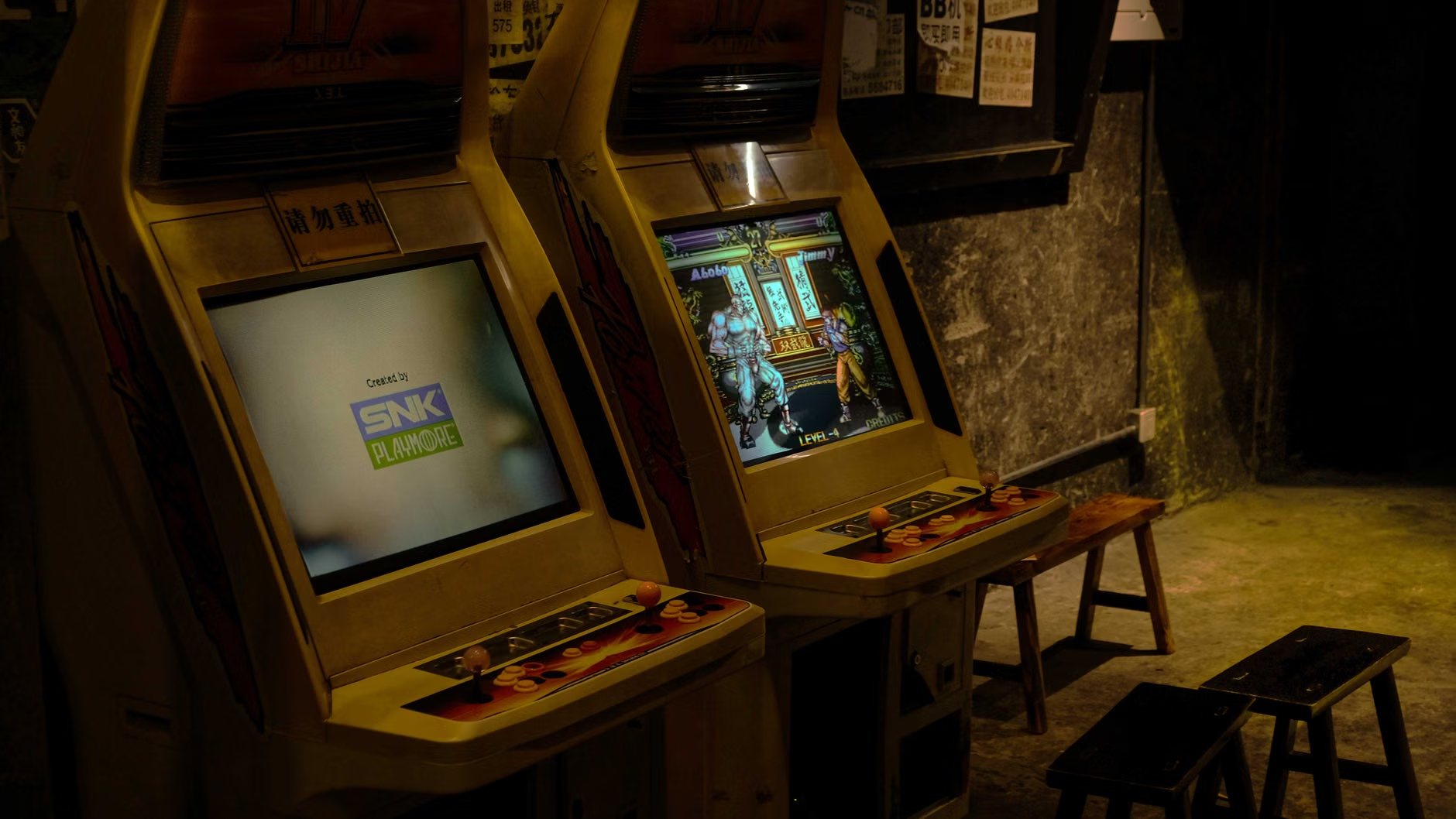
The competitive element was immediate. Two players stood shoulder to shoulder, each with their own six-button layout and an eight-way joystick, engaged in direct, high-stakes combat. Victories and defeats were public. The crowd around the machine would cheer, groan, and offer unsolicited advice. This social aspect turned gaming from a solitary pursuit into a communal spectacle, fostering a vibrant, impromptu tournament culture around every cabinet. It was a tangible, shared experience that transcended digital entertainment, creating real-world rivalries and friendships.
This public display of skill, or lack thereof, meant players quickly learned from watching others. Observing a master execute a precise combo, or defend against a barrage of attacks, provided immediate lessons. The learning curve was steep but fair, rewarding dedication and observation. The fact that many players were introduced to fighting games through SFII meant a blank slate, where skills were developed and shared, building a new generation of players from the ground up. The feeling of being part of this new wave, of contributing to its burgeoning culture, defined a generation’s arcade experience.
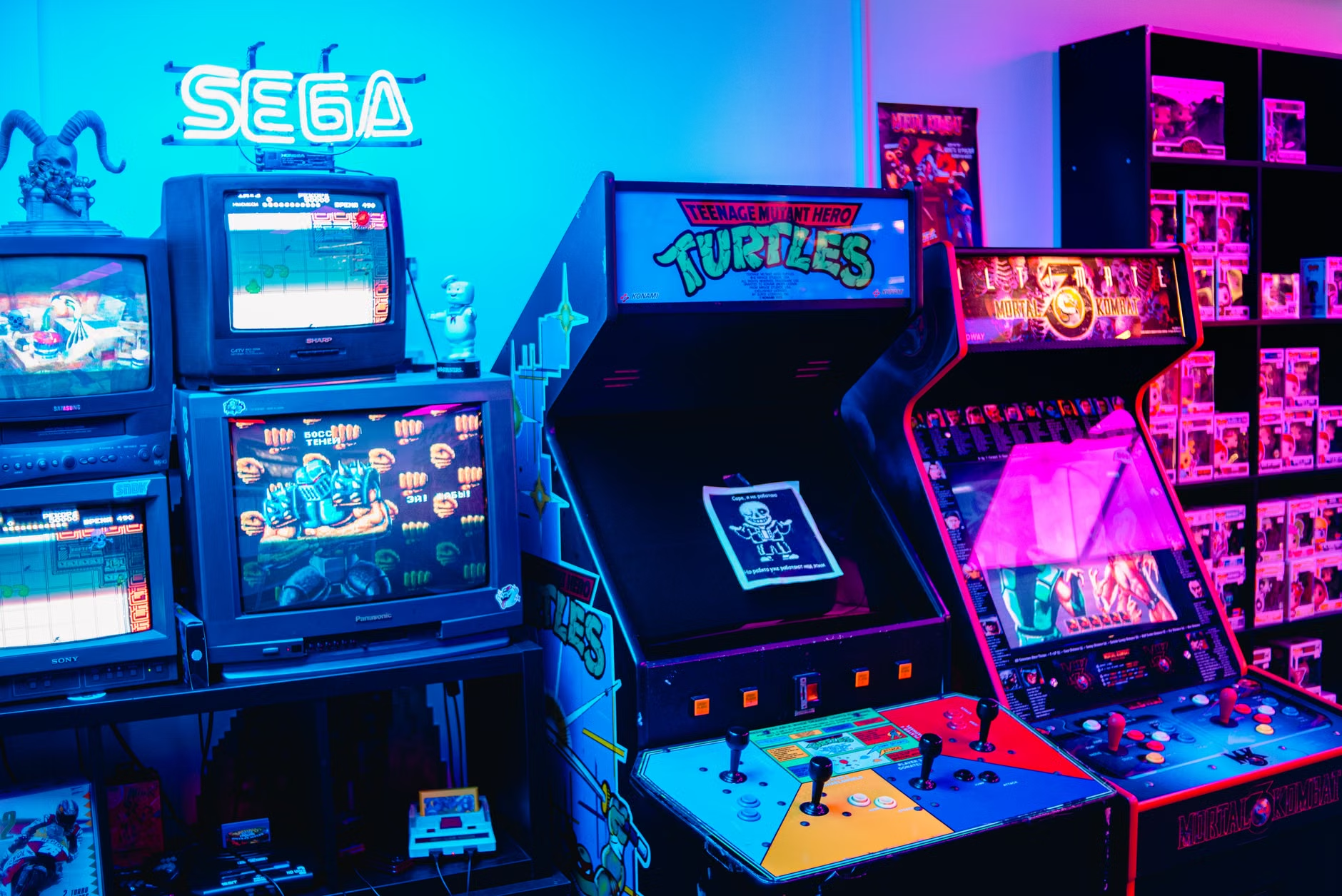
For context, consider other arcade titles available at the time. While beat ’em ups like Final Fight (1989) or Turtles in Time (1991) offered cooperative fun, they lacked the one-on-one competitive intensity. This particular title changed the expectations for what an arcade game could be, offering depth that kept players invested long after the initial novelty wore off. Its impact wasn’t just a fleeting trend; it was a fundamental shift in how players interacted with games, pushing the boundaries of competitive multiplayer.
The Joy of Discovery: Unlocking Special Moves
One of the most cherished memories for early Street Fighter II players was discovering special moves. Unlike modern fighting games with their extensive tutorials and on-screen command lists, SFII offered no such guidance. The game threw you into the fray, expecting you to figure things out. As one community member recounted, “Finding out the special moves by accident was just the coolest.” This statement perfectly encapsulates the era’s magic.
Players experimented, often frantically jiggling the joystick and mashing buttons in moments of desperation. Sometimes, a quarter-circle forward and a punch would result in Ryu’s Hadoken, or a charged down-up and kick would unleash Guile’s Flash Kick. These moments of accidental execution felt like unlocking a secret, a true accomplishment that was entirely self-taught. This organic learning process fostered a deeper connection to the game and its mechanics. It wasn’t about following instructions; it was about genuine exploration.
The discovery wasn’t always immediate or easy. The input timing for some moves was notoriously strict, particularly for newcomers. Executing a Shoryuken required a precise Z-motion on the joystick, followed by a punch button, a sequence that felt alien to players accustomed to simpler controls. Yet, the challenge only made the eventual success more rewarding. The satisfaction of consistently pulling off a Dragon Punch, knowing you had mastered a complex input, was a powerful motivator.
This period saw the rise of playground whispers and magazine secrets. Players would share techniques: “Do a fireball motion, but fast!” or “You have to hold back for a second, then forward, and kick.” These informal networks of knowledge exchange became almost as important as the game itself. It created a sense of community, with players teaching each other, reinforcing the game’s social standing. The lack of readily available information forced players to interact and collaborate, something many modern gaming experiences lack.
Contrast this with fighting games that preceded SFII. Titles like Yie Ar Kung-Fu (1985) had simpler, less intricate move sets, often relying on directional inputs and single button presses. Its approach to special moves was a significant leap forward, introducing a layer of strategic depth that transformed simple button mashing into a skill-based art form. It meant that even a casual player could occasionally get lucky, but true mastery required dedication and practice, pushing the player to learn and improve.
This aspect of discovery also highlighted the game’s replayability. With eight distinct characters, each with their own unique set of special moves, there was always something new to learn and master. Switching from Ryu to Chun-Li meant a completely different set of inputs and strategies, encouraging players to explore the full roster rather than sticking to a single character. This depth of choice ensured the game remained fresh for months, if not years, after its initial release, cementing its place as a truly engaging experience.
Original Arcade Imperfections: Glitches in The World Warrior
While Street Fighter II is revered for its foundational mechanics, the original “The World Warrior” arcade release was not a perfectly polished gem. It shipped with a number of quirks and notable glitches that the competitive community quickly discovered, some of which were capable of freezing the game or providing unfair advantages. These aren’t just minor visual hiccups; they represent genuine technical imperfections that shaped early arcade play. A YouTube video published on March 21, 2026, by “The Ultimate Classic Review!” details several of these specific bugs, providing historical context for any revisiting today.
The Undying Machine
One of the most widely reported and frustrating glitches was “The Undying Machine.” This issue could occur during the bonus car-smashing stage. Players would find themselves unable to progress, as the bonus stage timer would continue to tick down, yet the game would effectively freeze, preventing any further action. This forced players to either reset the machine – often a costly endeavour for arcade operators – or, if a second player was around, have them join in. The community quickly found that a second player damaging or jumping on the car in the bonus stage could often resolve the freeze, allowing the game to continue. This required quick thinking and a bit of luck, turning a bug into an unexpected cooperative moment for those present.
The Golden Stance (Guile)
Guile, with his charge-based special moves, was particularly susceptible to certain animation bugs. “The Golden Stance” glitch, also known as the “Upside-Down Kick Freeze,” involved Guile getting stuck in the last phase of his upside-down kick animation. Players could trigger this by charging a Sonic Boom (holding back), then, during the upward motion of his Somersault Kick (charged down-up and kick), releasing the Sonic Boom by pressing forward and a punch button. The timing window for this was fairly generous, making it a reproducible issue for those who knew the trick. Guile would remain frozen in mid-air, often rendering him invincible to certain attacks, creating an unfair advantage that could be exploited in competitive play. It exposed a flaw in the animation state machine that allowed for unintended transitions.
Handcuffs (Guile)
Another Guile-specific exploit, often referred to as “Handcuffs” or simply “freeze,” allowed players to incapacitate an opponent. This glitch involved charging a Flash Kick (holding down), ensuring the opponent was within throwing distance, and then pressing forward/back/up on the joystick. If executed precisely, the opponent would become trapped in a frozen state, unable to move or defend themselves, making them vulnerable to any subsequent attacks. This was a particularly devastating bug in competitive settings, as it could lead to an easy victory for the exploiting player. These glitches were not obscure, isolated incidents; they were community-reported issues that influenced competitive strategies in the early days, pushing players to explore the boundaries of the game’s code.
These technical shortcomings highlight a common theme with early arcade hardware: releases were often pushed out with less rigorous QA than modern titles, relying on later revisions to iron out bugs. The community was right about these imperfections; they were part of the original arcade experience, and any faithful emulation of the 1991 “The World Warrior” version should ideally retain them for historical accuracy. Understanding these glitches offers a deeper appreciation for the iterative development cycle fighting games went through, from arcade original to polished home console experience.
From Arcades to Living Rooms: The Console Conversions
Such was the immense popularity of Street Fighter II in the arcade, a home console port was inevitable. The question was, which system could handle it? Nintendo’s Super Nintendo Entertainment System (SNES) proved to be the ideal candidate, launching its version in 1992. This port wasn’t merely a direct conversion; it was a masterful re-engineering that often smoothed out many of the original arcade version’s technical imperfections and glitches, making it the definitive home experience for millions.
The SNES port was an astounding achievement for the time. It captured the look, feel, and sound of the arcade game with remarkable fidelity, particularly given the hardware limitations compared to a dedicated arcade board. While some graphical details were simplified, and a few frames of animation were trimmed, the core gameplay remained intact. More importantly, many of the game-breaking glitches, such as “The Undying Machine” or Guile’s “Golden Stance,” were either eliminated or significantly reduced. This made for a more stable and fairer competitive experience at home, where players could focus on skill rather than exploiting bugs.
The success of the SNES version led to a rapid series of revisions and expansions, first in arcades, then swiftly ported to consoles. This iteration, Street Fighter II Turbo (1992 arcade, 1993 SNES), introduced faster gameplay and the ability to play as the four Shadaloo bosses. Four new characters – Cammy, T. Hawk, Fei Long, and Dee Jay – were brought in with Super Street Fighter II (1993 arcade, 1994 SNES), alongside graphical upgrades. Each iteration refined the formula, balancing characters, tweaking move sets, and adding new stages and endings. These console versions allowed players to practice endlessly without spending a fortune on arcade credits, fostering a deeper understanding of the game’s mechanics and inspiring countless hours of local multiplayer sessions.
Its decision to expand and iterate on the core Street Fighter II engine proved incredibly shrewd. Each new version provided a fresh reason for players to engage, whether it was to master a new character, adapt to faster gameplay, or simply enjoy improved visuals. The community discussions around these versions were vibrant, debating character tiers and new strategies. By contrast, its console ports opened up the game to a global audience, allowing players to build their skills in the comfort of their own homes. This accessibility was paramount to its lasting cultural impact.
Compared to other arcade-to-home conversions of the era, the Street Fighter II ports stand out for their quality and enduring playability. Many contemporary arcade games suffered from heavily compromised home versions, but Capcom consistently delivered excellent ports that satisfied both casual players and hardcore enthusiasts. This dedication to quality ensured that the legacy of Street Fighter II wasn’t confined to dusty arcade cabinets, but flourished on home consoles, inspiring a new generation of fighting game fans. The SNES, Mega Drive, and later PlayStation versions of various Street Fighter II iterations are often considered some of the finest console fighting games ever made, proving that a well-executed port can truly elevate a game’s reach and impact.
Street Fighter II’s Lasting Influence: Competitive Depth
It didn’t just popularise fighting games; it codified their structure, establishing a template that remains evident even in modern titles. Its success stemmed from a combination of accessible controls for basic actions and a hidden depth for mastery. The six-button layout (three punches, three kicks) became the industry standard, allowing for a broader range of attacks than previous four-button fighters. This simple innovation opened up a world of strategic choices, where players could use light, medium, or heavy attacks to chain into combos or bait opponents. The community consensus is that this layout, simple on the surface, enabled a truly intricate dance of offensive and defensive options.
The game’s focus on special moves, charge motions, and unique character abilities created a genuine sense of competitive balance, even with its early glitches. Each character felt distinct, not just aesthetically but functionally. Ryu and Ken were balanced “shotokan” characters, strong with Hadokens and Shoryukens. Chun-Li offered speed and tricky aerial attacks. Guile’s charge moves required a different rhythm of play. This diverse roster meant players could find a character that suited their style, fostering genuine player investment and character specialisation.
This depth immediately led to the formation of a competitive scene. Arcades became arenas where players honed their skills, developed new strategies, and established local hierarchies. The concept of “character tiers” – ranking fighters by their competitive viability – emerged organically from these player communities. Discussions raged about which characters were truly dominant and which were situational. Watching high-level play was as captivating as playing, inspiring spectators to learn and improve their own game. It wasn’t just about winning; it was about demonstrating superior understanding of the game’s mechanics.
The influence of Street Fighter II extended far beyond its own sequels. It directly inspired a wave of fighting games throughout the 1990s and beyond. Mortal Kombat (1992), with its digitised sprites and bloodier fatalities, was clearly a response to SFII’s success, even if its mechanics differed. The King of Fighters series, Guilty Gear, and Tekken all owe a debt to SFII’s foundational principles regarding character rosters, special moves, and competitive balance. The fighting game genre, as we know it today, would simply not exist in its current form without Street Fighter II paving the way.
Many fighting game historians, including channels like “The Ultimate Classic Review!” (which published its Street Fighter 2 1991 Full Review in 2025), highlight how SFII established the core competitive pillars. Frame data, whiff punishing, zoning, mix-ups – these terms, now commonplace in fighting game parlance, found their nascent forms within Street Fighter II’s competitive environment. It taught players about spacing, timing, and psychological warfare, creating a rich competitive ecosystem that continues to evolve. The game’s design ensured that pure button mashing would only get a player so far; true victory required strategy and execution.
Playing Street Fighter II Today: Emulation and Handhelds
For those looking to experience the magic of Street Fighter II in 2026, emulation offers the most accessible route. Modern retro handhelds, and even PCs, can comfortably run the various arcade and console versions of the game. The key is choosing the right hardware and setting up the emulation accurately to capture the essence of the original experience. For many, a portable solution allows for quick, spontaneous matches, echoing the arcade’s pick-up-and-play appeal.
For UK retro handheld enthusiasts, several devices stand out. The Anbernic RG35XX H, typically priced around £75-90, is a horizontal device renowned for its strong performance on 8-bit and 16-bit consoles, including the SNES and the CPS-1 and CPS-2 arcade boards that ran Street Fighter II. Owners commonly report that SFII: Turbo on SNES runs at a locked 60fps, presenting a crisp image on its 3.5-inch IPS display. Its D-pad and face buttons are responsive enough for precise special move inputs. This handheld is an excellent entry point for reliving those classic fights on the go.
Stepping up slightly, the Retroid Pocket 2S, available for around £100-120, offers a more premium experience. Its more powerful SoC handles even the more demanding CPS-3 titles with ease, meaning any arcade version of Street Fighter II, from The World Warrior to Super Street Fighter II Turbo, will run with flawless frame rates. The device’s robust build quality and comfortable ergonomics are also a plus for extended play sessions. Its Android-based system allows for more versatile emulation options, including various RetroArch cores tuned for fighting games, which you can learn more about in our Setup & Emulation Hub.
Beyond handhelds, playing on a modern PC or single-board computer like a Raspberry Pi 5 hooked up to a TV remains a popular option. For an authentic arcade feel, connecting an external fight stick is highly recommended. The 8BitDo Arcade Stick, priced around £80-100, is a solid choice, offering both wired and wireless connectivity, and it’s compatible with a wide range of devices. For those seeking absolute authenticity, modding a generic fight stick with Japanese arcade components like Sanwa OBSF-30 pushbuttons and a Seimitsu LS-32 joystick can bring the feel of a genuine arcade cabinet to your living room. The difference in input responsiveness and feel is noticeable, particularly for veteran players. The cost of such components can vary, but a full set for a standard six-button stick typically runs around £40-60, before the base stick itself.
When emulating the arcade versions, ensuring you have the correct ROMs and BIOS files for the CPS-1 and CPS-2 systems is critical for accurate performance. RetroArch, a popular front-end for emulation, offers various cores that provide different levels of accuracy and performance. The Final Burn Neo core is a common choice for CPS-1/2 titles, providing a reliable and responsive experience. Calibrating your display settings to account for input lag, especially when playing on a modern TV, can also significantly improve the experience. Input lag on modern displays can be a noticeable issue for frame-perfect fighting games, so using a ‘game mode’ on your TV or an external scaler is often advisable to minimise this.
The Street Fighter Lineage: Evolution and Echoes
The impact of Street Fighter II wasn’t a singular event, but the genesis of a lineage that continues to evolve and thrive. Its core mechanics, character archetypes, and competitive ethos echo throughout every subsequent Street Fighter title. The success of SFII created a blueprint, setting expectations for what a fighting game should be and continuously challenging Capcom to innovate while respecting its roots. This is evident in the design philosophies of later entries, from the prequel series to the modern era.
The Street Fighter Alpha series (starting in 1995) acted as a prequel, exploring the backstory of characters like Ryu and Ken while introducing new gameplay mechanics such as Alpha Counters and Custom Combos. These additions built directly upon the foundation of SFII, offering more complex systems for competitive play without abandoning the fluid, accessible feel of the original. The character designs maintained the vibrant, expressive style that SFII established, while also pushing the animation quality forward. The Alpha games proved that the formula could be expanded and refined without losing its essence.
Its successor, Street Fighter III (1997), particularly its third revision, Street Fighter III: 3rd Strike (1999), moved further into competitive depth with its parry system, fundamentally altering the defensive game. This iteration showed a willingness to experiment, taking the core concepts of spacing and timing from SFII and elevating them with new layers of interaction. While initially divisive due to its vastly different roster and higher skill ceiling, 3rd Strike has since become a cult classic, celebrated for its unique mechanics and deep competitive meta. It proved that the series could evolve beyond its initial successes.
The transition to 3D with Street Fighter EX (1996) and then a full return to 2D sprites (or 3D models masquerading as 2D) in Street Fighter IV (2008) further illustrates the lineage’s strength. This 2008 release was a deliberate attempt to revitalise the series for a new generation, bringing back familiar faces alongside new ones, and introducing mechanics like the Focus Attack that were conceptually tied to SFII’s zoning and counter-play. It balanced modern sensibilities with nostalgic elements, proving that the core appeal of SFII’s fighting engine remained potent decades later.
Most recently, Street Fighter 6 (2023) continues this tradition, receiving widespread acclaim for its accessible controls (Modern Controls) and deep competitive systems (Drive System). Even with its contemporary flourishes and expanded World Tour mode, the fundamental joy of landing a perfect Shoryuken or carefully spacing a Hadoken remains directly descended from the 1991 original. The game’s critical success demonstrates that the DNA of Street Fighter II is not just present but thriving, constantly adapting while retaining the elements that made it a global phenomenon. This speaks to the strength of its initial design that every new Street Fighter game is judged against the high bar set by its distant ancestor.
Who Should Revisit Street Fighter II (1991) Today?
Revisiting the original Street Fighter II: The World Warrior in 2026 offers a distinct experience, quite different from playing its more refined sequels. This particular version, with its raw edges and unique glitches, holds a specific appeal. It isn’t for everyone, but certain players will find immense value and fascination in returning to where it all began. If you fit one of these profiles, it’s worth seeking out.
First, fighting game historians and enthusiasts should absolutely revisit it. Understanding the foundational mechanics, the character balance (or lack thereof), and the technical quirks of the 1991 original provides crucial context for the entire genre. Witnessing the exact glitches like “The Undying Machine” or Guile’s “Handcuffs” isn’t just a historical curiosity; it reveals the early stages of competitive play and how players adapted to an imperfect but pioneering system. It’s an archaeological dig into the roots of modern fighting game design.
Second, nostalgia seekers who specifically remember the arcade cabinets of the early 90s will find a powerful connection. For those who queued with pocket money, accidentally discovered a special move, or witnessed heated matches in a Burger King, the original version rekindles that specific era. It’s a reminder of a time before pervasive internet guides, when discovery was organic and community knowledge was traded in person. The slightly stiffer controls and unique imperfections are part of that authentic nostalgic experience, not flaws.
Conversely, those who should potentially skip the 1991 arcade version include players accustomed to the polished balance and quality-of-life features of modern fighting games. If your primary goal is a fair, tightly balanced competitive experience, the later iterations like Street Fighter II Turbo or Super Street Fighter II Turbo offer a much more refined and less glitch-prone experience. The original can feel clunky by modern standards, and its technical imperfections might frustrate players looking for a smooth, uninterrupted fight. Don’t go into it expecting Street Fighter 6 levels of polish or accessibility.
Competitive players who are only interested in optimal performance and deep, intricate combos might also find the original World Warrior a harder sell. While it laid the groundwork, the competitive meta of later versions is vastly more developed. The original is more about understanding the historical context and the raw, unrefined energy of a genre being born. For serious competitive play in 2026, Street Fighter V or Street Fighter 6 remain the obvious choices, offering far greater depth and a larger active player base. The question you need to ask yourself is whether you’re seeking a historical artefact or a living competitive game.
Ultimately, Street Fighter II (1991) is a relic that still shines. It offers a window into the initial spark that ignited a phenomenon, warts and all. For specific enthusiasts, it provides invaluable insight and a unique blast from the past. For others, it might be more beneficial to start with one of its excellent and more polished sequels, which offer a more refined taste of what made the series so beloved. Its value today is less about competitive dominance and more about its profound historical footprint, demonstrating how an imperfect creation could still become absolutely genre-defining.
Frequently Asked Questions
What made Street Fighter II so popular when it first came out?
Renowned for its vibrant graphics, diverse and memorable character roster, and intuitive six-button control scheme combined with hidden special moves, Street Fighter II became incredibly popular. Its one-on-one competitive gameplay fostered intense rivalries in arcades, making it a social phenomenon. The thrill of discovering moves by accident, without in-game tutorials, was a major draw for players in the early 1990s.
Are there any known glitches in the original Street Fighter II arcade version?
Yes, the original Street Fighter II: The World Warrior arcade version had several notable glitches. These included “The Undying Machine,” where the bonus stage could freeze, and Guile-specific bugs like “The Golden Stance,” where he could get stuck in an animation, and “Handcuffs,” which could freeze an opponent. Many of these issues were fixed in later arcade revisions and console ports. For a truly authentic arcade experience on an emulation device like the Anbernic RG35XX H, it’s important to select the correct ROM version that preserves these quirks.
Which Street Fighter II version is considered the best for competitive play?
For competitive play, Super Street Fighter II Turbo (1994) is widely regarded as the pinnacle of the Street Fighter II series due to its refined balance, extensive character roster, and introduction of Super Combos. It offers the most polished and strategically deep experience among the original 2D iterations, maintaining a strong competitive community even in 2026. Many players also enjoy Street Fighter II Turbo for its faster pace and inclusion of boss characters.
How can I play Street Fighter II today for an authentic experience?
You can achieve an authentic Street Fighter II experience today through emulation on a modern retro handheld like the Retroid Pocket 2S, or by running emulators on a PC. Using a dedicated fight stick, such as the 8BitDo Arcade Stick, significantly enhances the arcade feel. Ensure you’re using accurate ROMs and a reliable emulator like RetroArch with the correct cores for the arcade or console version you wish to play.
Did Street Fighter II really save the arcade industry?
Many industry historians and community members agree that Street Fighter II played a pivotal role in revitalising the arcade industry in the early 1990s. Its widespread appeal, competitive depth, and social draw brought players back into arcades in droves, inspiring a new wave of fighting games and extending the lifespan of the arcade format for several years. It injected much-needed excitement and innovation into a sector that had begun to decline.
What are the key differences between the original Street Fighter II and its later console ports?
The original Street Fighter II: The World Warrior arcade version featured specific glitches and often had slightly rougher balance. Later console ports, particularly the SNES version, smoothed out many of these bugs and often introduced quality-of-life improvements. Subsequent arcade and console revisions, like Street Fighter II Turbo and Super Street Fighter II, added new characters, faster gameplay speeds, and additional moves, creating a more refined competitive experience. The console versions often allowed for endless practice without the cost per play of arcades.
✓ Recommended by Ben Rawlinson
Recommended based on community testing data, benchmark results, and verified UK pricing — we only link products that earn it.
- Anbernic RG35XX HBest for: excellent for 16-bit emulation
- Retroid Pocket 2SBest for: premium CPS-1/2 arcade emulation
- 8BitDo Arcade StickBest for: authentic arcade control
- Sanwa OBSF-30 PushbuttonsBest for: essential for custom arcade stick
- Seimitsu LS-32 JoystickBest for: classic arcade stick upgrade
RetroInHand earns a small commission from qualifying Amazon UK and eBay purchases at no extra cost to you.
What to Read Next
If you found this useful, here are a few articles worth reading next:
- Retroid Pocket 2S Review: Best Value Under £100 in 2026 UK? — a full review of a great handheld for arcade emulation, perfect for Street Fighter II.
- 8BitDo FlipPad Review: Is It Worth £22 in 2026? — a look at a modern retro controller that would enhance many fighting game experiences.
- Best Retro Handheld Starter Kit Under £100 UK (2026) — provides options for getting into retro gaming on a budget, including devices capable of running Street Fighter II.
More than just a game, Street Fighter II (1991) stands as a cultural cornerstone that profoundly shaped a genre and a generation of players. Its initial arcade release, with all its raw energy and even its technical quirks, offered a taste of competitive gaming that was unlike anything before it. The accidental discovery of special moves, the communal arcade experience, and the sheer joy of pulling off a Dragon Punch for the first time are memories etched into the minds of millions.
For those revisiting it in 2026, understanding the context of its original imperfections and the evolution through its various ports enriches the experience. Emulation on modern handhelds and PCs allows this classic to live on, providing new generations with a chance to understand why it captured the world’s imagination. The enduring question isn’t whether Street Fighter II was good, but how profoundly it continues to influence every punch and kick in the fighting game universe, pushing players to wonder what the next evolution will bring.
This article was produced with AI assistance and reviewed by the editor. See our Editorial Standards.