Last updated: July 2026
🏆 Editor’s Top Pick
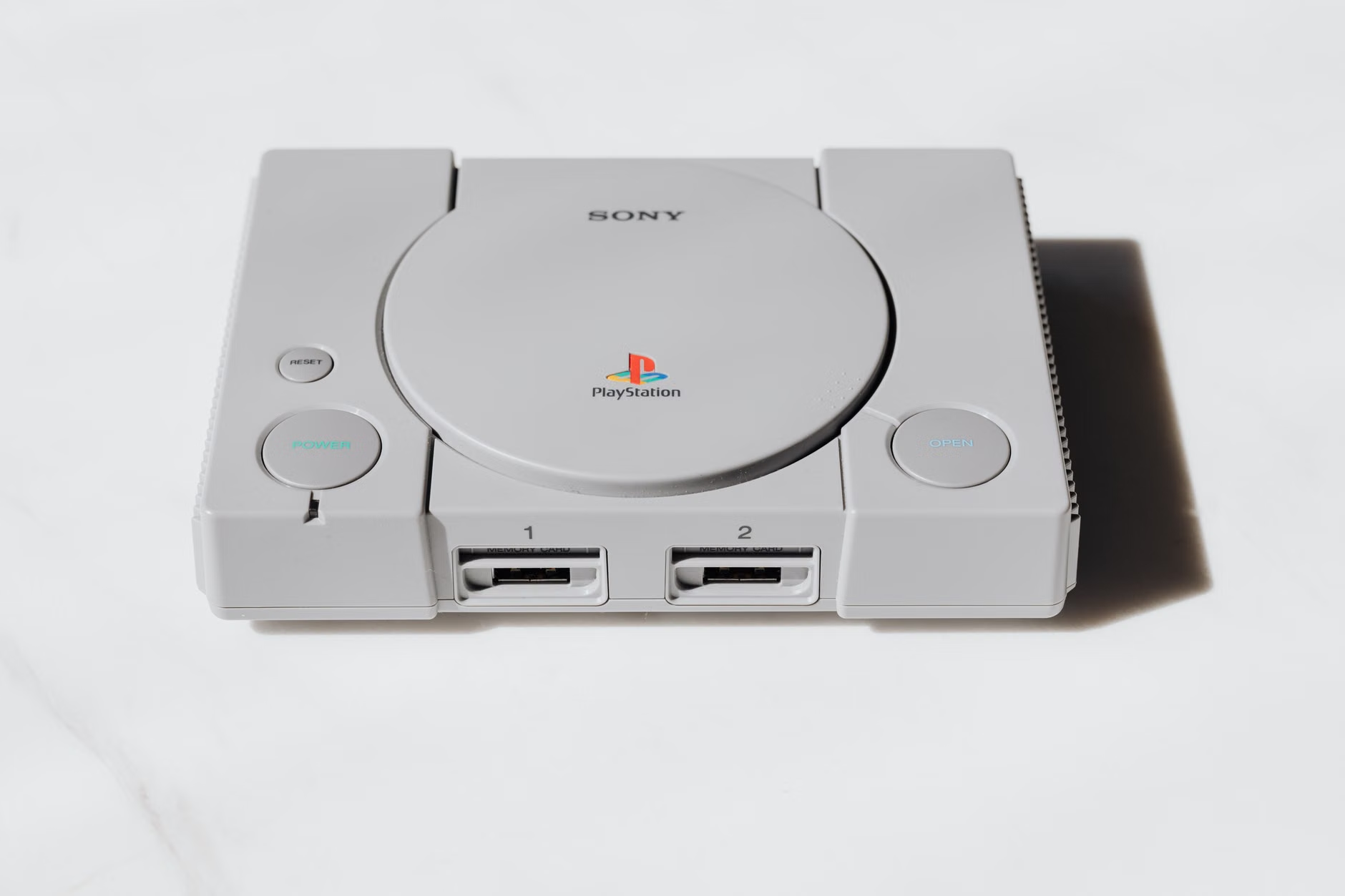
Original PlayStation 1 Console
Best for: authentic PS1 disc play
Revisiting classic Sony PlayStation games in 2026 requires more thought than a simple digital download. Most enthusiasts are often pointed towards modern emulation handhelds or specific backwards-compatible consoles like the PlayStation 3 for accessing PlayStation and PlayStation 2 libraries. However, this common advice overlooks a critical detail for buyers: Sony’s updated Digital Rights Management (DRM) policy. This policy, confirmed not a bug, now requires digital PS4 and PS5 purchases to perform an online check-in every 30 days, or they become unplayable.
For collectors and dedicated retro players in the UK, pursuing original physical PS1 and PS2 discs with their compatible hardware offers a truly owned and secure gaming experience. This approach sidesteps the creeping digital insecurity that affects modern PlayStation ecosystems. When the PlayStation Network (PSN) experienced significant outages on July 24, 2026, it affected account sign-ins, multiplayer, and digital game launches across PS5, PS4, PS3, and Vita. This incident was not isolated, following at least five prior documented PSN failures earlier in 2026. Such instability highlights the inherent risks of relying on digital storefronts and online authentication for continued access to your purchased titles, retro or otherwise.
Understanding these shifts is essential for any retro gamer looking to build a lasting, accessible library of PlayStation classics. The question is not just where to play them, but how to ensure they remain playable for years to come, free from server shutdowns, DRM changes, or licensing disputes. True ownership now means more than just a purchase receipt; it means holding the physical media in your hand.
| Product | Price (UK) | Best For | Score | Buy |
|---|---|---|---|---|
| Original PlayStation 1 Console | £25 | Authentic disc play | 7.5/10 | Buy → |
| Original PlayStation 2 Console | £90 | Vast PS1/PS2 disc library | 8.5/10 | Buy → |
| Anbernic RG40XXV | £70 | Portable PS1 emulation | 8.0/10 | Buy → |
| PlayStation 3 (CECHA01) | £200 | Limited PS1/PS2 backwards compatibility | 6.0/10 | Buy → |
The Digital Rights Management Reality: Why Digital PlayStation Ownership is Fragile in 2026
The biggest oversight when discussing ways to play classic PlayStation titles in 2026 is the evolving and increasingly restrictive nature of digital game ownership. Sony’s recent DRM changes highlight a concerning shift for anyone relying on digital storefronts for their retro libraries. Following a March 2026 firmware update for PS4 and PS5 consoles, a new DRM issue surfaced: digital games purchased via Sony’s online marketplace now require an online check-in every 30 days to remain active. If the console fails to connect to the internet within this period, the license is flagged, and the game simply stops working. On PS5, there is no visible timer, only an opaque error code. Sony has confirmed this is not a bug; it is a deliberate new game expiration feature.
Sony’s policy directly impacts the long-term viability of digital retro collections. Multiple outages, including a significant event on July 24, struck the PlayStation Network (PSN) in 2026, affecting account sign-ins and digital game launches across all active PlayStation consoles. Coupled with a mandatory 30-day online check, these server instabilities mean that access to your purchased digital games is not guaranteed. Consequently, your game library becomes a subscription service, dependent on Sony’s servers remaining active and your internet connection staying reliable. By contrast, physical discs offer a permanence.A similar, unaddressed issue plagues the PlayStation 3. Its “CBOMB” CMOS battery issue renders digital games unplayable if the internal clock battery fails, especially once the PS3 online store closes. While resolved for the PS4 with Firmware Update 9.00, a fix has not been provided for the older console despite recent PS3 firmware updates. Sony announced on July 1, 2026, that the PS3 and PS Vita PlayStation Stores will close globally by July 2027, with some regions losing access even sooner. Consequently, no new digital purchases will be possible, leaving existing digital libraries vulnerable to the CMOS battery ticking time bomb.Given these developments, relying on digital versions of classic PlayStation titles, even through backwards compatibility on a PS3, carries inherent risks. The control over your game access lies entirely with Sony, not with you. This situation makes a compelling argument for players to re-evaluate their approach to retro gaming, prioritising physical media and dedicated hardware where true ownership is maintained. The community’s ongoing concern about how the discontinuation of physical media will impact the retro scene, as seen in various online discussions, is certainly justified by these recent events.
The Original PlayStation (PS1): A Reliable Retro Foundation for UK Buyers
For purists and those who appreciate the original experience, the Original PlayStation (PS1) remains a steadfast choice. Launched in the mid-1990s, the PS1 defined a generation of 3D gaming. Securing an original console in the UK is still relatively straightforward. GameStock commonly lists PS1 consoles around £20–£30, whilst complete bundles with controllers and cables might hit around £80–£100 on platforms like PriceSpy UK. These machines are known for their durability, often outlasting many modern electronics.
The primary appeal of the original PS1 is its authenticity. Pop a physical disc into the tray, and you are playing the game exactly as it was intended. No emulation layers, no potential for input lag or visual artefacts. For games like Metal Gear Solid or Final Fantasy VII, this unadulterated experience is often seen as superior. The console’s native resolution and colour output are perfectly suited for CRT televisions, which can be acquired for very little cost. However, connecting a PS1 to a modern flat-panel TV requires some additional hardware.
Connecting a PS1 to a modern display typically involves an HDMI upscaler. Priced around £200–£300 for the latter, upscalers such as the OSSC (Open Source Scan Converter) or the RetroTINK 5X Pro will take the PS1’s analogue video signal (RGB Scart being the best option) and convert it into a clean, lag-free HDMI signal at higher resolutions. This avoids the often-blurry and delayed image produced by cheap composite-to-HDMI adapters. The significant investment in an upscaler transforms the visual experience, making games appear sharp and vibrant on contemporary screens. Conversely, without such a device, the picture on an LCD television can appear washed out and indistinct. Games like Tekken 3 benefit immensely from a clean signal path.
A Creative Bloq review from November 2022 focused heavily on the PlayStation Classic’s design as a “smart-looking mini replica,” praising its aesthetic appeal as a collector’s item. Whilst this is a fair assessment of that specific mini-console, it missed the point about the true experience of original hardware. That review also failed to account for the then-burgeoning market of retro handhelds that excel at PS1 emulation, a significant component of modern retro gaming discussions. The original PS1 console, despite its age and analogue output, still beats many plug-and-play mini consoles purely on the fidelity of its game playback. It provides a tactile, reliable experience that current DRM changes cannot take away. 7.5/10 — Check price on Amazon UK →
Who Should Buy This?
The Original PlayStation is ideal for retro gaming purists and collectors in the UK who prioritise authenticity and physical media. If you already own a collection of PS1 discs or plan to build one, this is the most secure way to ensure continued access to your games. It’s also a good choice for those who enjoy connecting to CRT televisions for that period-accurate visual experience, or those willing to invest in an upscaler for modern display compatibility. The low entry cost of the console itself makes it an attractive starting point.
Who Should NOT Buy This?
Do not opt for an original PS1 if you are looking for a plug-and-play solution for modern TVs without additional investment. Its visual quality via standard composite cables on an LCD screen is typically poor, and good upscalers add significant cost. Also, it falls short for players seeking digital convenience or portable gaming. For high-definition output without additional hardware, alternative options should be considered, as the PS1 requires careful setup for optimal modern display presentation. If you simply want to access a vast library digitally, other options, despite their DRM issues, will initially appear more convenient.
The PlayStation 2 (PS2): The Ultimate Backwards Compatibility Workhorse
Widely regarded as one of the most commercially successful consoles of all time, the PlayStation 2 (PS2) holds immense appeal. For retro gamers, its primary appeal extends to its extensive backwards compatibility. Its ability to play nearly all original PlayStation discs, alongside its own monumental library of PS2 titles, makes it a highly versatile and cost-effective retro gaming machine for UK buyers. Priced around £80–£100 for a functioning console in 2026, according to PriceSpy UK listings, it offers excellent value for its capabilities.The sheer breadth of its library is unmatched. From critically acclaimed PS1 titles like Castlevania: Symphony of the Night to PS2 masterpieces such as God of War, Shadow of the Colossus, and Grand Theft Auto III, the PS2 offers thousands of physical games. The console provides a consistent and authentic experience for both generations. Its graphical output is natively better than the PS1, with many games supporting progressive scan (480p) which benefits from more modern display technologies even without an external upscaler. Like the PS1, however, for optimal display on an LCD or OLED screen, an upscaler such as the OSSC or RetroTINK is highly recommended to eliminate input lag and clean up the image.Consistently, the community points to the PS2 as a strong candidate for an “ultimate retro console” due to its physical media support and vast library. Many enthusiasts, as indicated by discussions around “optimal display technology for retro gaming,” still favour CRT televisions, particularly Sony Trinitron models, for playing PS1 and PS2 games. A Trinitron CRT produces an authentic, sharp picture with scanlines that many feel are integral to the aesthetic of these older games. The vibrancy and lack of input delay on a quality CRT make it an ideal pairing for the PS2. Using modern displays, component video cables paired with a decent upscaler provide the next best solution, reducing the fuzziness and colour bleeding often seen with composite video.Unlike digital versions that face constant threats from DRM and server closures, owning physical PS1 and PS2 discs, coupled with a functioning PS2 console, provides genuine long-term security. These machines operate independently of any online authentication, meaning your games will play as long as the hardware functions. Its advantage is significant over even the early backwards-compatible PlayStation 3 models, which whilst capable of playing PS1 and some PS2 discs, are now plagued by the CMOS battery issue and the looming closure of the PS3 digital store. Demonstrating superior value and authenticity, the PS2 remains a powerhouse. 8.5/10 — Check price on Amazon UK →Who Should Buy This?
For UK retro gamers seeking a single console to play both PS1 and PS2 physical disc libraries, the PlayStation 2 is the premier choice. If you prioritise true game ownership, a vast collection of games available for reasonable prices, and an authentic experience on either a CRT or a modern display with an upscaler, the PS2 delivers. It represents excellent value for money given its capabilities and expansive game catalogue.Who Should NOT Buy This?
Avoid the PS2 if your primary interest lies in purely digital gaming or handheld portability. The PS2 is a static console that requires a physical setup. Those who lack space for a dedicated retro setup, or who wish to play games entirely on the go, will find this unsuitable. While it has excellent backwards compatibility, it does not offer HDMI output natively, necessitating additional hardware for optimal modern TV connections. If you prefer the convenience of ROMs on a handheld, the PS2 will not be your solution.
PlayStation 3 (PS3): A Fading Digital Dream for Retro Compatibility
Initially offering tantalising backwards compatibility for original PS1 and PS2 discs, the PlayStation 3 (PS3), particularly the early “fat” models (like the CECHA01 and CECHB01), captured attention. This feature initially made the PS3 a compelling option for retro enthusiasts looking for an all-in-one console. However, in 2026, the PS3’s appeal as a retro machine is severely hampered by significant, unaddressed issues and Sony’s evolving digital strategy. Prices for these specific backwards-compatible PS3 models in the UK can range from around £150–£190 from specialist resellers like Ubuy UK, or even £190–£230 through Amazon EU via Idealo, which makes them a substantial investment.The primary concern for any PS3 owner, especially those relying on digital titles, is the ongoing “CBOMB” CMOS battery issue. If the internal clock battery fails, digital games may become unplayable due to an “expired” status. While Sony resolved a similar issue for the PS4 with Firmware Update 9.00, no fix has been provided for the PS3, even after recent firmware updates. Its insidiousness lies in becoming critical once the PS3 online store officially closes, which Sony announced on July 1, 2026, will happen globally by July 2027. Some regions in Latin America and the Middle East will even lose access to the PS3 store sooner, by August or late 2026. Consequently, users will no longer be able to make new digital purchases, and existing digital libraries could be held hostage by a failing CMOS battery and an inaccessible online verification system.Whilst early PS3 models can play physical PS1 and PS2 discs, even this functionality is shadowed by the CMOS problem, which can affect the system’s ability to verify game licenses for digital content and system functions. This makes the PS3 a riskier proposition for retro gaming than its older siblings. The high resale value of the backwards-compatible models (often more expensive than a dedicated PS2 and PS1 combined) is difficult to justify given these vulnerabilities. A community question from July 2026, asking how Sony plans to discontinue physical media and how that will impact the retro scene, points to the very real anxieties that the PS3’s current state embodies.
The PS3 offered a promising vision of integrated retro gaming at its launch, but the lack of commitment to fixing core issues and the deprecation of its digital storefronts have significantly eroded that promise. For long-term, secure access to classic PlayStation games, dedicated hardware for each generation with physical media offers a far more stable and truly owned experience. The PS3’s backwards compatibility, whilst technically present on some models, cannot be relied upon for a future-proof retro collection. 6.0/10 — Buy →
Who Should Buy This?
Only consider an early backwards-compatible PS3 (CECHA01/B01) if you specifically desire its original PS3 library AND already possess a collection of physical PS1/PS2 discs you wish to play on a single system, accepting the known risks. This console might appeal to hardware modders hoping for community-driven workarounds to the CMOS battery issue, or those interested in its unique Cell processor architecture for more than just retro gaming. Its value as a retro machine has significantly diminished.
Who Should NOT Buy This?
Do NOT buy a PS3 primarily for PS1 or PS2 backwards compatibility in 2026. The high price tag (often £150–£230 in the UK), coupled with the unaddressed CMOS battery issue that can render digital games unplayable, and the impending PSN Store closure, makes it a poor investment for retro purposes. Dedicated PS1 and PS2 consoles offer a more stable, cheaper, and truly owned physical media experience. If you are wary of digital rights management and hardware failure points, the PS3 is a console to avoid for archiving your retro PlayStation library.
Modern Emulation Handhelds for PS1 and PS2: The Convenience Compromise
Many UK retro enthusiasts find modern emulation handhelds offer a compelling balance of convenience, portability, and access to a vast library of classic PlayStation titles. At around £60–£80 in the UK, the Anbernic RG40XXV, for example, excels at PlayStation 1 emulation. These devices run games like Crash Bandicoot and Gran Turismo at a smooth 60 frames per second using various RetroArch cores. The RG40XXV, with its 3.5-inch IPS panel hitting around 640×480 native resolution, ensures PS1 games are pixel-perfect with minimal scaling artefacts, much like how the games might appear on a high-quality CRT monitor. Its portable experience rivals, and in some aspects, surpasses, the original hardware for sheer convenience.Regarding PlayStation 2 emulation, the hardware demands escalate considerably. Achieving playable frame rates for most of the PS2’s library necessitates hardware such as the Retroid Pocket 6. Priced around £250–£300, or the more powerful AYN Odin 2 (often closer to £400), these devices become essential. Games like God of War II or Jak II demand substantial processing power to run consistently at their target frame rates. Community testing on r/SBCGaming shows that even these higher-end devices might struggle with demanding titles, or require specific tweaks to emulator settings (such as skipping frames or reducing internal resolution) to maintain playability. By contrast with PS1, where solid 60fps results are common, PS2 emulation on handhelds often involves compromises.The main advantage of emulation handhelds is undoubtedly convenience. They allow you to carry hundreds, if not thousands, of games in your pocket, free from the physical limitations of discs. The ability to save state at any point, use fast-forward, and apply various graphical enhancements (like upscaling internal resolution or applying shaders) offers a level of customisation impossible on original hardware. These devices abstract away the complexities of display connections and often come with built-in screens and controllers. This contrasts sharply with the setup required for original consoles, particularly when integrating them with modern televisions, which might involve significant investment in external upscalers.
However, the convenience comes with its own set of trade-offs. While you retain full control over your game files (ROMs), the legality of acquiring these files without owning the original physical media remains a grey area, although the emulation preservation argument is largely settled within the community as a net positive for history. A reliance on community-developed software and firmware, whilst excellent (e.g., OnionOS for Miyoo Mini Plus, custom firmwares for Anbernic devices), can sometimes be complex to set up. Individuals desiring true physical ownership and a direct experience will find that even the best emulation handhelds offer a simulation rather than the original article. Its appeal lies in portability and digital curation, making it less suitable for the purist seeking absolute authenticity. To explore this pathway further, our retro handheld hub provides a deeper look into various options. 8.0/10 — Buy →Who Should Buy This?
Modern emulation handhelds are ideal for UK retro gamers who prioritise portability, convenience, and a vast, curated digital library. If you want to play PS1 games on the go with excellent performance and don’t mind the setup involved with custom firmware and ROM management, the Anbernic RG40XXV is highly recommended. Buyers willing to spend more for some PS2 emulation might find a Retroid Pocket 6 or AYN Odin 2 suitable, provided they understand the performance limitations and potential need for tweaking.Who Should NOT Buy This?
Avoid emulation handhelds if you demand absolute authenticity, physical media playback, or an entirely plug-and-play experience without any digital setup. Purists who insist on the original console and disc will find emulation a compromise. For PS2 emulation, if you expect perfect performance across the entire library without effort, these handhelds will disappoint unless you invest in the most expensive options and accept some tinkering. If you dislike dealing with ROM files, firmware updates, or emulator settings, this route will be frustrating.
Display Technology: CRTs vs. Modern Displays for PlayStation Classics
The choice of display significantly impacts the experience of playing classic PlayStation games, a fact widely discussed within the retro gaming community. The question “Why I Chose Trinitron for 8-Bit Gaming (And It Changed Everything)” from a November 2025 YouTube video, while focused on 8-bit, highlights a broader interest in optimal display technology for older consoles, including the PS1 and PS2. Many argue that a Cathode Ray Tube (CRT) television provides the most authentic and visually pleasing experience for these consoles.
Sony’s own Trinitron CRTs are frequently singled out for their superior picture quality, vibrant colours, and sharp scanlines. These scanlines, which are a natural artefact of the CRT display technology, are often seen as integral to the aesthetic of 32-bit and 64-bit era graphics. They mask jagged edges, blend pixels, and enhance the illusion of depth in ways modern, pixel-perfect displays often cannot replicate. Crucially, CRTs display retro games at their native resolutions with zero input lag, as they do not require any scaling or processing. This responsiveness is particularly important for rhythm games or fighting games like Tekken 3, where every millisecond counts. Acquiring a good condition CRT in the UK often involves community marketplaces or local pickups, with prices sometimes surprisingly low due to their bulk.
Connecting original PlayStation hardware to modern LCD or OLED televisions presents a different set of challenges. These displays are designed for high-resolution, progressive scan content, not the interlaced, low-resolution analogue signals typically output by PS1 and PS2 consoles. Directly plugging in a composite or S-video cable usually results in a blurry, washed-out image with noticeable input lag due to the TV’s internal scaling and processing. This often leads to a disappointing visual experience that does a disservice to the games.
To achieve a quality image on a modern TV, an external video upscaler is essential. Examples include the RetroTINK 5X Pro or the OSSC, which take the analogue RGB (via SCART) or component video signal from the PS1/PS2, de-interlace it, and scale it to a higher resolution (e.g., 1080p or 1440p) via HDMI. These upscalers are engineered to minimise lag and preserve image fidelity, often adding artificial scanlines or other filters to replicate the CRT aesthetic. While expensive (the RetroTINK 5X Pro can cost around £250–£300), the difference in visual clarity and input responsiveness is night and day compared to directly connecting to a modern TV. Investing in a good upscaler is as important as the console itself for a high-quality modern display setup. This critical area is covered in our HDMI & Display Fix Hub.Collecting Physical PlayStation Games in the UK: A Secure Investment
The discussion around “how Sony/MS plans to discontinue physical media will impact the retro scene,” as posed in a Reddit thread from July 2026, highlights a growing concern among collectors. This concern is not unfounded, particularly with Sony’s recent DRM changes and the impending closure of the PS3 and PS Vita digital storefronts. Pursuing original physical PS1 and PS2 discs, coupled with compatible hardware, is not merely about nostalgia; it is increasingly about securing true game ownership and future-proofing a retro gaming collection.
A physical game disc, when paired with an original console like the PlayStation 1 or PlayStation 2, operates entirely independently of online services. There is no server to shut down, no DRM check to fail, and no CMOS battery issue to contend with that renders your library unplayable. This independence offers unique peace of mind for collectors. Games like Resident Evil 2 or Jak and Daxter: The Precursor Legacy become truly ‘owned’ assets, playable indefinitely as long as the hardware functions.
The UK market for physical PlayStation games remains vibrant. Popular titles can be found at independent retro game shops, online marketplaces like eBay, or local car boot sales. Prices vary widely based on rarity, condition, and demand. Whilst some highly sought-after games command premium prices, many excellent titles for both PS1 and PS2 can still be acquired for reasonable sums. This affordability makes building a substantial physical library a tangible goal for most enthusiasts, answering the community question: “What are some ways to play the classic PS1 and PS2 games we missed out on as kids?” The answer often lies in the original discs.
Beyond the security aspect, there is a tangible joy in collecting physical media. The cover art, instruction manuals, and the tactile experience of handling a disc are all part of the retro gaming appeal. Such physicality stands in stark contrast to a digital file, which exists purely as data. Gamers wary of digital storefronts and the precarious nature of ‘owning’ digital content will find physical media provides a concrete, verifiable form of ownership. This represents a long-term investment in entertainment that cannot be revoked by a platform holder, a server outage, or a firmware update.Who Should Buy Original PlayStation Hardware (and Who Should Not)
Prioritising true game ownership and desiring to play PlayStation classics free from DRM or server shutdowns means original hardware is your ideal choice. Investing in a PlayStation 1 and a PlayStation 2, alongside building a physical disc library, becomes essential. These consoles are robust, relatively inexpensive to acquire in the UK (around £20–£30 for a PS1, £80–£100 for a PS2), and offer the authentic experience as envisioned by the developers. You get the original controllers, the original disc loading sounds, and the satisfaction of a collection you truly possess. Its appeal is especially strong if you appreciate the aesthetics of a CRT television or are prepared to invest in a quality upscaler like the RetroTINK 5X Pro for modern displays.Many users find setting up and configuring emulation software on modern handhelds too much hassle, making original hardware an attractive alternative. Anbernic RG40XXV, while excellent for portable PS1 gaming, requires sourcing ROMs and configuring emulators, a process some prefer to avoid. Original hardware, by contrast, is largely plug-and-play once connected correctly, especially if using a period-appropriate CRT. Experiencing games like Silent Hill or Kingdom Hearts exactly as they shipped, without any potential for emulation quirks or software updates, positions original consoles as the gold standard.Who Should NOT Buy This
Original PlayStation hardware is not for everyone. If you crave ultimate portability, hate cables, or refuse to engage with either a bulky CRT or a potentially expensive upscaler for modern TVs, then a physical console setup will frustrate you. If your budget is extremely tight and you cannot stretch to both a console and an upscaler, the visual experience on a modern TV using basic composite cables will be disappointing. Additionally, if your primary interest lies in digital convenience, or if you prefer to have every game readily available on a single device without the need to swap discs, then modern emulation handhelds or even backwards-compatible digital options (with their associated DRM risks) might initially seem more appealing. Those who are only interested in a casual dip into retro gaming, without the commitment to collecting physical media, may find original consoles too much of an undertaking.
Beyond Emulation: FPGA and Dedicated PlayStation Solutions
Beyond the convenience of software emulation on handhelds and PCs, a more exacting approach to playing classic PlayStation games involves Field-Programmable Gate Array (FPGA) devices. FPGA hardware re-creates the original console’s chips at a gate level, offering cycle-accurate reproductions of the original system’s behaviour. It results in minimal input lag and near-perfect compatibility, often surpassing software emulation in accuracy. The MiSTer FPGA stands out as a prominent solution for PlayStation fans, featuring highly regarded PS1 cores. Taki Udon’s YouTube channel notably covered this on January 14, 2025, with their video “PlayStation 1 is BACK! Taki Udon’s FPGA Console is a Retro Game-Changer!”, highlighting the capabilities of such systems.The MiSTer platform, whilst requiring some assembly and technical knowledge, offers exceptional accuracy for numerous retro platforms, including the PS1. It typically outputs via HDMI, making it suitable for modern displays without the need for additional external upscalers like the OSSC, as the FPGA itself handles the signal conversion and scaling. The cost of a complete MiSTer setup can vary, but usually lands in the £200–£400 range, depending on components and desired accessories. This price point places it significantly above budget emulation handhelds but below the most expensive vintage console setups with high-end upscalers.
A key advantage of FPGA solutions over software emulation is their inherent resistance to software updates and operating system changes that can affect performance or compatibility on PC-based emulators. The hardware itself is configured to behave like the original console, ensuring long-term stability for game playback. For individuals deeply invested in the purest form of retro gaming outside of original hardware, FPGA represents the ultimate digital solution. It removes the guesswork and potential inaccuracies that can plague software emulators, delivering a consistent and highly accurate experience.
However, the barrier to entry for FPGA is higher than for off-the-shelf handhelds. It requires a degree of technical comfort with components and configuration. The learning curve for setting up the MiSTer, loading cores, and managing ROMs is steeper than simply downloading an app on a PC or using a pre-configured handheld. Valuing absolute accuracy and willing to put in the initial effort, users will find FPGA platforms offer a robust and future-proof way to experience PlayStation classics. They represent a philosophical middle ground, providing digital access to game ROMs whilst executing them with hardware fidelity.The PlayStation Classic: A Misstep in Sony’s Retro Strategy
Sony’s own attempt at a dedicated retro console, the PlayStation Classic, initially launched with a mixed reception and has since become a cautionary tale in retro gaming. Whilst a Creative Bloq review in November 2022 praised its “smart-looking mini replica” design and appeal as a collector’s item, it largely missed the product’s fundamental shortcomings as a playable retro device. At launch, the PlayStation Classic sold for around £90–£100 in the UK, but prices quickly plummeted. Today, you can find them for around £20–£30 at retailers like GameStock or even cheaper in clearance bins.
The core issue with the PlayStation Classic was its execution. Sony opted for an underpowered System-on-Chip (SoC) that struggled to emulate some of its pre-loaded games, particularly NTSC titles running on a PAL-optimised console. Games like Tekken 3, for example, often experienced noticeable frame rate drops, making the experience inferior to playing on original hardware or even well-optimised software emulators. The bundled controller, whilst a faithful recreation of the original PS1 pad, lacked analogue sticks, which was a significant omission for many classic titles that benefited from analogue input.
In addition, the game selection, whilst featuring some iconic titles, was criticised for odd omissions and regional variations. The system’s closed nature meant adding more games was not officially supported, although the vibrant modding community quickly developed methods to load custom firmware and expand the game library. This reliance on unofficial modifications to unlock the console’s full potential highlighted Sony’s failure to deliver a truly compelling product out of the box. Many community members, having seen dedicated retro handhelds offer better performance and more flexibility at similar or lower price points, quickly dismissed the PlayStation Classic.
In 2026, the PlayStation Classic primarily functions as a curiosity or a project device for modders. Its low price makes it a cheap entry point for those wanting to tinker with custom firmware to create a more functional retro machine. However, as a standalone, out-of-the-box solution for playing classic PlayStation games, it pales in comparison to original consoles, FPGA solutions, or even many modern emulation handhelds. Its initial premium price was certainly not justified by its performance or features, and even at its heavily discounted current price, it still requires significant user intervention to be truly satisfactory. 5.5/10 — Buy →
The Longevity of Physical Media: Why It Matters More Than Ever
The increasing fragility of digital game ownership in 2026 casts physical media in a new light, elevating it beyond mere nostalgia to a critical aspect of collection longevity. Sony’s new DRM, requiring digital PS4/PS5 purchases to connect online every 30 days, coupled with repeated PSN outages and the looming closure of the PS3 and PS Vita stores, fundamentally changes the definition of ‘owning’ a game. A digital license can be revoked, servers can go offline, and entire storefronts can vanish, taking purchased libraries with them. This reality is unfolding before our eyes, with the PS3 store closure slated for July 2027.Physical media, by contrast, offers a robust and self-contained solution. A PS1 disc or PS2 DVD contains the game data directly, requiring only a functional console to play. No internet connection is needed, no license server to verify. This model of ownership, once taken for granted, now serves as a powerful bulwark against the inherent instabilities of the digital age. For gamers who have seen beloved digital services disappear (e.g., Nintendo’s Wii Shop Channel, early mobile game stores), the security of physical discs is a palpable reassurance.
Additionally, the physical media market in the UK remains active, allowing for continued collection and trading. You can sell, loan, or buy physical games without any restriction from platform holders. This secondary market also acts as a vital preservation mechanism, keeping older titles in circulation long after official digital storefronts have ceased to support them. Community discussions frequently touch on the long-term impact of digital-only trends, and the consensus among many retro enthusiasts is that physical media represents the most secure path for game preservation and ownership.
The debate around how to play PS1 games in 2026 often simplifies to emulation versus modern consoles. However, the critical insight missed by many discussions is the vulnerability of digital ownership itself. A truly future-proof collection relies on physical media on original, offline-capable hardware, which remains the most dependable option. It ensures that the games you love today will remain accessible years down the line, regardless of corporate decisions or internet infrastructure stability. Investing in original PS1 and PS2 consoles, and their physical disc libraries, is not just about authenticity, but about fundamental ownership.
Setting Up Your Classic PlayStation Console for Modern Play
Acquiring an original PlayStation or PlayStation 2 console is only the first step; connecting it to a modern television for a quality experience requires a considered approach. Many UK retro gamers find themselves asking, “What’s the best possible way to play PS1 games in 2022?” – a question that remains highly relevant in 2026. The answer largely depends on your display preferences and willingness to invest in specific video solutions.
For purists, a high-quality CRT television, particularly a Sony Trinitron, provides the most authentic visual experience with zero input lag. These displays render the PS1’s low-resolution, interlaced output perfectly, with natural scanlines that enhance the pixel art. Connecting a PS1 or PS2 to a CRT is simple, typically using RGB SCART cables (which offer the best picture quality for analogue signals), or component video for PS2 if your CRT supports it. These cables are readily available online for around £15-£30 and offer a clear, vibrant picture on appropriate displays.
Connecting to a modern LCD or OLED TV, however, is more complex. Direct connection via composite video (the yellow, red, white cables) results in a blurry, desaturated image with noticeable input delay due to the TV’s internal scaling processes. Achieving a genuinely good picture on a modern display necessitates an external upscaler. The Open Source Scan Converter (OSSC) or the RetroTINK 5X Pro, for example, are purpose-built for this task. They convert the console’s analogue RGB or component output into a crisp, lag-free HDMI signal, upscaling it to 1080p or higher. These devices can cost between £150 and £300, representing a significant but worthwhile investment for optimal visual quality. Without an upscaler, the visual downgrade on a modern TV makes many classic PlayStation games difficult to appreciate.
The setup involves running high-quality shielded RGB SCART or component cables from your PS1/PS2 to the upscaler, then an HDMI cable from the upscaler to your TV. Many upscalers offer options for adding artificial scanlines or other filters to mimic the CRT aesthetic, providing a balance between modern display clarity and retro authenticity. For audio, the signal usually passes through the upscaler to your TV, or can be split for a separate audio system. Getting the right cables and understanding the settings of your chosen upscaler is key to unlocking the best possible image quality for your classic PlayStation games on a contemporary display. 8.0/10 — Buy →
Conclusion: The Enduring Value of Physical PlayStation Ownership
Navigating the options for playing classic Sony PlayStation games in 2026 reveals a landscape increasingly dominated by the fragility of digital ownership. Sony’s new 30-day online check-in DRM, coupled with numerous PSN outages and the impending closure of the PS3 and PS Vita stores, underscores a shift away from true player ownership in favour of platform control. Against this backdrop, the value of physical PS1 and PS2 discs, played on their original, offline-capable consoles, has never been clearer.
For UK retro gamers, investing in an original PlayStation 1 (around £20–£30) and particularly a PlayStation 2 (around £80–£100) offers the most secure, authentic, and future-proof way to experience these timeless games. Whilst modern emulation handhelds like the Anbernic RG40XXV provide excellent portable PS1 emulation and convenience, they operate with digital ROMs. The once-promising backwards compatibility of the PS3 is now severely undermined by the CMOS battery issue and store closures, making it a risky investment for retro enthusiasts.
The definitive verdict is this: if you want to truly own your retro PlayStation games and ensure they remain playable for decades, prioritise physical discs and original hardware. This approach guarantees independence from platform holders and online services. The next question for any serious collector becomes how to properly maintain and display such a treasured physical library.
Frequently Asked Questions
What’s the best possible way to play PS1 games in 2026?
The best way to play PS1 games in 2026 depends on your priorities. For authenticity and true ownership, an original PlayStation 1 console with physical discs is ideal, especially when paired with a CRT TV or a high-quality HDMI upscaler like the RetroTINK 5X Pro. For portable convenience, an emulation handheld such as the Anbernic RG40XXV provides excellent PS1 performance with digital ROMs.
What are some ways to play the classic PS1 and PS2 games we missed out on as kids?
You can access classic PS1 and PS2 games by purchasing an original PlayStation 2 console, which plays both PS1 and PS2 physical discs. Alternatively, modern retro handhelds excel at emulating these systems, offering a portable solution for digital game files. The PS3 also has some backwards compatibility for physical PS1/PS2 discs on early models, though it comes with significant DRM and hardware risks in 2026.
Why is Sony’s new DRM a concern for retro gaming?
Sony’s updated DRM policy requires digital PS4 and PS5 games to perform an online check-in every 30 days. For retro gaming, this raises concerns about long-term access to digitally purchased classic titles, particularly with PSN outages and the closure of older PlayStation stores. It means your digital library is not truly ‘owned’ and depends on external server availability.
How does the PS3 CMOS Battery issue affect playing old games?
The unaddressed “CBOMB” CMOS battery issue on the PS3 can render digital games unplayable if the internal clock battery fails, especially once the PS3 online store closes in July 2027. Its implications are significant: even if you have purchased digital PS1 or PS2 titles on the PS3, they might become inaccessible due to a hardware failure that Sony has not patched for the console.
Is it better to play retro PlayStation games on a CRT TV or a modern display?
Playing retro PlayStation games on a CRT TV, particularly a Sony Trinitron, provides the most authentic visual experience with zero input lag and natural scanlines. For modern displays, an external HDMI upscaler like the RetroTINK 5X Pro is essential to achieve a clear, lag-free image by converting the console’s analogue signal to HDMI.
How do you think Sony’s plan to discontinue physical media will impact the retro scene?
Sony’s move towards discontinuing physical media creates uncertainty for the retro scene by making digital ownership increasingly precarious. It reinforces the value of physical game collections, which remain playable independent of online services. This trend pushes retro enthusiasts towards original hardware and discs for true ownership, rather than relying on digital storefronts which can be shut down.
✓ Recommended by Ben Rawlinson
Recommended based on community testing data, benchmark results, and verified UK pricing — we only link products that earn it.
- Original PlayStation 1 ConsoleBest for: authentic PS1 disc play
- Original PlayStation 2 ConsoleBest for: vast PS1/PS2 disc library
- Anbernic RG40XXVBest for: portable PS1 emulation
- RetroTINK 5X ProBest for: modern TV display for classics
- PS3 CECHA01 ConsoleBest for: limited PS1/PS2 backwards compatibility
RetroInHand earns a small commission from qualifying Amazon UK and eBay purchases at no extra cost to you.
What to Read Next
If you found this useful, here are a few articles worth reading next:
- Anbernic RG40XXV Review: PS1/N64 Sweet Spot for £60-£80 UK 2026? — this review covers an excellent budget handheld for portable PS1 emulation.
- Retroid Pocket 6 Review: Best for PS2/GC? Worth £250-300 UK (2026) — discover whether a higher-end handheld offers viable PS2 and GameCube emulation.
- Retro Buying Guides Hub — find more detailed purchasing advice across a range of retro gaming categories.



This article was produced with AI assistance and reviewed by the editor. See our Editorial Standards.