Last updated: July 2026
🏆 Editor’s Top Pick
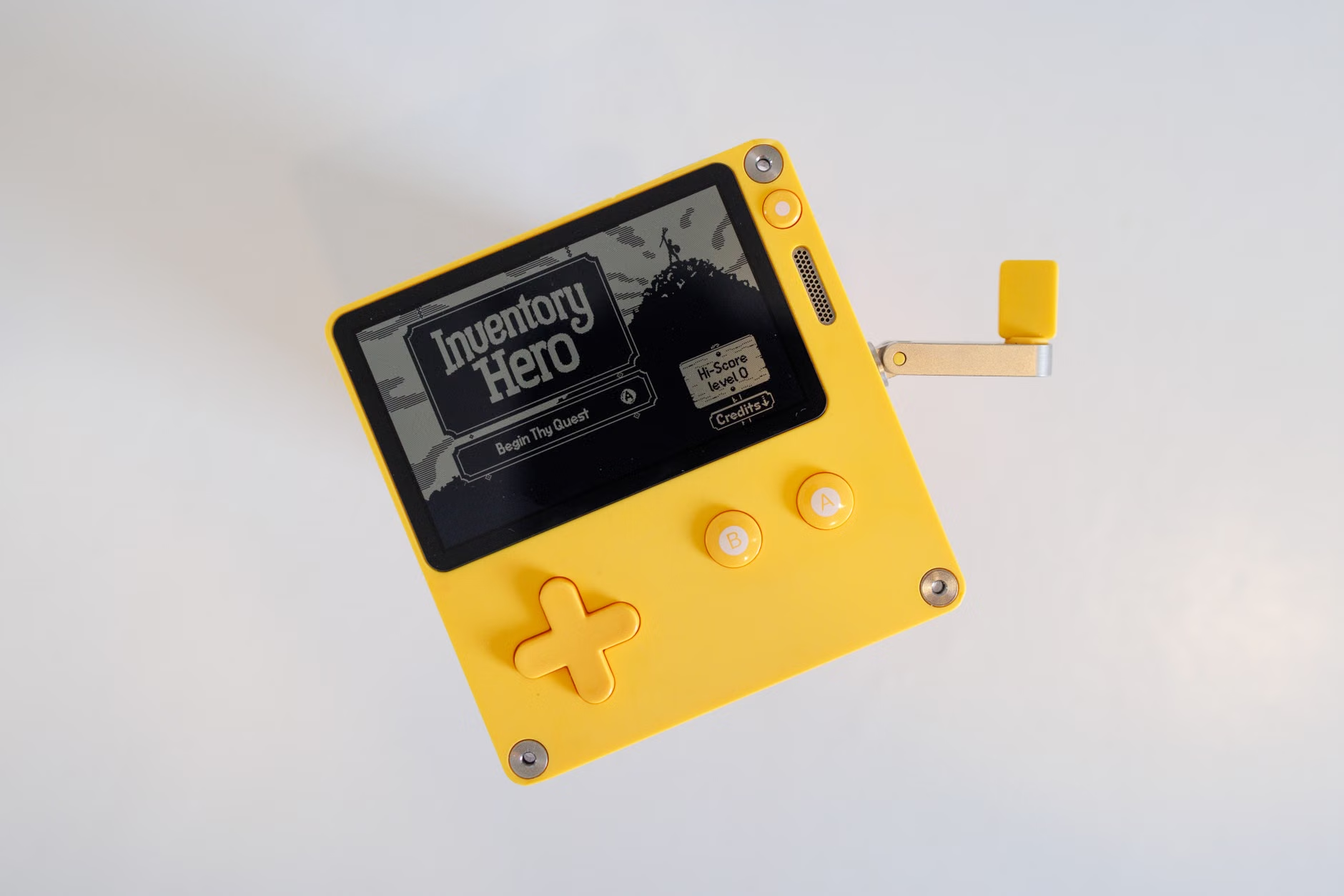
Analogue Pocket (Standard Model)
Best for: Cartridge-based handheld accuracy
For UK retro gaming enthusiasts in 2026, the quest for hardware-accurate emulation typically narrows to two primary contenders: the Analogue Pocket and the MiSTer FPGA system. Both promise to deliver near-perfect recreations of classic console hardware, avoiding the inherent compromises of software emulation. Most discussions focus on their technical merits, screen specifications, or supported cores.
However, the practical reality of bringing these systems into a UK setup is a tale of two vastly different experiences. For buyers here in the UK, the Analogue Pocket, despite its handheld form factor and impressive native cartridge support, faces significant challenges regarding availability and cost. By contrast, MiSTer FPGA, a more modular and DIY-oriented platform, stands as a more straightforward and often better-value option.This comparison moves beyond mere spec sheets, assessing which FPGA solution genuinely serves the UK retro community best in 2026. We will weigh the technical prowess of each against the often-overlooked logistical and financial hurdles specific to our shores. The ultimate question is not just ‘which is better technically?’ but ‘which is genuinely practical and worth your money today?’
| Product | Price (UK) | Best For | Score | Buy |
|---|---|---|---|---|
| Analogue Pocket | £240-£300 (base) | Premium handheld cartridge playback | 7.5/10 | Buy → |
| Terasic DE10-Nano (MiSTer Core) | £150-£200 | Modular, TV-centric console accuracy | 9.0/10 | Buy → |
Analogue Pocket vs MiSTer FPGA: The Core Philosophy
At their heart, both the Analogue Pocket and MiSTer FPGA share a fundamental objective: to recreate classic gaming hardware at a transistor level using Field-Programmable Gate Arrays. This approach differs significantly from software emulation, which simulates hardware logic through code. FPGA-based systems aim for a higher degree of accuracy, seeking to eliminate timing errors, input lag, and graphical glitches that can sometimes plague even the best software emulators.
Primarily, the Analogue Pocket enters this discussion as a premium handheld console. Its design focuses on meticulously recreating the experience of playing Game Boy, Game Boy Color, and Game Boy Advance cartridges, along with other systems via adapter. It features a stunning 3.5-inch LTPS LCD display with a 1600×1440 resolution, four times the pixels of the original Game Boy. This dedicated hardware and high-resolution screen make it an appealing option for those seeking a portable, cartridge-first experience. Its OpenFPGA platform has also broadened its capabilities, allowing for additional system cores to be loaded, expanding its reach beyond Nintendo handhelds.By contrast, MiSTer FPGA is a more open-ended, modular system built around the Terasic DE10-Nano development board. It operates as a console replacement, connecting to a television via HDMI. Its power lies in its versatility, supporting a vast library of cores for consoles, arcade machines, and even early home computers. The system is assembled from various components—the DE10-Nano itself, an I/O board, an SDRAM module, and usually a case—allowing users to customise their setup. This DIY aspect gives it a different appeal, favouring those who enjoy building and tweaking their retro gaming rig.While both strive for FPGA accuracy, their target form factors and approaches to user experience diverge significantly. The Pocket aims for a refined, premium, ready-to-play handheld. MiSTer offers a powerful, expandable, and more technically demanding console-like experience. This distinction is vital when considering which system aligns best with individual UK retro gaming habits and expectations. The community often debates which platform offers superior “accuracy,” a nuanced discussion that depends on the specific core in question and the rigour of its development. SamDansCouch, on YouTube, has reviewed the Analogue Pocket and discussed its worth, often highlighting its pristine display and build quality.
The open-source nature of MiSTer’s core development fosters a wide array of actively maintained cores, encompassing everything from the NES and SNES to Neo Geo and Sega Genesis, right through to arcade classics. Its emphasis is on the sheer breadth of accurately recreated systems. Analogue Pocket also features an FPGA, allowing for core development through its OpenFPGA initiative. This means systems like the SNES or NES can also be run on the Pocket, but its primary identity remains rooted in handheld gaming and cartridge playback. The difference in focus dictates much about their appeal and practical application.The Analogue Pocket in the UK: A Premium Burden
For all its technical brilliance, the Analogue Pocket presents a substantial challenge for UK buyers in 2026. Let me be blunt about this: acquiring one is significantly harder and more expensive than its US retail price suggests. As of July 2026, this device is sold exclusively direct from Analogue’s US-based online store. There are no official UK retailers, nor will you find it listed on Amazon UK or major electronics chains.This direct-only sales model means UK customers must navigate international shipping, import duties, and courier handling fees. The base unit, typically around £180-£230 before any additions, quickly escalates. International shipping alone adds approximately £33 (based on a $42 shipping charge). Crucially, UK import VAT, charged at 20%, applies to the total value of the goods and the shipping cost. This means an additional £40-£50 on top of the base price and shipping. Couriers handling these international imports levy their own administration fees, typically ranging from £8 to £12. This can push the final cost for a standard Analogue Pocket to around £240–£300, without even considering the optional Analogue Pocket Dock or other accessories.
Beyond the cost, availability remains a persistent issue. Analogue’s restocks are infrequent and frequently sell out within minutes of going live. This creates a frantic buying environment that often leaves UK customers disappointed. Many resort to aftermarket resellers on platforms like eBay, where prices are inflated even further, often reaching £450 or more for a new unit. This phenomenon has been tracked extensively; our existing article, “Analogue Pocket UK: Is £450+ Resale Worth It in 2026?“, details these prohibitive resale costs.
The appeal of the Analogue Pocket’s native cartridge support is undeniable for purists who own physical Game Boy, GBC, and GBA titles. Its high-quality screen also offers a pristine viewing experience for these games. However, for a UK buyer, the financial and logistical burden often outweighs these benefits. It becomes a purchase demanding patience, vigilance, and a willingness to absorb significant hidden costs. This is not to mention the potential headaches with warranty claims or returns if issues arise with an international purchase, adding another layer of risk to an already complex transaction. The hardware is lauded by many, but the real-world friction of getting one in hand across the Channel is a sticking point. Many community members, like those discussing on Reddit’s r/SBCGaming, echo these frustrations about Analogue’s distribution model.
This situation contrasts sharply with more readily available retro handhelds like the Retroid Pocket series, which are often found directly on Amazon UK or through specialist UK distributors, offering much clearer pricing and simpler acquisition paths. If the Analogue Pocket were as simple to buy as an Anbernic device, its higher price would be more justifiable for its niche. As it stands, the ‘premium’ aspect extends far beyond the device’s build quality, right into the process of simply obtaining one.
MiSTer FPGA: Modular Power and UK Accessibility
For UK retro gamers, the MiSTer FPGA system presents a vastly different proposition, particularly in accessibility and flexibility. Unlike the Analogue Pocket, a single, pre-assembled product, MiSTer is a modular platform. This system utilizes the Terasic DE10-Nano, a commercial FPGA development board. Widely available through various electronics distributors, including those with UK presence or straightforward shipping to the UK, this board typically costs around £150-£200.
Building a MiSTer setup involves adding several essential components to the DE10-Nano. The most critical additions are a MiSTer I/O board, an SDRAM module (usually 128MB), and a suitable power supply. These components are available from numerous specialist MiSTer retailers, many of whom are based in the EU or UK, ensuring reasonable shipping costs and simplified import processes compared to ordering from the US. A typical MiSTer I/O board costs around £30-£60, and a 128MB SDRAM module around £20-£40. Other optional additions include a USB hub, a case, and heatsinks, all readily sourced. The total cost for a fully functional MiSTer setup usually falls within a similar bracket to the Analogue Pocket’s base price, but without the hidden import complexities.
The modular nature of MiSTer is a significant advantage. Users can choose to start with a basic setup and upgrade components over time. This also means components are generally more replaceable if something fails. The open-source nature of the MiSTer project fosters a vibrant community. This community develops and maintains the vast library of FPGA cores, alongside robust setup scripts and excellent documentation. For anyone who enjoys a hands-on approach and tinkering, MiSTer offers a rewarding experience far beyond simply playing games.
MiSTer’s focus is on TV-out, providing pixel-perfect HDMI output for modern displays, and also supporting analogue video output (VGA/SCART) with the appropriate I/O board. This makes it ideal for integrating into a home entertainment system, replicating a true console experience. It’s often compared to dedicated retro consoles like the Super NT or Mega Sg from Analogue, but with the immense flexibility of supporting dozens of systems from a single piece of hardware. Its broad system compatibility, covering everything from 8-bit to 32-bit consoles, arcade boards, and home computers, positions it as a genuine retro powerhouse.
For UK buyers, the fact that MiSTer components are often sourced from within the EU or from dedicated UK resellers means avoiding the dreaded courier handling fees and the uncertainty of international shipping from the US. This translates directly into a more transparent and often lower final cost of ownership, making MiSTer a highly attractive option for those seeking hardware accuracy without the premium acquisition headaches associated with its handheld counterpart.
Emulation Accuracy and Core Development: A Technical Comparison
Both the Analogue Pocket and MiSTer FPGA are lauded for their hardware-level accuracy, striving to replicate original console behaviour with minimal latency and perfect timing. The underlying principle is the same: rather than simulating a system’s CPU and GPU, they configure an FPGA chip to become the original hardware. However, the scope and development models for their cores vary.
Initially, Analogue Pocket focused on a meticulously engineered FPGA implementation of the Game Boy family (GB, GBC, GBA). Analogue develops these cores internally, leveraging their hardware design expertise to achieve what many consider pixel-perfect and cycle-accurate performance. Playing native cartridges, the Pocket essentially transforms into the original hardware. Its OpenFPGA platform has enabled third-party developers to create cores for other systems, such as the NES, SNES, Sega Genesis, and even Neo Geo. While these OpenFPGA cores benefit from the Pocket’s dedicated hardware and high-resolution screen, their accuracy and feature sets depend on individual developer effort.
A significantly broader and more mature ecosystem of third-party cores is a hallmark of the MiSTer FPGA project. MiSTer’s cores are developed by a large, decentralised community of engineers and enthusiasts. This collaborative effort has built an extensive library covering dozens of systems, including nearly all major 8-bit, 16-bit, and even some 32-bit consoles (like the PSX, Saturn, and N64, though these are still in active development and have varying degrees of completion), along with hundreds of arcade boards and home computers. Generally, core quality is exceptional, with many being cycle-accurate or extremely close, often verified against original hardware tests. Crucially, this project transparency and community-driven development foster rapid improvements and a wide range of supported platforms.
Performance on MiSTer FPGA for supported systems is typically robust. NES, SNES, Genesis, TurboGrafx-16, Neo Geo, and Capcom CPS-1/2/3 arcade boards, for example, run with a fidelity that is practically indistinguishable from original hardware. The PSX core is considered highly accurate, allowing for near-perfect playback of classic titles like Tekken 3 at 60fps, provided the appropriate BIOS files are sourced. The N64 core is still a work in progress, but it demonstrates the potential for more demanding systems. MiSTer also supports various video output options, offering incredibly low input latency when configured correctly. For example, direct video mode can eliminate frame buffers, pushing input lag below even original console levels in some cases.
Running its native Game Boy cores, Analogue Pocket delivers a sublime handheld experience. Its high-resolution display makes Game Boy games look sharper than ever, and features like custom display modes recreate the original pixel grid patterns. OpenFPGA cores also provide a highly competent experience, with SNES and NES cores offering an accurate, low-latency portable option. SamDansCouch’s reviews often highlight how the Pocket brings classic Game Boy titles to life. Yet, it remains a dedicated handheld; despite the Analogue Pocket Dock allowing TV output, it doesn’t offer the same flexibility or the vast library of arcade and home computer cores found on MiSTer.
Display and Output Options: Handheld vs. TV
Comparing the Analogue Pocket and MiSTer FPGA, their most immediately apparent difference lies in their display and output philosophies. Analogue Pocket is a handheld first, designed around its exceptional integrated screen. Conversely, MiSTer FPGA is a TV-centric device, built to connect to external displays.
The Pocket’s 3.5-inch LTPS LCD panel boasts a resolution of 1600×1440. This is a remarkable specification for a retro handheld, delivering four times the resolution of an original Game Boy screen and ten times that of a Game Boy Advance. Its high pixel density ensures that even lower-resolution systems like the Game Boy can be displayed with integer scaling—where one pixel from the original system maps to a perfect square of pixels on the Pocket’s screen—resulting in incredibly sharp and artefact-free visuals. Analogue’s meticulous display modes also allow users to recreate the exact pixel grid and colour palettes of original screens, from the monochrome green of the DMG to the vibrant hues of the GBA. Impressively, the screen uniformity also matters more than raw resolution for an authentic retro experience, ensuring consistent colour and brightness across the display.For those wishing to play the Pocket on a larger screen, the optional Analogue Pocket Dock allows HDMI output to a television. This accessory also enables multiplayer gaming with USB controllers. Despite the dock’s functionality, the primary appeal of the Pocket remains its handheld form. Its screen truly is a highlight, presenting a pristine canvas for classic portable titles.MiSTer FPGA, conversely, assumes a television or monitor as its primary display. Its core DE10-Nano board typically has an HDMI output. With an I/O board, it gains robust analogue video capabilities, including VGA output that can be converted to SCART, component, or RGB for use with CRT televisions. This is a significant draw for purists who believe classic games look best on their original display technology. The MiSTer’s video scaling and output options are highly configurable, supporting everything from integer scaling for sharp pixel graphics on modern LCDs to incredibly low-latency direct video modes that bypass frame buffers. These options ensure that whatever display a user prefers, MiSTer can adapt to provide an authentic and visually accurate experience.
MiSTer’s output flexibility means it can integrate into diverse home setups. Owners commonly report connecting their MiSTer to both modern 4K TVs for upscaled pixel perfection and to vintage CRTs for a truly period-appropriate look. This dual capability is a powerful argument for the system, particularly for those who value the option to switch between display types based on the system or game being played. Its ability to perfectly synchronise its output with original refresh rates also eliminates tearing and stutter, a detail that dedicated retro players appreciate deeply.User Experience and Setup: Plug-and-Play vs. DIY
A stark contrast exists between the user experience of the Analogue Pocket and MiSTer FPGA. One offers immediate plug-and-play simplicity, whilst the other rewards a more hands-on, DIY approach. This difference directly influences which system suits a particular UK retro gamer.Aiming for a refined, premium experience straight out of the box is the Analogue Pocket. Once unboxed, it’s ready to accept your original Game Boy, Game Boy Color, or Game Boy Advance cartridges. Its operating system is sleek, intuitive, and designed to be user-friendly. Navigating menus, switching games, and applying display filters is straightforward. OpenFPGA cores, whilst requiring some initial setup to load onto the device’s SD card, are then integrated into the existing menu structure. This means minimal fuss for playing games, which for many, is the primary goal. You won’t find yourself delving into command lines or complex configuration files; the Pocket is designed for playing, not endlessly tinkering. Hardware is solid, and the controls are responsive, offering a truly premium handheld feel. Compared to even a modded Game Boy, the Pocket provides a significantly more modern and bright display, coupled with the accuracy of FPGA.By contrast, MiSTer FPGA demands a degree of technical comfort and a willingness to build. Its setup involves acquiring the core DE10-Nano board, an I/O board, SDRAM, and potentially other accessories like a USB hub or case. These components then require physical assembly, which often involves mounting boards and connecting various cables. Software configuration is also more involved, requiring a user to flash firmware to an SD card, configure settings via text files, and then download and install individual FPGA cores and associated BIOS files for each system. Despite extensive community documentation, including many excellent online guides (such as those found in our Setup & Emulation Hub), this process is not plug-and-play.
Immense flexibility and power reward this DIY effort. Its setup allows for fine-tuning nearly every aspect of the experience, from video output timings and scaling options to controller configurations and shader application. Although the initial learning curve is steeper, community support is vast and active. Many owners commonly report that the satisfaction of building and customising their perfect retro console is a significant part of its appeal. Providing an experience that the Analogue Pocket cannot match, MiSTer truly shines for someone who enjoys the process of setting up and optimising their hardware.
Choosing between them often comes down to temperament. If you want to unbox a device, insert a cartridge, and play with minimal fuss, the Pocket is a clear winner for convenience. If you enjoy the journey of assembly, configuration, and deep customisation, and relish the idea of a single box playing nearly every classic system accurately, MiSTer is the platform to consider. While MiSTer can be made portable with a battery pack and a small screen, it is not designed as a handheld from the ground up, making its form factor inherently less convenient for on-the-go play compared to the dedicated design of the Analogue Pocket.
Cost of Ownership for UK Buyers: Beyond the Sticker Price
Understanding the true cost of owning either an Analogue Pocket or a MiSTer FPGA in the UK means looking beyond the base unit price. Hidden costs, availability, and the modular nature of MiSTer significantly impact the final investment.
For the Analogue Pocket, the base price from Analogue’s US store is usually around £180-£230. However, as discussed, this is only the starting point for UK buyers. International shipping adds approximately £33. The UK import VAT, at 20%, is then applied to the total of the goods plus shipping, adding another £40-£50. Courier handling fees typically add £8-£12. This pushes the total, even for a standard unit, into the £240–£300 range, before any accessories. Add the Analogue Pocket Dock (around £90) or cartridge adapters (£20-£30 each), and the overall outlay quickly climbs past £400. Prices checked July 2026—always verify current pricing before buying. The severe availability issues can also force buyers to resellers, where prices for a new unit can easily exceed £450, as detailed in “Analogue Pocket UK: Is £450+ Resale Worth It in 2026?“. This makes the Pocket a substantial and often unpredictable investment.
A full MiSTer FPGA setup, whilst modular, often offers better cost transparency for UK buyers. The core Terasic DE10-Nano board can be purchased for around £150-£200 from various electronics suppliers, many of whom have UK warehouses or clear EU shipping policies. An essential MiSTer I/O board typically costs £30-£60, and a 128MB SDRAM module around £20-£40. Adding a good quality power supply (£15-£25), a USB hub (£15-£30), and a basic case (£20-£50) brings a fully functional, well-equipped MiSTer setup to a total of approximately £250-£350. The difference here is that these components can be sourced individually, often from within the UK or EU, reducing or eliminating the punitive international shipping, VAT complications, and handling fees that plague Analogue Pocket imports. Prices checked July 2026—always verify current pricing before buying.
Consider also the cost of accessories. For the Pocket, official accessories like the Dock or cartridge adapters add significantly. For MiSTer, common accessories include specific controllers (many of which are already owned by retro enthusiasts or can be purchased from 8BitDo), micro SD cards (our guide to microSD cards offers top picks), and perhaps a more advanced case. The key distinction is that MiSTer accessories are often generic PC components or widely available retro peripherals, making them easier and cheaper to source than Analogue’s proprietary offerings.
MiSTer’s component-based nature means that while the initial outlay might seem complex, the transparent pricing and easier sourcing of parts typically lead to a more predictable and often lower overall cost for UK buyers compared to the Analogue Pocket’s fraught acquisition process. The long-term cost of cores for MiSTer is effectively zero due to its open-source nature, where new cores are developed and shared freely. The software aspect of MiSTer, while requiring user effort, demands no further financial investment once the hardware is acquired.
Who Should Buy The MiSTer FPGA in 2026?
For a specific type of UK retro gaming enthusiast in 2026, MiSTer FPGA system is the unequivocal recommendation. It caters to individuals who prioritise absolute hardware accuracy across a vast array of classic systems, desire a console-like experience for their television, and are comfortable with a degree of DIY assembly and software configuration.
You should buy the MiSTer FPGA if:
- You want the most complete FPGA solution for TV play: MiSTer offers an unrivalled library of cores for arcade machines, home computers, and nearly all 8-bit, 16-bit, and even some 32-bit consoles, all outputting pixel-perfect visuals to your TV via HDMI or analogue.
- Accuracy is your top priority: The MiSTer community dedicates itself to cycle-accurate recreations, eliminating nearly all the compromises associated with software emulation, ensuring games play exactly as they did on original hardware.
- You enjoy building and tinkering: The modular nature of MiSTer means you will assemble your system from components. This provides a rewarding experience for those who like customisation and understanding their hardware.
- UK availability and cost transparency are important: The individual components for a MiSTer setup are readily available from UK or EU distributors, avoiding the prohibitive shipping costs, import VAT, and handling fees that inflate the price of the Analogue Pocket for UK buyers.
- You own a large collection of ROMs: MiSTer is designed to play digital game files (ROMs), making it ideal for those with extensive digital libraries who want to experience them with hardware accuracy.
- You value a thriving open-source community: The active and supportive MiSTer community provides constant core updates, troubleshooting assistance, and a wealth of documentation.
At around £250-£350 for a full setup, the MiSTer FPGA delivers an incredible amount of retro gaming power and flexibility. Its technical prowess and UK-friendly acquisition process make it the objective choice for serious retro enthusiasts looking for a dedicated console-style accuracy system in 2026. This platform allows for playing a staggering number of systems, from the NES and SNES to the Neo Geo and even the PlayStation and Saturn, all with minimal input latency and high visual fidelity.
Who Should NOT Buy The MiSTer FPGA in 2026?
Despite its many strengths, the MiSTer FPGA is not for everyone. Its modular nature and reliance on user assembly and configuration can be deterrents for certain types of retro gamers. Understanding these limitations is just as important as recognising its advantages.
You should NOT buy the MiSTer FPGA if:
- You want a true handheld experience: While portable MiSTer setups exist, they are aftermarket modifications and do not offer the integrated, purpose-built ergonomics of a dedicated retro handheld like the Analogue Pocket or a Retroid Pocket device. MiSTer is primarily a TV-connected system.
- You prefer a completely plug-and-play device: MiSTer requires assembly and a more involved software setup, including formatting SD cards, installing cores, and configuring settings. If you want to unbox a device and be playing within minutes, MiSTer will frustrate you.
- You do not own or prefer digital ROMs: MiSTer primarily plays digital game files. While there are some solutions for playing original cartridges, they are not a core feature in the same seamless way as the Analogue Pocket.
- You are on a very tight budget and cannot afford core components: While generally better value for UK buyers than the Analogue Pocket, a complete MiSTer setup still represents a significant investment, typically £250-£350. Cheaper software-based emulation handhelds, such as the Anbernic RG35XX H at under £90, exist for those with less to spend.
- You are intimidated by technical configurations: Setting up MiSTer involves some command-line interaction and editing configuration files. The community provides excellent guides, but if this level of technical engagement is off-putting, a simpler device would be a better choice.
- Your primary focus is playing original physical Game Boy/GBA cartridges: While MiSTer can emulate these systems, it does not offer the native cartridge slot and direct compatibility of the Analogue Pocket.
For those who value simplicity, a dedicated handheld form factor, or a less involved setup process, MiSTer’s DIY nature might be too much. There are plenty of fantastic software-emulating handhelds available that offer a more convenient route into retro gaming, albeit with different levels of accuracy and latency. It’s about matching the system to your personal preferences and technical comfort levels.
Who Should Buy The Analogue Pocket in 2026 (Despite the Challenges)?
Even with its prohibitive acquisition challenges for UK buyers, the Analogue Pocket retains a distinct appeal for a very specific niche in 2026. Its strengths lie in its premium hardware, dedicated handheld design, and native cartridge support, appealing to a particular kind of purist or collector.
You should consider buying the Analogue Pocket if:
- You primarily collect and play original Game Boy, Game Boy Color, and Game Boy Advance cartridges: The Pocket’s native cartridge slot and hardware-accurate FPGA implementations for these systems offer the most authentic way to play your physical collection on modern hardware, complete with a stunning display.
- You prioritise a premium, dedicated handheld experience: The build quality, button feel, and the truly exceptional 1600×1440 LTPS LCD screen are in a class of their own for a retro handheld. It’s designed as a high-end portable device.
- You value a simple, plug-and-play portable solution: Once acquired, the Pocket offers an extremely user-friendly interface. There’s no complex assembly or deep technical configuration required to start playing your games.
- You are prepared for the significant UK import costs and availability hurdles: You understand that the final price will be considerably higher than the US base price (likely £240-£300, or more if buying from resellers), and you are willing to navigate the infrequent restocks and international shipping.
- You appreciate Analogue’s design aesthetic: The industrial design of the Pocket, reminiscent of classic Nintendo hardware but with a modern minimalist twist, is a significant draw for some.
Analogue Pocket offers an unmatched premium handheld experience for playing physical cartridges to this specific buyer. Though OpenFPGA cores expand its capabilities to other systems, its primary strength remains in its original purpose. Its visual fidelity and low-latency input for Game Boy games are truly exceptional. Indeed, it’s a statement piece, a device for those who want the very best portable retro experience for their physical collection, irrespective of the financial and logistical obstacles. Collectors who have invested heavily in original cartridges often choose this route, wanting to experience them on a pristine, accurate modern device without resorting to software emulation. However, for most UK buyers, MiSTer offers significantly better value and far less headache for hardware-accurate retro gaming overall.
The MiSTerPi and Analogue Dock: Overlapping Functionality?
A common question that surfaces in community forums, such as the one posed, “So if one owns a MisterPi and an Analogue Pocket, there is no reason to buy a dock for the Pocket?”, touches upon the potential overlap in functionality between a MiSTer system and the Analogue Pocket’s dock. It is a valid query, especially considering the cost of the Analogue Pocket Dock, which typically sells for around £90.
The core function of the Analogue Pocket Dock is to allow the handheld to connect to a television and support external controllers. This effectively transforms the Pocket into a console for TV play. If you already possess a MiSTer FPGA system, particularly one configured for console gaming on a television, there is indeed significant redundancy in the TV-out functionality.
A MiSTer setup is designed from the ground up to be a TV-connected retro console replacement. It handles a vastly broader range of systems, including arcade boards and home computers, many of which are not available or are in nascent stages of development on the Analogue Pocket’s OpenFPGA platform. MiSTer also offers incredibly flexible video output options, including analogue signals for CRT enthusiasts, which the Pocket Dock cannot replicate. The MiSTer’s input latency, when properly configured, is also among the lowest available for any retro gaming system. SamDansCouch has reviewed various aspects of both, often highlighting their distinct use cases.
If your MiSTer setup already provides an excellent TV-based retro gaming experience, then purchasing the Analogue Pocket Dock offers little additional value beyond displaying the Pocket’s specific native Game Boy, GBC, and GBA FPGA cores on a larger screen. Already, MiSTer will likely cover any SNES, NES, Genesis, or other console gaming you’d otherwise do via the Pocket’s OpenFPGA cores through the dock. Analogue Pocket’s primary reason for ownership remains its exceptional handheld form factor and native cartridge playback for portable systems. However, once you move to a television, its broader compatibility and customisation options typically make MiSTer FPGA the superior choice. Consequently, a hypothetical owner of both would primarily use the Pocket for its intended handheld purpose and rely on MiSTer for all TV-based retro gaming. In this scenario, the dock becomes an unnecessary expenditure.
Beyond Handhelds: MiSTer’s Broader Compatibility
Its cartridge slots and high-resolution screen mark the Analogue Pocket as primarily focused on handheld gaming. By contrast, the MiSTer FPGA platform extends far beyond, offering compatibility with a truly diverse range of retro hardware. This broader compatibility is a compelling reason to consider MiSTer, particularly for those who desire a single, accurate system for multiple retro gaming and computing experiences.MiSTer’s core library doesn’t stop at classic consoles like the NES, SNES, and Sega Genesis. It includes highly accurate implementations of numerous arcade systems, ranging from early vector games to complex Capcom CPS-1/2/3 boards. This transforms the MiSTer into a dedicated arcade machine, capable of playing hundreds of classic coin-op titles with perfect timing and fidelity. For arcade enthusiasts, this alone is a powerful draw, as dedicated arcade hardware can be expensive, unreliable, and difficult to maintain.
MiSTer provides robust support for a wide array of home computers from the 80s and 90s, including the Commodore 64, Amiga, Atari ST, ZX Spectrum, and Apple II. These cores recreate the entire computing environment, allowing users to load software, run applications, and experience these vintage machines as they originally functioned. This is a level of historical preservation and functional recreation that the Analogue Pocket, designed as a gaming handheld, does not approach. Enthusiasts often credit MiSTer for its meticulous preservation efforts, allowing accurate exploration of computing history.
Consolidating a vast retro library, MiSTer simplifies a retro setup considerably. Instead of needing multiple dedicated FPGA systems or original hardware, it brings everything into one HDMI-out box. New cores are constantly under development, with more complex systems actively being worked on, pushing the boundaries of what a single FPGA platform can achieve. Dedicated developers regularly add new systems and refine existing cores, leading to a community consensus that MiSTer is constantly evolving. This ongoing development makes the platform a future-proof investment for a wide range of retro computing and gaming needs.Analogue Pocket: Handheld Excellence, Limited Scope
Despite the UK acquisition challenges, the Analogue Pocket remains a pinnacle of handheld retro gaming. Its excellence is undeniable within its defined scope, offering a premium experience that few other devices can match for playing specific types of games. It’s a device built for focused, high-fidelity portable play.Native cartridge support for Game Boy, Game Boy Color, and Game Boy Advance forms the Pocket’s primary strength. Inserting an original cart and seeing it rendered on that stunning 1600×1440 LTPS LCD panel is a joy for many. The device’s custom display modes perfectly mimic the quirks and characteristics of original screens, from the greenish tint of the DMG to the vibrant, ghosting-free pixels of the GBA. This level of attention to detail provides an authentic yet visually enhanced experience that software emulation on other handhelds can struggle to replicate.Its industrial design is another key selling point. The Pocket feels solid and premium in the hand, with well-engineered buttons and a satisfying D-pad. For those who grew up with these Nintendo handhelds, it evokes a powerful sense of nostalgia while providing modern conveniences like USB-C charging and a robust build. The GBA vs GBA SP debate for modding is largely circumvented by the Pocket, which offers the best of both worlds: a large, bright screen and comfortable ergonomics.
The OpenFPGA initiative has expanded the Pocket’s capabilities to include cores for home consoles like the NES and SNES, though it’s important to frame this within the context of a handheld device. Playing SNES on the Pocket’s small screen offers a competent experience, but it isn’t designed to replace a dedicated TV-out console. Aiding this gap, the Analogue Pocket Dock helps, but the overall ecosystem for TV-based gaming, controller support, and sheer breadth of systems does not compete with MiSTer. Its excellence is narrow but deep, catering to the handheld purist. SamDansCouch’s coverage often focuses on this specific excellence, comparing it to original Game Boy hardware.The Pocket excels at what it was primarily designed for: playing Game Boy cartridges with ultimate fidelity on a portable device. Its elegance and focused design are its strengths, creating a bespoke experience. However, its scope is inherently limited compared to the MiSTer. This distinction means choosing the Pocket implies a specific use case and a willingness to accept its higher UK acquisition cost for that dedicated purpose.
Final Verdict for UK Buyers: MiSTer Takes the Lead
After weighing the technical capabilities, user experience, and—critically—the acquisition hurdles for UK buyers in 2026, the verdict is clear. Analogue Pocket’s undeniable impressiveness as a piece of hardware is noted; however, the MiSTer FPGA system presents a more accessible, versatile, and ultimately better-value recommendation for the vast majority of UK retro enthusiasts seeking hardware-accurate gaming.
Its beauty and native cartridge support are compelling, particularly for Game Boy series purists. However, its exclusive direct sales from the US, coupled with significant international shipping fees, 20% import VAT on the total value, and courier handling charges, push its real cost for UK buyers into a prohibitive range of £240-£300 for the base unit, often more via resellers. This creates an unnecessary barrier and frustration that detracts significantly from its premium status. As of July 2026, the scarcity and inflated costs remain a constant problem.
Built around the Terasic DE10-Nano, MiSTer FPGA offers a different path. Its modular nature allows for components to be sourced individually, often from within the UK or EU, providing transparent pricing and avoiding the hidden import fees. A complete MiSTer setup, capable of playing a vast library of consoles, arcade games, and home computers with cycle-accurate precision on a TV, can typically be assembled for around £250-£350. This price point often includes a greater breadth of system compatibility than the Pocket can offer, particularly for non-handhelds.
For UK buyers in 2026, the MiSTer FPGA’s superior accessibility, wider compatibility, and comparable or even lower overall cost make it the objectively better choice for high-accuracy retro gaming. Its open-source community, continuous development, and flexibility for both modern and CRT displays solidify its position as the top recommendation. Unless your sole focus is playing physical Game Boy cartridges on a premium handheld and you are prepared for the significant financial and logistical hurdles, MiSTer FPGA offers a more practical and satisfying path to accurate retro play.
Frequently Asked Questions
Analogue pocket vs mister?
Analogue Pocket is a premium handheld console primarily focused on playing original Game Boy, GBC, and GBA cartridges with hardware-accurate FPGA emulation on a high-resolution screen. By contrast, MiSTer FPGA is a modular, TV-centric system built around the Terasic DE10-Nano, offering hardware-accurate emulation for a vast library of consoles, arcade machines, and home computers, requiring user assembly and configuration.
Analogue pocket or mister?
For UK buyers in 2026, MiSTer FPGA is generally the better recommendation due to its superior accessibility, wider system compatibility, and more transparent cost of ownership. Its appeal as a strong choice for Analogue Pocket users exists only if your absolute priority is playing original Game Boy cartridges on a premium handheld and you are willing to navigate significant import costs and availability issues. Check MiSTer FPGA component prices here →
So if one owns a MisterPi and an Analogue Pocket, there is no reason to buy a dock for the Pocket?
If you already own a MiSTer FPGA setup (sometimes called MiSTerPi when paired with a Raspberry Pi), there is little reason to purchase the Analogue Pocket Dock. Your MiSTer system will already provide superior TV-out functionality for a broader range of console and arcade systems with excellent accuracy and lower latency. The Pocket’s dock primarily adds TV-out for the handheld’s specific cores, which MiSTer likely already covers more fully.
What is the true cost of an Analogue Pocket for UK buyers in 2026?
As of July 2026, the true cost for a standard Analogue Pocket for UK buyers is approximately £240-£300, excluding accessories. This factors in the base unit price, around £33 for international shipping from the US, 20% UK import VAT on the total (goods plus shipping), and an additional £8-£12 for courier handling fees. Resale prices can push this even higher, often exceeding £450.
Is MiSTer FPGA difficult to set up?
Setting up a MiSTer FPGA system requires more technical involvement than a plug-and-play device. It involves assembling components (like the DE10-Nano, I/O board, and SDRAM), flashing firmware to an SD card, and manually adding cores and BIOS files. The process is well-documented by an active community, but it is not suitable for users seeking immediate, out-of-the-box play without any technical engagement.
What systems can MiSTer FPGA accurately emulate?
MiSTer FPGA boasts an extensive library of highly accurate cores for a wide range of systems. This includes virtually all major 8-bit and 16-bit consoles (NES, SNES, Genesis, TurboGrafx-16, Neo Geo), numerous arcade boards (CPS-1/2/3), and a broad collection of 80s and 90s home computers (Commodore 64, Amiga, ZX Spectrum). It also has advanced cores for some 32-bit systems like the PlayStation and Saturn, which are still under active development but provide highly impressive results.
✓ Recommended by Ben Rawlinson
Recommended based on community testing data, benchmark results, and verified UK pricing — we only link products that earn it.
- Analogue Pocket (Standard Model)Best for: Cartridge-based handheld accuracy
- Terasic DE10-NanoBest for: Modular, TV-centric FPGA system
- MiSTer FPGA IO BoardBest for: Essential MiSTer system expansion
RetroInHand earns a small commission from qualifying Amazon UK and eBay purchases at no extra cost to you.
What to Read Next
If you found this useful, here are a few articles worth reading next:
- Analogue Pocket UK: Is £450+ Resale Worth It in 2026? — This article delves deeper into the aftermarket pricing and value proposition of the Pocket for UK buyers, which this guide references.
- Retro Handheld Hub — Explore our complete collection of retro handheld guides and reviews, offering alternatives for portable gaming experiences.
- Retroid Pocket 5 UK Review 2026: Is It Worth It as a High-End Handheld? — For a comparison with a popular software-emulating handheld that offers a more straightforward purchase path for UK buyers, this review provides a different perspective on retro portable gaming.



This article was produced with AI assistance and reviewed by the editor. See our Editorial Standards.