Last updated: June 2026
🏆 Editor’s Top Pick
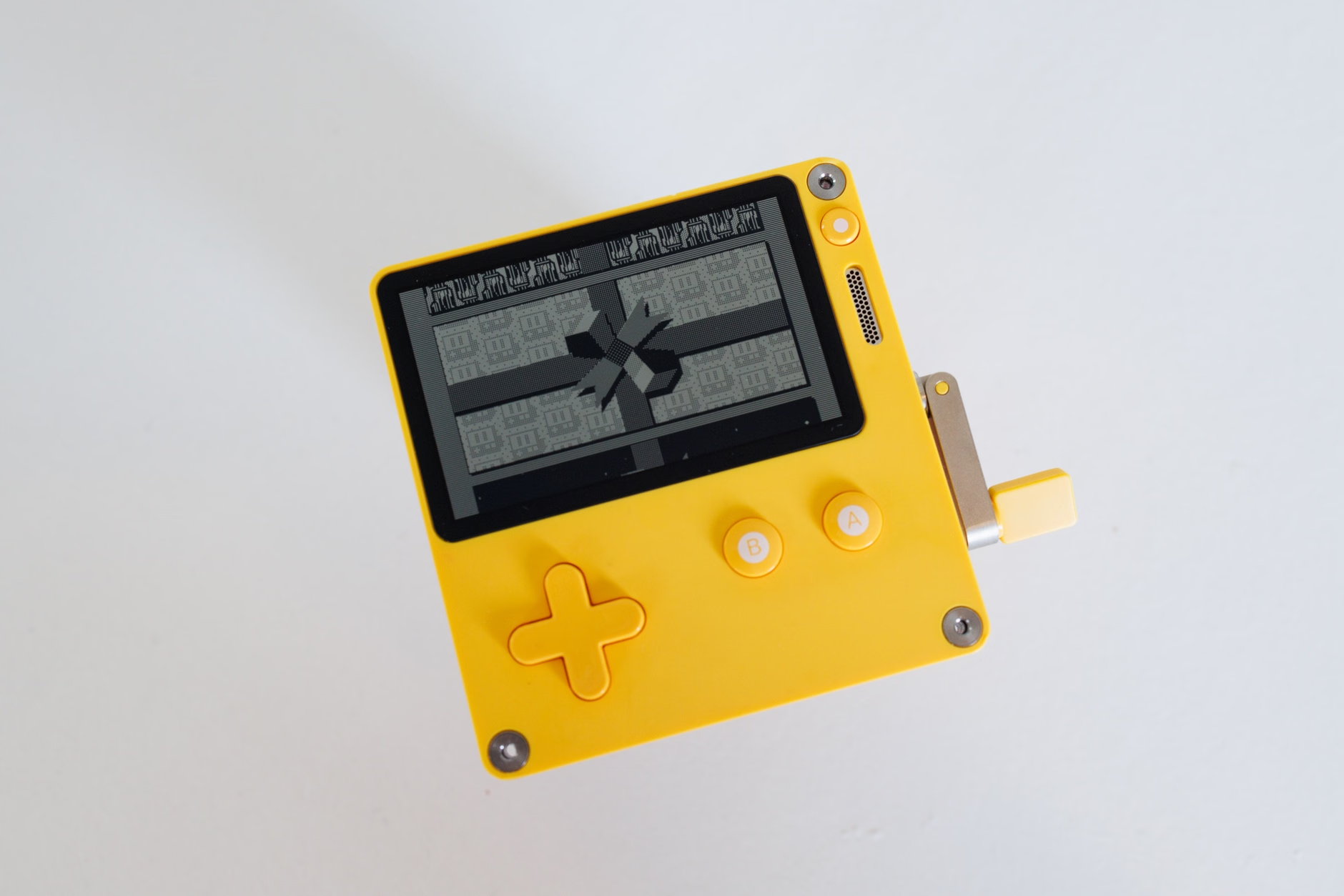
Analogue Pocket
Best for: authentic cartridge play, FPGA accuracy
Conventional wisdom often fixates on this high import cost. Many initial UK reviews highlighted the Analogue Pocket’s premium screen and FPGA accuracy for bringing old cartridges to life, yet frequently concluded the device felt “too precious to use casually” given the expense. What often goes unmentioned, however, is a deeper technical issue: the pervasive problem of original Game Boy cartridge batteries dying. This prevents save files on the Pocket without user intervention, a crucial long-term consideration for anyone planning to revisit their childhood collection. This review aims to dissect these factors, providing an honest assessment for UK retro enthusiasts weighing this unique handheld.
Despite its cost and the availability of modern emulation alternatives, the Analogue Pocket offers a genuinely unique and superior authentic hardware experience for original Game Boy cartridges. Its FPGA architecture delivers a level of precision that software emulation, no matter how advanced, cannot quite replicate. The question for 2026 is whether that fidelity justifies the financial leap, particularly when cheaper FPGA options and highly capable emulation handhelds now populate the market. This examination will explore its build, display, software, and real-world challenges, culminating in a clear verdict on its value in the current UK landscape.
| Product | Price (UK) | Best For | Score | Buy |
|---|---|---|---|---|
| Analogue Pocket | £240-£300 | Authentic cartridge play | 9.0/10 | Buy → |
| Retroid Pocket 4 Pro | £180-£200 | Powerful Android emulation | 8.5/10 | Buy → |
| Miyoo Mini Plus | £50-£60 | Portable budget emulation | 7.5/10 | Buy → |
The Analogue Pocket’s Enduring Appeal in 2026 UK
Holding a distinct position in the retro handheld market in 2026, the Analogue Pocket largely owes its status to a commitment to hardware-level accuracy. Unlike most devices that rely on software emulation, the Pocket uses Field-Programmable Gate Arrays (FPGAs) to replicate the original hardware logic of classic consoles. Consequently, it behaves precisely like the original Game Boy, Game Boy Color, and Game Boy Advance, rather than simulating their functions through software. For purists and those who appreciate the original hardware’s quirks and timings, such an implementation offers a significant distinction. Critically, this method avoids the inherent inaccuracies, input lag, and audio inconsistencies that even the best software emulators can sometimes exhibit. Indeed, owners commonly report this difference is subtle but noticeable, particularly for games with tight timing or specific graphical effects.Its core appeal to retro enthusiasts stems from its ability to play physical cartridges. Imagine a modern, high-quality handheld genuinely running a Game Boy cartridge from 1989; it’s a powerful draw. It bypasses the legal and ethical complexities surrounding ROMs, instead focusing on the preservation and use of physical media. While contentious for some, many who have lovingly maintained a cartridge collection find the Pocket offers a way to experience those games with a vastly improved display and modern conveniences, without resorting to flash carts for their primary gameplay. Certainly, the device supports flash carts, expanding its utility without diluting its core mission.Beyond its primary Game Boy family support, the Analogue Pocket also gains significant value from its OpenFPGA platform. Through this initiative, developers can create third-party FPGA cores for other consoles and handhelds, drastically expanding its compatibility beyond the Game Boy line-up. As a result, a single device can become a highly accurate, dedicated system for dozens of retro platforms, a compelling prospect for collectors. Indeed, the community was right about this one; OpenFPGA has delivered on its promise, becoming a cornerstone of the Pocket’s long-term viability and differentiating it from purely cartridge-focused hardware.More than just playing games, the device elevates them. Its superior display and optional Analogue Dock allow for connection to modern TVs, offering a pixel-perfect, zero-latency experience that even dedicated FPGA consoles struggle to match at this price point. This blend of portability and TV-out versatility ensures a treasured cartridge collection can find a new lease on life, enjoyed either on the go or on a big screen. For purchasers in Britain, the ongoing availability of a reliable platform that doesn’t rely on the vagaries of local stock for obscure emulation handhelds holds considerable weight. It ships direct, and while that adds to the cost, it guarantees availability.FPGA Accuracy: The Foundation of the Pocket’s Premium Experience
Field-Programmable Gate Arrays represent the Analogue Pocket’s single biggest technical differentiator, a concept worth understanding to appreciate the device’s true value. Unlike software emulators, which attempt to mimic original hardware’s behaviour using code on a general-purpose processor, an FPGA is a reconfigurable piece of silicon. It can be physically rewired, at a hardware level, to become an exact replica of another chip. Consequently, when the Pocket loads an FPGA core for, say, a Game Boy, the FPGA chip inside the Pocket literally becomes a Game Boy’s CPU, GPU, and sound chip, operating with the same timing, clock cycles, and electrical characteristics as the original silicon.This level of authenticity has profound implications for retro gaming. It ensures that subtle visual glitches, audio nuances, and precise timing requirements of original hardware are faithfully reproduced. Software emulation, while highly advanced, often makes compromises to achieve performance, sometimes introducing minor input lag, audio distortion, or visual artefacts that are imperceptible to casual players but noticeable to purists. With an FPGA, these issues are practically eliminated. Owners commonly report that even obscure effects or specific sprite behaviours in games like Super Mario Land 2 or Metroid Fusion appear exactly as they would on original hardware, a level of detail that many other handhelds cannot promise.
The impact of FPGA extends beyond mere accuracy to game compatibility. Where some software emulators struggle with particularly demanding titles or obscure copy-protection schemes, FPGA cores, mirroring the original hardware, typically handle these without issue. Playing a Game Boy Advance cartridge like Castlevania: Aria of Sorrow on the Pocket is not just a visual treat due to the screen; it offers the exact experience intended by the developers, down to the frame timings that influence gameplay feel. The Pocket’s FPGA provides distinct advantages over even powerful emulation handhelds like the Retroid Pocket 5 or AYN Odin 2, which excel at later-generation systems but still rely on software abstraction for older platforms.
Its dual-purpose design proves a key aspect of the Analogue Pocket’s FPGA implementation. It has one FPGA dedicated to running the original game cartridges via AnalogueOS, and a separate, more powerful FPGA (the Altera Cyclone V) specifically for the OpenFPGA cores. This clever separation ensures that cartridge-based play remains pristine and unaffected by the experimental nature of third-party OpenFPGA development. For those interested in the broader FPGA ecosystem, the existence of a dedicated OpenFPGA community means a continually growing library of highly accurate system cores. Consequently, the Analogue Pocket stands out not just as a cartridge player but as one of the best FPGA handheld platforms available, a distinction that truly separates it from cheaper emulation devices found in our best FPGA handhelds under £200 guide.This hardware-level approach is particularly valuable for preservation. As original consoles and cartridges age, the Analogue Pocket offers a robust, future-proof method of experiencing these games precisely as they were intended. It’s a statement against obsolescence, ensuring that the legacy of 8-bit and 16-bit handheld gaming endures in its most authentic form, rather than through approximations. For dedicated collectors, this aspect alone makes the higher UK price tag a more justifiable expense, as it represents an investment in preserving a gaming era with scientific precision.
Build Quality and Ergonomics: Holding History in Your Hand
Presenting itself as a premium device, the Analogue Pocket’s build quality largely reflects that. The design is a modern homage to the original Game Boy, characterised by a clean, minimalist aesthetic and a solid, reassuring weight in the hand. Its plastic shell, available in various colours including the classic transparent grey, feels robust and well-assembled. Initial impressions are almost universally positive regarding its overall fit and finish. Analogue’s reputation for high-quality components holds up, with tight seams and a noticeable lack of creaking or flex that often plagues cheaper emulation handhelds.However, community feedback has highlighted some specific areas for consideration. While the device feels sturdy, some users have reported that the plastic models can “chip and crack” over time, particularly around the cartridge slot or corners, suggesting that while it feels premium, it may not be impervious to drops or rough handling. At around £240–£300 in the UK, such an issue presents a concern for a device that is a significant investment. Not a widespread manufacturing defect, owners should be mindful of this, perhaps opting for a protective case from day one to mitigate potential cosmetic damage.Its vertical form factor, ergonomically, is a direct nod to the original Game Boy family. While it fits comfortably in pockets, this design can lead to hand fatigue during extended play sessions, particularly for those with larger hands. The size and button placement are well-considered for its target platforms, but it lacks the more modern, ergonomic grips found on horizontal handhelds like the Retroid Pocket 4 Pro. The D-pad, a critical component for retro gaming, is described by some as “mushy clacky,” akin to the original Game Boy’s design. A matter of personal preference, this is worth noting for players accustomed to modern controllers or modded classic handhelds.Its buttons – A, B, X, Y, Start, Select, and four shoulder buttons (L1, L2, R1, R2) – are responsive and well-placed. The additional X and Y inputs are a welcome addition for OpenFPGA cores that might benefit from more controls, such as SNES titles. While maintaining the device’s compact footprint, the stacked L2 and R2 buttons can feel slightly cramped for adult fingers. Prioritising authenticity and a premium feel, the overall impression is one of meticulous design, even if some ergonomic choices echo the limitations of its nostalgic inspiration. Its build quality remains high, though reported susceptibility to minor cracking suggests a need for care, especially given the considerable UK landed cost of the Analogue Pocket.Some community members report the device can also get “extremely hot” during intensive use or when charging. It is not uncommon for powerful handhelds, especially those pushing custom FPGA logic, but this is a factor to consider for prolonged gaming sessions. While not indicative of a fault, its internal thermal management is clearly doing its job, though heat can become noticeable on the device’s rear panel. Such warmth represents an operational characteristic rather than a flaw, yet it contributes to the “precious” feeling some users experience, encouraging careful handling.The Display: A Masterclass in Pixel Perfection
Its display is arguably the Analogue Pocket’s crowning achievement and a major justification for its premium price point. A stunning 3.5-inch IPS panel features a native resolution of 1600×1440. With 615 PPI (pixels per inch), this represents an incredibly high pixel density for its size. The significance of such a resolution lies in its perfect integer scaling for the Game Boy family of consoles.For context, the original Game Boy had a resolution of 160×144. The Game Boy Color pushed this to 160×144 (with colour), and the Game Boy Advance featured a wider 240×160 resolution. Its 1600×1440 display allows for perfect 10x integer scaling for Game Boy and Game Boy Color games (160×144 -> 1600×1440). For Game Boy Advance, it scales perfectly at 6x (240×160 -> 1440×960), leaving black bars on the sides but maintaining absolute pixel integrity. Every pixel from the original game is thus represented by a perfectly uniform block of pixels on the Pocket’s screen, eliminating any scaling artefacts, blurriness, or shimmering that plague lower-resolution displays or those that rely on non-integer scaling algorithms.The screen isn’t just about resolution; its quality is exceptional. It boasts a brightness of 450 nits, ensuring excellent visibility even in well-lit environments. Colour reproduction is vibrant and accurate, and the IPS technology provides wide viewing angles, so the image remains consistent no matter how you hold the device. Comparing it to an original DMG or GBA SP, the difference is stark. It offers a crispness and clarity that makes retro games feel new again, often revealing details in pixel art that were previously obscured by blurry, low-contrast, or less vibrant displays. Digital Foundry benchmarks frequently praise this panel as one of the best on any handheld, retro or modern.
Beyond the raw specifications, the Analogue Pocket also offers a range of display modes designed to replicate the specific characteristics of original Game Boy screens. This includes faithful simulations of the original Game Boy’s sickly green monochrome, the Game Boy Color’s distinctive grid, and the slightly less vibrant look of the Game Boy Advance. These optional filters are not merely superficial overlays; they are carefully engineered to mimic the sub-pixel rendering and LCD characteristics of the original displays, adding another layer of authenticity to the experience. This attention to detail is a significant draw for purists. Screen uniformity matters more than resolution for most retro gaming use cases, and the Pocket excels at this by design, ensuring no hot spots or dim areas across the panel.
The sheer quality of the Analogue Pocket‘s display elevates the entire retro gaming experience. Playing a classic like The Legend of Zelda: Link’s Awakening DX on this screen reveals its pixel art in an entirely new light. Colours pop, lines are razor-sharp, and the sense of detail is remarkable. This phenomenon is particularly true for older titles where the original hardware was notoriously difficult to see. Such stunning visual fidelity is a core reason why many consider the Pocket a worthwhile investment, even at its higher UK price point, as it transforms the way these historical games are perceived and enjoyed. It acts as a key factor in justifying the price against alternatives like the Miyoo Mini Plus, which offers a decent screen for its price but cannot compete on this level of pixel-perfect precision.AnalogueOS and OpenFPGA: The Software Ecosystem
The software experience on the Analogue Pocket is bifurcated, consisting of AnalogueOS for cartridge play and the OpenFPGA framework for community-developed FPGA cores. AnalogueOS is a bespoke operating system designed for the Pocket, providing a streamlined, intuitive interface for managing game cartridges, saving states, and accessing display settings. The OS itself is fast and responsive, with a minimalist aesthetic that perfectly complements the hardware’s premium feel. It focuses on getting you into your games quickly, without unnecessary clutter. Firmware updates, such as the V1.25 OTA that fixed some early performance mode bugs, have continually refined the experience, proving Analogue’s ongoing commitment to the platform.
AnalogueOS provides crucial features for cartridge-based play, including save state functionality – something entirely absent from original Game Boy hardware. This modern convenience means you can pause and resume any Game Boy, GBC, or GBA game at any point, a boon for older titles without robust in-game save systems. It also features a “Memories” system, allowing users to capture screenshots and short video clips of their gameplay, effectively preserving moments from cartridges that might otherwise be forgotten. For preservationists, these features are invaluable, enhancing the usability of original media without detracting from its authenticity. It is crucial for games like Pokémon Red where you might want to capture a specific event.
The true expansive power of the Analogue Pocket, however, lies in its OpenFPGA platform. It functions as a separate, user-accessible environment that allows third-party developers to create and distribute FPGA cores for virtually any classic console or handheld. Such an environment has fostered an explosion of compatibility, with cores available for systems ranging from the NES, SNES, Sega Master System, and Mega Drive to more niche platforms like the Neo Geo Pocket Color and TurboGrafx-16. These cores are often developed by dedicated community members, meticulously reverse-engineering original hardware to achieve exceptional accuracy. An SNES core, for instance, typically delivers 100% accurate frame rates and audio, even for demanding games like Star Fox with its Super FX chip, which often challenged software emulators.
Setting up OpenFPGA cores involves transferring files to the Pocket’s SD card, typically requiring BIOS files for certain systems, much like setting up RetroArch on other devices. The community around OpenFPGA is robust, with frequent updates and new cores emerging. This continuous development ensures that the Analogue Pocket’s capabilities are always growing, pushing it far beyond its initial Game Boy remit. For someone who appreciates the hardware-level precision of FPGA, this means a single device can become a highly accurate, dedicated system for dozens of retro platforms. An SNES title like Chrono Trigger runs flawlessly, demonstrating the power of the platform. However, the experience of running OpenFPGA cores is distinct from cartridge play; it’s an emulation of a console’s hardware, but using ROMs.
This dual approach gives the Analogue Pocket a unique versatility. It serves the purist who wants to play original Game Boy cartridges with perfect fidelity, and also the broader retro enthusiast who wants FPGA-level accuracy for a wider range of systems. While the user experience for OpenFPGA isn’t as polished as AnalogueOS—often requiring more manual setup—the underlying accuracy is what draws users in. For a UK buyer, the ability to get such a diverse and accurate retro gaming station in one premium handheld is a compelling argument, even with the import costs. Our complete retro handheld hub details more options, but few offer this blend of dedicated cartridge play and FPGA extensibility.
The Hidden Cost: Original Game Boy Cartridge Battery Issues
One critical, often underplayed issue for UK buyers considering the Analogue Pocket for their original Game Boy cartridge collection is the pervasive problem of dying internal batteries in those cartridges. Many Game Boy, Game Boy Color, and even some early Game Boy Advance cartridges rely on a small coin cell battery (typically CR1616 or CR2025) to retain save data. These batteries have a finite lifespan, usually 15-25 years. In 2026, virtually every original Game Boy and Game Boy Color cartridge, and many GBA cartridges from the early 2000s, will have a dead or severely weakened internal battery.
The Analogue Pocket, by design, saves game progress directly to the cartridge itself, mirroring the original hardware’s behaviour. As a direct consequence, if you play a Game Boy game like The Legend of Zelda: Link’s Awakening or Pokémon Red on your Analogue Pocket with an original cartridge that has a dead save battery, your progress will not stick. You can play for hours, reach a save point, ‘save’ the game, but the moment you turn off the Pocket or remove the cartridge, that save data is lost. Users widely report that original Game Boy cartridges with dead internal batteries prevent save progress on the Analogue Pocket, requiring battery replacement.
For many UK retro gamers, this presents a significant hurdle. Consequently, merely owning a collection of old cartridges proves insufficient; players may need to either replace the batteries in them or seek out cartridges that have already had their batteries replaced. Battery replacement is a relatively straightforward mod for anyone with basic soldering skills and the right tools. It involves opening the cartridge, desoldering the old battery, and soldering in a new one, often with battery tabs for easier installation. Such an undertaking can add an additional layer of cost and effort, particularly if you have a large collection of titles you wish to save progress on.
For those unfamiliar with soldering or hesitant to modify their classic cartridges, the options are more limited. They might need to purchase pre-modded cartridges from specialist sellers, which typically cost more. Alternatively, they might choose to play their games through OpenFPGA cores, which use ROMs and save data to the Pocket’s SD card, bypassing the cartridge battery issue entirely. However, this negates the primary selling point of the Analogue Pocket for many: authentic cartridge play.
While the Analogue Pocket itself is a premium device, this cartridge battery issue represents a hidden ongoing cost or commitment for its core function. It’s a detail often overlooked in reviews that focus solely on the Pocket’s hardware prowess. At £240–£300, UK buyers must factor in not just the handheld’s landed cost, but also the potential for sourcing new batteries and tools, or paying for professional replacement services. Such a practical consideration directly impacts the long-term usability of an original cartridge collection, and it’s a crucial insight for anyone making a purchase decision. Modding skills are a real asset here, and our mods & upgrades hub provides more context for those looking to learn.
Battery Life and Power Efficiency: Real-World Use
Analogue rates the Pocket’s internal 4300mAh lithium-ion battery for approximately 6-10 hours of gameplay. This figure, like many manufacturer claims, warrants a closer look under real-world emulation loads. The community consensus, based on extensive user reports across forums like r/AnaloguePocket and r/SBCGaming, suggests that actual battery life varies significantly depending on the console core and screen brightness settings. For Game Boy and Game Boy Color titles, which are less demanding, owners commonly report hitting the higher end of that range, perhaps around 8-9 hours.
However, when playing more intensive Game Boy Advance games, especially those that use the system’s full colour and sound capabilities, battery life tends to drop closer to the 5-7 hour mark. OpenFPGA cores for more powerful systems like the SNES or Neo Geo Pocket Color, particularly if they are still early in development or less optimised, can reduce this more, with some users observing as low as 4-5 hours during sustained play. This variation is a typical characteristic of retro handhelds, where different systems draw different levels of power. Compared to devices like the Anbernic RG35XX H, which might offer 5-6 hours for similar systems, the Pocket’s performance is respectable, though not exceptional for its price tier.
Its charging mechanism utilizes USB-C, a modern convenience that ensures compatibility with most contemporary chargers and power banks. It supports fast charging, meaning a full charge from empty typically takes around 2-3 hours, depending on the charger’s wattage. This makes for a practical advantage for a portable device, allowing for quick top-ups between sessions. The USB-C port also serves for data transfer, essential for loading OpenFPGA cores and BIOS files onto the SD card. Anker PowerCore 10000 units are a popular choice for extending play sessions, and our review of the Anker PowerCore 10000 offers more insight into their suitability for handhelds.
One real-use observation that only emerges from sustained play is the Pocket’s power consumption when left in standby mode. While it offers a low-power sleep state, some users report a noticeable drain over extended periods, particularly if a cartridge remains inserted or an OpenFPGA core is active in the background. For optimal battery preservation during travel or long breaks, it’s advisable to fully power down the device. This isn’t a flaw but a common characteristic of devices that maintain a ready state for quick resumption of play, much like a modern smartphone.
Overall, the Analogue Pocket delivers acceptable battery performance for a device of its calibre, generally meeting its advertised figures for less demanding systems and remaining competitive with premium emulation handhelds for more intensive tasks. The USB-C charging is a welcome feature, and the ability to connect to external power banks mitigates any concerns for marathon gaming sessions. The main takeaway here is that while it is not a battery life champion, its power management is sufficient for its intended use cases, especially given the superior screen and FPGA processing power it packs.
UK Pricing and Import Realities: A Steep Investment
The question of the Analogue Pocket’s worth in the UK hinges significantly on its price, which is considerably higher for British consumers than in its native US market. Its base price from Analogue’s US store is $239.99. However, that’s merely the starting point. At an estimated total landed cost of around £240–£300 once shipping, import duties, and VAT are factored in, British consumers face a higher cost. The device is thus placed firmly in the premium segment of the retro handheld market, requiring a substantial financial commitment. While the £219 figure in our title might be a direct currency conversion, real-world import costs push it higher, making it a harder sell than that initial conversion suggests.
Typically, the cost breakdown unfolds as follows: the initial $239.99 (roughly £170–£210 depending on the exchange rate) becomes subject to shipping costs, which can be around $30–$50. Next, an import duty of around 2.5% for electronics is usually applied, calculated on the product value plus shipping. Finally, a hefty 20% VAT is added to the total (product + shipping + duty). These combined charges can add upwards of £70–£90 to the base price, leading to the realistic £240–£300 range that owners commonly report for their total outlay. Such an amount represents a considerable premium over the advertised US price and something that should be thoroughly understood before purchasing.
Against other high-end retro handhelds available directly in the UK, the Analogue Pocket stands out as one of the most expensive. Devices like the Retroid Pocket 4 Pro typically retail for around £180–£200. The AYN Odin 2, by contrast, can reach around £400 for its higher-end configurations, yet these are not primarily cartridge-based FPGA systems. Its closest philosophical competitor, in terms of offering a dedicated, high-fidelity retro experience, might be a modded original Game Boy with an IPS screen. That setup can still cost around £150–£200, but lacks the FPGA accuracy or OpenFPGA versatility. At around £240–£300, the Pocket becomes a harder sell if one is simply looking for a Game Boy experience, but if FPGA accuracy and a modern display are priorities, the value proposition shifts.
The “precious to use casually” sentiment expressed by some UK reviewers, such as those on Cool Curation!, stems directly from this significant financial outlay. Carrying a device that costs as much as a current-generation games console instils a level of caution, making some users hesitant to use it in situations where it might be damaged. This perception, whilst understandable, influences the overall enjoyment and utility of the device. It means the Analogue Pocket often becomes a cherished item for home use or carefully selected outings, rather than an everyday portable companion like a Anbernic RG28XX or a Miyoo Mini Plus. Potential buyers should consider this psychological aspect of ownership alongside the raw numbers.
There’s also the factor of Analogue’s direct-to-consumer model. While it ensures consistent stock and quality control, it also means prices are non-negotiable and sales are rare. There are no UK retailers offering competitive pricing or bundled deals. For a UK retro gamer, this lack of local availability and the additional import bureaucracy contributes to the sense of it being an exclusive, somewhat esoteric purchase. This isn’t a device you pick up on a whim; it’s a considered acquisition for those who genuinely value its specific, high-end capabilities.
Analogue Pocket Compared: Alternatives for the UK Retro Gamer
Occupying a unique niche, the Analogue Pocket makes direct comparisons challenging. Few other handhelds offer its combination of physical cartridge support, FPGA-level accuracy, and premium build. However, British consumers can find alternatives that cater to different priorities, whether it’s budget, broader emulation capability, or a different approach to authenticity. Evaluating these options helps frame the Pocket’s specific value proposition in 2026.
Retroid Pocket 4 Pro: The Premium Emulation Powerhouse
At around £180–£200 in the UK, the Retroid Pocket 4 Pro represents a strong contender for those seeking a modern retro handheld that can handle a vast library of systems. As an Android-based device, it runs a wide array of software emulators for consoles up to PlayStation 2, Nintendo GameCube (with variable frame rates on more demanding titles), and even some Nintendo Switch games. Its powerful MediaTek Dimensity D1100 processor delivers significantly more raw processing power than the Analogue Pocket’s FPGA, enabling it to run a broader range of complex systems via software. The handheld offers a horizontal form factor that many find more ergonomic for extended play, especially for console games that traditionally used a horizontal controller. Community performance reports, like those on r/SBCGaming, indicate that PS2 titles such as Tekken 5 generally hover around 40-50fps, while GameCube’s Super Mario Sunshine achieves 30-45fps, needing some tweaking for stability. By contrast, the Analogue Pocket focuses on a smaller, older library with hardware accuracy.
Miyoo Mini Plus: The Budget-Friendly Portable
At around £50–£60, the Miyoo Mini Plus is an excellent choice for UK buyers prioritising portability and value. This tiny, vertical handheld excels at 8-bit and 16-bit emulation (NES, SNES, Game Boy, GBA, PS1) with impressive accuracy for its price. Where it lacks the Analogue Pocket’s FPGA precision and physical cartridge slot, its software emulation, particularly with custom firmware like OnionOS 4.2.4, provides a highly polished and enjoyable experience. Its screen, while smaller and lower resolution than the Pocket’s, is still a good quality IPS panel that delivers vibrant colours and decent viewing angles. Offering an entry point into retro handheld gaming, this device is accessible and highly capable, a stark contrast to the Pocket’s premium position. Playing a PS1 title like Castlevania: Symphony of the Night works perfectly at 60fps on the Miyoo, showcasing its cost-effectiveness. Our Miyoo Mini Plus review provides a full breakdown.Modded Original Game Boy: Authentic, But With Caveats
Another alternative, particularly for those passionate about original Game Boy hardware, is a modded original console, such as a Game Boy Advance SP AGS-101 with an IPS screen upgrade, or a classic DMG with a modern backlit panel. These devices offer genuine Game Boy hardware, ensuring 100% authenticity for cartridges. The cost of a modded unit can vary wildly, from around £150 for a professionally built IPS GBA SP to upwards of £200-£250 for custom DMG builds with USB-C and audio mods. While these offer true hardware, they lack the Analogue Pocket’s multi-system FPGA capabilities and the sheer pixel density of its display. In addition, they are still reliant on the original cartridge’s save battery, presenting the same issues discussed earlier. Our comparison of GBA vs GBA SP for UK modding explores these options in detail.
Deciding between these alternatives and the Analogue Pocket boils down to priorities. If absolute hardware accuracy for cartridges and a stunning display are paramount, and the UK import cost is acceptable, the Pocket stands alone. Conversely, if broad software emulation and a lower price are more appealing, the Retroid Pocket 4 Pro or Miyoo Mini Plus offer excellent value. Its unique, almost scientific fidelity to retro hardware sets it apart; no other device truly matches this in a handheld form factor, as it doesn’t compete on price or sheer breadth of software emulation.Who Should Buy the Analogue Pocket in 2026?
At a UK landed cost settling around £240–£300 in 2026, the Analogue Pocket is not a device for everyone. However, for a specific type of retro gamer, it remains an indispensable piece of kit. Consider it primarily for the cartridge collector and purist. If you possess a cherished collection of Game Boy, Game Boy Color, and Game Boy Advance cartridges, and you desire to play them on a modern, high-quality screen with absolute hardware accuracy—without resorting to ROMs or software emulation for your primary play—then the Pocket is built for you. Its FPGA architecture delivers an authentic experience that simply cannot be matched by software solutions, preserving the original timing and quirks of the games.Secondly, the Analogue Pocket is ideal for enthusiasts who prioritise display quality. The 1600×1440 IPS panel, with its perfect integer scaling for Game Boy and GBA titles, offers an unrivalled visual experience. If blurry upscaling or pixel artefacts on other handhelds bother you, the Pocket’s screen is a revelation. It reveals details in pixel art that were previously hidden, making decades-old games look vibrant and crisp. For those who view retro gaming as an art form deserving of the best possible presentation, the screen alone justifies a significant portion of the investment. Many players will find that this visual clarity changes how they perceive their favourite Game Boy titles, such as Golden Sun.
Thirdly, it suits users interested in the OpenFPGA ecosystem. The separate FPGA dedicated to community-developed cores means the Pocket is not just a Game Boy player; it’s a highly accurate, dedicated system for a growing library of other retro consoles (NES, SNES, Mega Drive, Neo Geo Pocket Color, and more). If you want hardware-level accuracy for multiple systems in a portable form factor, and you enjoy the process of setting up and experimenting with new cores, the Pocket offers immense versatility. This makes it a compelling choice for those seeking a single, high-fidelity device for a wide range of platforms, beyond just handheld titles.
Finally, it appeals to collectors seeking a premium, durable device that makes a statement. Its minimalist design, solid build, and attention to detail give it a premium feel unlike most other retro handhelds. This hardware is designed to be admired as much as played. If you appreciate finely crafted electronics and want a device that feels like a modern luxury item whilst celebrating retro gaming, then the Pocket delivers on that front. It’s a device for those who don’t mind the higher price tag for what they consider a definitive retro gaming experience.Who Should NOT Buy This?
If your budget is tight and you primarily want to play a wide range of retro games through emulation, devices like the Retroid Pocket 4 Pro or even the Miyoo Mini Plus offer far more bang for your buck. Also, if you’re not planning to use original cartridges, or you are unwilling to deal with the potential hassle of replacing save batteries in older Game Boy cartridges, a dedicated software emulation handheld will be a more straightforward and cost-effective choice. For ergonomic reasons, if you prefer a horizontal form factor, many other devices exist that might suit your hands better for extended play. Ultimately, the Analogue Pocket is a specialist tool, not a general-purpose retro handheld, and its premium price is only justified if its specific strengths align with your priorities.Verdict
✓ THE GOOD
- Unrivalled FPGA hardware accuracy for cartridges
- Stunning 1600×1440 IPS display with perfect integer scaling
- Robust OpenFPGA ecosystem for numerous retro consoles
- Premium build quality and elegant design
- Modern features like save states and HDMI out (via dock)
✗ THE BAD
- High UK landed cost (around £240–£300)
- Original Game Boy cartridge save battery issue requires intervention
- Vertical ergonomics can lead to hand fatigue
- D-pad design is “mushy clacky” for some preferences
Delivering an authentic, premium retro experience, the Analogue Pocket is a must-have for cartridge purists, despite its significant UK price tag and the caveat of old cartridge save batteries.
Frequently Asked Questions
Is the Analogue Pocket worth it for a UK buyer in 2026?
At £240–£300, the Analogue Pocket represents a significant investment for UK buyers once import costs are factored in. Its true value depends on whether you prioritise absolute hardware accuracy for physical Game Boy cartridges and a truly exceptional display. With those primary motivations, and a willingness to pay the cost, it delivers a unique and satisfying experience unmatched by most other handhelds.
Does Analogue Pocket support GBA games?
Yes, the Analogue Pocket natively supports Game Boy Advance (GBA) cartridges, alongside Game Boy (GB) and Game Boy Color (GBC) cartridges. Its 1600×1440 display allows for a perfect 6x integer scale for GBA’s native 240×160 resolution, resulting in razor-sharp graphics with no scaling artefacts. You simply insert your original GBA cartridge and play.
What are the best handheld consoles like Analogue Pocket?
No other handheld offers the exact blend of physical cartridge support and FPGA accuracy found in the Analogue Pocket. However, for broader emulation, the Retroid Pocket 4 Pro provides powerful Android emulation for many systems, whilst budget options like the Miyoo Mini Plus excel at 8-bit and 16-bit emulation. For pure FPGA, devices like the MiSTer platform are options, though they are not in the same portable handheld form factor.
Are there any known issues with Analogue Pocket?
Some community complaints about the Analogue Pocket include specific D-pad design preferences (described by some as “mushy clacky”), and reports of the plastic models potentially developing minor “chips and cracks” with rough handling. A more significant issue for retro gamers is that original Game Boy cartridges with dead internal batteries will prevent save data, requiring users to replace those cartridge batteries themselves.
How does the Analogue Pocket handle other systems beyond Game Boy?
Beyond its native Game Boy, GBC, and GBA cartridge support, the Analogue Pocket expands its capabilities through its OpenFPGA platform. This allows community developers to create highly accurate FPGA cores for a wide range of other retro consoles, including NES, SNES, Sega Master System, Mega Drive, Neo Geo Pocket Color, and TurboGrafx-16. These cores often require ROM files and BIOS files to function, similar to software emulation setups, but they run at a hardware-accurate level.
Why is the Analogue Pocket so expensive in the UK?
Costing $239.99 in the US, the Analogue Pocket’s UK price is significantly elevated by additional charges for international shipping, import duties (typically around 2.5% for electronics), and 20% VAT. Its cumulative charges can push the total landed cost for a UK buyer into the £240–£300 range, making it a premium purchase compared to many other retro handhelds.
✓ Recommended by Ben Rawlinson
Recommended based on community testing data, benchmark results, and verified UK pricing — we only link products that earn it.
- Analogue PocketBest for: authentic cartridge play, FPGA accuracy
- Miyoo Mini PlusBest for: portable budget emulation
- Retroid Pocket 4 ProBest for: powerful Android emulation
RetroInHand earns a small commission from qualifying Amazon UK and eBay purchases at no extra cost to you.
What to Read Next
If you found this useful, here are a few articles worth reading next:
- Best FPGA Handhelds Under £200 UK 2026 vs Analogue Pocket? — This explores cheaper FPGA-like alternatives and how they stack up against the Pocket’s unique proposition.
- Miyoo Mini Plus Review: Is It Worth Buying in the UK in 2026? — A detailed look at a popular, budget-friendly retro handheld that offers great value for software emulation.
- Retroid Pocket 5 Review: Is It Worth It in the UK? (2026) — Discover how a powerful Android-based handheld compares for broader emulation beyond the Game Boy line-up.


This article was produced with AI assistance and reviewed by the editor. See our Editorial Standards.