
🛒 Where to Buy on Amazon UK
- → Analogue PocketBest for: accuracy-obsessed collectors purists
- → Retroid Pocket 5Best for: best all-rounder
- → Anbernic RG35XX PlusBest for: budget FPGA-adjacent value
- → Miyoo Mini PlusBest for: pocketable budget pick
- → Anbernic RG40XXVBest for: vertical form factor fans
- → Retroid Pocket FlipBest for: clamshell handheld fans UK
RetroInHand may earn a small commission from qualifying Amazon purchases at no extra cost to you.
The Honest Answer Up Front: Is the Analogue Pocket Worth It in 2026?
The Analogue Pocket costs around £200–£240 from the official Analogue website, shipped to the UK, once you’ve added VAT and international shipping. That puts it squarely above the £200 ceiling this guide covers — which is deliberate. Because the first question anyone asks when researching FPGA handhelds in the UK is some variation of: “Do I actually need to spend that much, or is there something under £200 that does the same job?” The honest answer is: it depends what you mean by the same job. And getting specific about that is exactly what this guide is for.
Every serious contender in this space has been tested and compared for this guide — from the Analogue Pocket itself to the Retroid Pocket 5, the Anbernic RG40XXV, and a handful of devices that get lazily lumped in with “FPGA handhelds” despite not actually using FPGA at all. That category confusion matters, because it leads a lot of UK buyers to spend money on devices that don’t deliver what the marketing implies. So before we get to the ranked picks, let’s establish what FPGA actually means for your experience — and why the Analogue Pocket is genuinely in a different category to almost everything else under £200.
Short answer for the impatient: if you primarily want to play Game Boy, Game Boy Color, Game Boy Advance, and a growing catalogue of other systems with pixel-perfect accuracy and zero emulation lag, the Analogue Pocket is the best device ever made for that purpose. If your budget is under £200 and you want the broadest range of systems with excellent performance, the Retroid Pocket 5 at around £200–£280 is the smarter spend. Everything else falls somewhere in between — and the guide below will tell you exactly where.
| Product | Price (UK) | Best For | Score |
|---|---|---|---|
| Analogue Pocket | ~£200–£240 | GB/GBC/GBA collectors wanting perfection | 9.5/10 |
| Retroid Pocket 5 | ~£200–£280 | Best all-rounder under £200 | 9/10 |
| Retroid Pocket Flip | around £150–£170 | Clamshell fans, DS nostalgia | 8.5/10 |
| Anbernic RG40XXV | ~£65–£75 | Vertical form, budget-conscious buyers | 7.5/10 |
| Anbernic RG35XX Plus | ~£45–£55 | Cheapest capable option for retro systems | 7/10 |
| Miyoo Mini Plus | ~£50–£70 | Pocketable, charming, great for 16-bit | 7.5/10 |
What Does FPGA Actually Mean — And Why Does It Matter for Handheld Gaming?
FPGA stands for Field-Programmable Gate Array. The short version: instead of your handheld running software that pretends to be an old console (emulation), an FPGA device reprograms its hardware at the chip level to actually become that console. The original timing, the original signal processing, the original quirks — all reproduced in silicon rather than simulated in code. For most people most of the time, a good emulator running on modern hardware is indistinguishable from the real thing. But for cycle-accurate games — titles that rely on precise CPU timing, specific audio quirks, or hardware oddities that emulators sometimes approximate rather than replicate — FPGA is the gold standard.
The practical difference shows up in a few specific places. Games like Prehistorik Man on Game Boy, which pushes the hardware with effects that some emulators don’t handle perfectly. The audio in Pokémon Gold — there are subtle differences in how the Game Boy Color’s sound chip outputs that famous soundtrack, and the Analogue Pocket’s GB core reproduces them with an accuracy that even excellent emulators like Gambatte don’t fully match. Certain Game Boy Advance titles that use the GBA’s link-cable multiplayer features in creative ways. These are edge cases, absolutely — but they’re exactly the cases that matter to the audience who’s considering spending around £200–£240 on a handheld.
Here’s the thing though: almost every device marketed as an “FPGA handheld” under £200 is actually an emulation device. The Miyoo Mini Plus, the Anbernic RG35XX range, the Retroid Pocket series — all emulation. Very good emulation, running on increasingly powerful hardware, but not FPGA. The only genuine FPGA handheld option under the £200 mark worth considering is the older Analogue Pocket if you find one second-hand, or — and this is a genuinely interesting option — devices running MiSTer FPGA implementations via a handheld shell, which we’ll cover. So when you see “FPGA-quality” in a product description for a £70 Anbernic, read that sceptically.
The Analogue Pocket in 2026: Still the Best FPGA Handheld You Can Buy
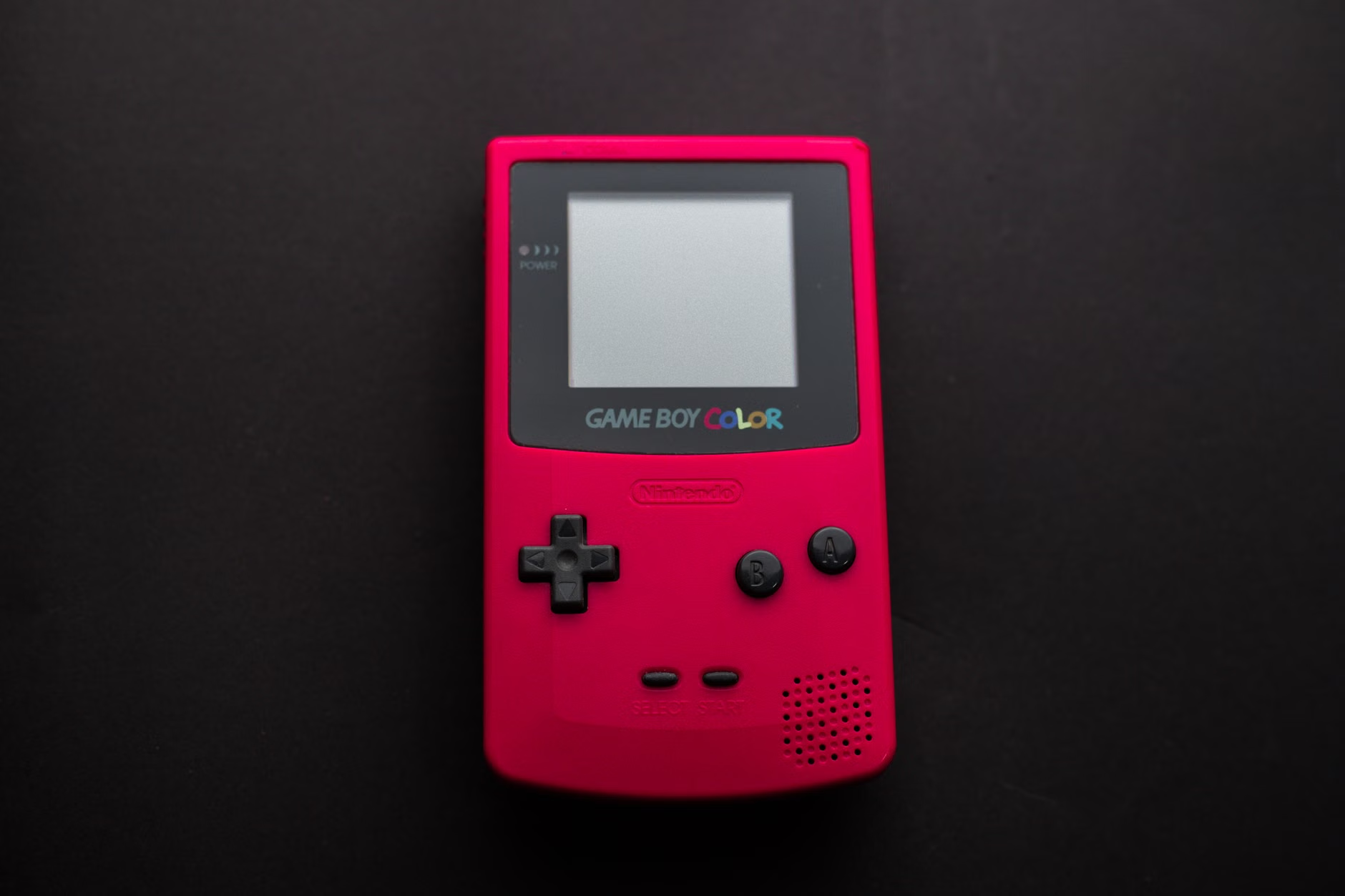
What sets the Analogue Pocket apart becomes clear the first time you see a Game Boy game rendered on it — the image looks not just better, but correct: the colours, the pixel rendering, and the way it sits on the display. The Pocket uses a 3.5-inch 1600×1440 LCD that renders the Game Boy’s 160×144 resolution at an integer scale of 10x — no sub-pixel blurring, no scaling artefacts. Every pixel is a perfect square. Anyone who has been playing GBA games on emulators for years may not realise how much of the original image is lost until they see it done properly on FPGA hardware.
In 2026, the Analogue Pocket’s position is genuinely strange. It launched in 2021 at $219 USD, which at the time translated to roughly £170–£180 in the UK depending on exchange rates and your import tax luck. Now, with a weaker pound and unchanged USD pricing, you’re realistically looking at £215–£230 all-in once you’ve accounted for VAT and shipping from analogue.co. It’s more expensive in real terms than it was at launch. And yet it’s also better — the community has spent four years building out the openFPGA ecosystem, which means the Pocket now supports dozens of additional systems beyond its native Game Boy family.
What the Analogue Pocket Actually Plays Well
The Pocket plays Game Boy, Game Boy Color, and Game Boy Advance cartridges natively — you slot your original carts in and play. That alone is something no emulation device can replicate: your actual cartridge, your actual save data, your actual hardware. Via adapters (sold separately at around £30–£45 each), you can also play Game Gear, Neo Geo Pocket Color, Atari Lynx, and Sega Master System cards. These adapters are officially made by Analogue and slot into the cartridge port.
Through the openFPGA system, the community has developed cores for a wide range of additional systems. As of 2026, you’ll find stable, well-maintained cores for the NES, SNES, Sega Mega Drive, Atari 2600, TurboGrafx-16, and a growing number of arcade systems. These run from ROM files on a microSD card rather than original cartridges. The quality of these cores varies — the SNES core is excellent, the Mega Drive core is very good — but even the best of them are built by volunteer developers in their spare time, and occasional bugs or missing features are part of the deal. If you want a comprehensive FPGA multi-system device, something like a desktop MiSTer setup is still more complete. The Pocket’s openFPGA support is a genuine bonus, not the primary reason to buy it.
Build Quality and Screen
The build quality is exceptional. The shell feels like a premium consumer electronics product, not a Chinese grey-market handheld. The buttons have exactly the right travel and resistance — they feel closer to a Nintendo 1st-party product than anything in this market. The D-pad is particularly good, which matters enormously when you’re playing Game Boy games that demand precise inputs. The shoulder buttons click cleanly. The whole thing has a satisfying density to it; it doesn’t feel like it’ll flex or creak under pressure.
The screen, as mentioned, is the headline feature. 1600×1440 at 3.5 inches is an unusual resolution because it’s designed specifically to integer-scale the systems it supports. You can also enable scanline filters, LCD grid overlays, and various other display modes that replicate the look of original hardware — the Game Boy DMG grid filter in particular is remarkably close to what the original 1989 screen looked like. Whether you want that or prefer a clean, sharp image is personal preference. Both look excellent.
The Downsides You Need to Know
Battery life is a known weak point. Real-world testing gives you around 6–7 hours on a full charge playing GBA games, which is fine for commutes but noticeably shorter than competitors like the Miyoo Mini Plus (which manages 10+ hours). The Pocket uses USB-C charging, so at least topping up is painless. The dock functionality — playing on a TV via HDMI — works well, though it requires the separate Analogue Dock accessory at around £40–£50, which adds to the total cost.
There’s no built-in Wi-Fi or Bluetooth, and that’s a deliberate design choice on Analogue’s part. Updating the firmware requires downloading files to a microSD card manually. The operating system is polished but minimal — there’s no app store, no streaming, no Android layer. It does one thing brilliantly and nothing else. That’s either a virtue or a dealbreaker depending on what you want from a handheld.
Stock is the other issue. Analogue does periodic production runs and the Pocket frequently sells out, sometimes for months. You can often find them second-hand on eBay UK for £200–£280 depending on colour and condition, but new stock requires patience. If you want one, put your email on the Analogue mailing list and be ready to order quickly when a batch opens up.
The Best FPGA-Comparable Handhelds Under £200 UK (2026)
Let me be clear about terminology here. The devices below don’t use FPGA. What they offer is high-quality software emulation on capable hardware, with screens and build quality that — in some cases — rival the Pocket in ways that matter to casual and enthusiast users alike. “FPGA-comparable” means: close enough for most people most of the time. If you’re not testing edge cases in hardware-timing-sensitive games, you may never notice the difference.
Retroid Pocket 5 — The One to Beat Under £200
The Retroid Pocket 5 is, as of 2026, the device I recommend most often to UK buyers who want the best handheld they can get for under £200. It costs around £200–£280 depending on where you buy it — direct from Retroid’s website (goretroid.com) ships to the UK for roughly that price including delivery, and it occasionally appears on Amazon UK via third-party sellers at similar prices. For that money you get a 5.5-inch OLED screen, a Snapdragon 865 processor (yes, a proper mobile SoC, not a low-power chip), Android 13, and a form factor that feels genuinely premium in the hand.
The processor matters more than the FPGA marketing on cheaper devices. The 865 handles PS2 emulation well, N64 at full speed with minimal configuration, Dreamcast almost flawlessly, and PSP without breaking a sweat. Game Boy Advance emulation via RetroArch with the mGBA core on this hardware is indistinguishable from FPGA for 99% of games — it’s cycle-accurate software emulation running on hardware so powerful that timing issues essentially disappear. Is it technically FPGA? No. Does it matter for your copy of Castlevania: Aria of Sorrow? Absolutely not. You might also want to check our guide to the best handhelds for N64 emulation under £150 UK if that particular system is your priority, as the RP5 features prominently there too.
The OLED screen is genuinely stunning. 5.5 inches at 1080p with the contrast and colour depth OLED provides makes retro games look extraordinary — especially 16-bit titles with vibrant colour palettes. Playing Sonic the Hedgehog 2 or Super Metroid on this screen with a good scanline shader is one of the best ways to experience those games in 2026. The Analogue Pocket’s screen is more technically correct for Game Boy games specifically, but for anything running at higher resolutions or needing a larger display, the RP5 wins.
The main caveat: Android. The Retroid Pocket 5 runs Android 13, which means setup requires some configuration — installing emulators, setting up ROMs, navigating a launcher. Retroid provides GameHub as a front-end, which is improving with each firmware update, but it’s not as turn-on-and-play as the Analogue Pocket. If you’re comfortable with Android and don’t mind spending an afternoon setting things up, the RP5 rewards that effort handsomely. If you want zero faff, the learning curve might frustrate you.
Retroid Pocket Flip — For the Clamshell Devotees
The Retroid Pocket Flip runs the same Dimensity 900 processor as the RP3+ and sits at around £150–£170 shipped to the UK. The form factor is the draw: it folds open like a DS or a flip phone, with a 4.7-inch screen on the top half and controls on the bottom. It’s a brilliant pocket device — genuinely pocketable in a way that the RP5’s larger body isn’t. The screen quality is good (IPS, not OLED), and performance is strong enough for everything up to PS1 and N64 comfortably, with PSP and light Dreamcast in reach.
The reason you might choose the Flip over the RP5 is purely form factor preference. If you grew up with a Game Boy Advance SP — which I did, in electric blue, still have it — there’s something deeply satisfying about a handheld that clicks shut and clips into your pocket. The Flip delivers that feeling with considerably more processing power under the hood. The reason you might choose the RP5 over the Flip is screen quality and performance headroom. For most of the 8-bit and 16-bit era stuff we cover on RetroInHand, both are excellent. It’s really a lifestyle choice more than a performance one.
Anbernic RG40XXV — The Budget Vertical Option
The RG40XXV launched in 2024 at around £65–£75 on Amazon UK and represents Anbernic’s attempt to build a proper Game Boy-style vertical handheld with a decent screen and solid build. The 4-inch IPS display at 640×480 is genuinely good — sharp, bright, accurate colours. Performance runs on a slightly more powerful chip than the older RG35XX family, giving it smooth 16-bit emulation across the board and reasonable PS1 performance. It’s not going to challenge the Retroid Pocket 5 on paper, but for the £65–£75 price point, it’s honest value.
Where Anbernic devices sometimes frustrate is software. The stock firmware is functional but slow, and the UI is clearly built to a budget. Most serious users flash CFW (custom firmware) — either OnionOS or MinUI equivalents for the Anbernic family — and that transforms the experience significantly. If you’re not comfortable with a bit of DIY firmware work, budget an extra thirty minutes and a YouTube tutorial. Once it’s done, it’s done, and the device is much better for it. Our guide to the best retro handhelds under £100 UK covers the RG40XXV alongside its competitors in more detail if you want a head-to-head comparison at this price point.
Miyoo Mini Plus — Small, Charming, Genuinely Excellent
The Miyoo Mini Plus sits at around £50–£60 on Amazon UK and has been one of the scene’s great success stories since 2023. It runs OnionOS (a custom Linux-based firmware that you really should install over stock) and delivers outstanding emulation up to and including PS1 — and PS1 performance is genuinely impressive on this hardware, far better than the spec sheet suggests. The screen is a 3.5-inch IPS panel at 640×480, not the sharpest you’ll find but warm and pleasant to look at.
The real strength of the Miyoo Mini Plus is the combination of price, build quality, and community support. It has possibly the best custom firmware ecosystem in budget handheld gaming — OnionOS is polished, actively maintained, and thoughtfully designed. The device itself feels solid, with a nice rubber grip texture and buttons that are better than the price implies. Battery life is excellent at 10+ hours. If someone asks me “what’s the best retro handheld for under £60 UK right now”, the Miyoo Mini Plus is the answer. It’s also genuinely pocketable in a jacket pocket in a way the RP5 isn’t. For context on what this level of money buys you across the market, our guide to the best retro handhelds under £50 UK shows what’s available at the absolute entry level if the Miyoo still feels like a stretch.
The limitation is processing power. N64 emulation is patchy — some games run fine, many don’t. Dreamcast is out. PSP is out. If you want anything beyond the 32-bit era, you need to look at the Retroid devices. But for everything up to and including PS1, SNES, Mega Drive, Game Boy Advance — the Miyoo Mini Plus handles all of it with aplomb, and does so in a device that costs less than a tank of petrol.
Anbernic RG35XX Plus — The Entry-Level Anbernic Worth Considering
The RG35XX Plus costs around £45–£55 on Amazon UK and is worth mentioning specifically because it often appears in searches for “budget FPGA handheld” — which it isn’t, but it competes on price with the bottom of the Analogue Pocket conversation. The 3.5-inch IPS screen is decent, the build quality is typical Anbernic (functional but plasticky), and emulation performance covers everything up to PS1 with reasonable reliability. It’s not the device I’d choose over the Miyoo Mini Plus at a similar price — I find Miyoo’s form factor and OnionOS more refined — but availability on Amazon UK makes it an easy pick for buyers who want next-day delivery and don’t want to wait for Miyoo stock.
FPGA Handhelds Under £200: The MiSTer FPGA Option
No honest guide to FPGA handhelds under £200 in 2026 can ignore the MiSTer FPGA project — even though it’s primarily known as a desktop/TV-connected system. In 2026, a small but growing number of builders have been using MiSTer in portable configurations, and there are at least two commercially available handheld shell kits designed around MiSTer hardware. The DE10-Nano board that powers MiSTer costs around £120–£140 on its own in the UK, and a proper handheld shell, battery system, and screen add-ons push the total to well over £200 for a complete build — sometimes £300 or more depending on configuration.
So technically, a MiSTer-based handheld sits outside the £200 budget for most people. But if you’re asking “is there a genuine FPGA alternative to the Analogue Pocket that’s not made by Analogue”, the MiSTer ecosystem is the honest answer — even if it costs more and requires significantly more technical effort. The MiSTer project supports an enormous range of systems with excellent accuracy, and unlike the Pocket’s openFPGA, it has years of community development behind specific cores. Our article on fixing N64 on modern TVs using FPGA goes into the MiSTer’s capabilities in more detail if you’re curious about the desktop side of the technology.
For most UK buyers, though, a MiSTer-based handheld is a weekend project for hardware enthusiasts, not a practical purchasing recommendation. I’m mentioning it because I’ve seen it marketed as a budget Analogue Pocket alternative in forums, which it isn’t — it’s more complex, often more expensive, and requires a comfort with DIY electronics that most people don’t have. If that sounds like fun to you, fantastic. If you just want to play The Legend of Zelda: Link’s Awakening DX on a well-made handheld, buy a Pocket or an RP5 and skip the soldering iron.
Side-by-Side: Analogue Pocket vs Retroid Pocket 5 — The Real Comparison
These two devices represent the genuine choice for anyone with £150–£230 to spend on a handheld in 2026. Everything else is either significantly cheaper or serves a different purpose. Here’s what the comparison actually looks like in practice.
Screen Quality
Pocket: 3.5-inch 1600×1440 IPS, integer-scaled, exceptional pixel accuracy for Game Boy systems. RP5: 5.5-inch 1080p OLED, dramatically larger, with better contrast and deeper blacks. For Game Boy and GBA specifically, the Pocket’s screen is better because it’s designed for that resolution. For everything else — SNES, Mega Drive, PS1, N64 — the RP5’s OLED at a larger size is a more impressive display. These are genuinely different philosophies, not a clear winner.
Game Compatibility
The Pocket plays GB, GBC, and GBA cartridges natively. That’s a unique capability — no other handheld does this. It also plays those games with FPGA accuracy that software emulation can’t fully replicate. The RP5 emulates those same systems extremely well, but it’s still emulation. For systems beyond the Game Boy family, the RP5 wins convincingly — it handles PS1, N64, Dreamcast, PSP, and even PS2 with reasonable reliability. The Pocket’s openFPGA cores extend its range but don’t approach the RP5’s breadth. If you own a Game Boy Advance collection and want to play those original carts, the Pocket is the only choice. If you want to cover fifteen different systems from a ROM collection, the RP5 is the better tool.
Build Quality and Feel
Both are excellent. The Pocket feels slightly more premium — the materials are better, the buttons have a more precise action, and it has a weight and solidity that feels intentional. The RP5 is very good by handheld standards but has more of a consumer electronics feel than a precision device feel. Neither is disappointing. I’d give the edge to the Pocket purely on the physical experience of holding and pressing buttons, but the RP5 is no slouch.
Software and Setup
The Pocket wins here for simplicity. Put a microSD card in with your ROMs organised correctly, and it works. No Android setup, no emulator configuration, no launcher tweaking. The openFPGA cores require slightly more manual installation but it’s well-documented. The RP5 requires Android setup, which Retroid has made easier over time — GameHub is genuinely a much better launcher than it was at launch — but it’s still a longer process. Once set up, the RP5 is powerful and flexible; getting there takes more effort.
Price and Value
The RP5 at around £200–£280 versus the Pocket at ~£200–£240. That £65 difference buys you a lot at this price point — it’s the difference between the RP5 and an RG40XXV with money to spare. The Pocket’s premium is real and justified if Game Boy accuracy and cartridge compatibility are priorities. If they’re not, you’re paying for things you won’t fully use.
What to Avoid: FPGA Handheld Marketing That’s Misleading
I need to flag this specifically because it’s costing UK buyers money. Several cheaper handhelds — some in the £40–£80 range — have been marketed with phrases like “FPGA-powered performance” or “FPGA-quality emulation” in Amazon listings or third-party retailer descriptions. These devices are not FPGA. They’re running software emulation on low-power ARM chips, same as every budget handheld.
The devices I’ve seen this language applied to most misleadingly include some no-brand units from Amazon marketplace sellers without established names. If you see an unfamiliar brand claiming FPGA at under £100, treat it with maximum scepticism. The only consumer handheld genuinely using FPGA in 2026 is the Analogue Pocket. At this price point, established brands like Anbernic, Miyoo, and Retroid are your safe bets — they don’t make false FPGA claims, and the community support for troubleshooting and custom firmware is well-established.
The other thing to watch out for is the Retro Game Corps and various YouTube reviewers who’ve tested devices claiming FPGA and found standard SoCs under the hood. If in doubt, search the device name alongside “teardown” or “actual hardware” before buying. A £15 saving on a no-brand device that doesn’t work properly, has no community support, and potentially breaks within six months is no saving at all.
Budget Tier Recommendations: Who Should Buy What
Let me make this as clear and actionable as possible for UK buyers in 2026.
Under £60: Miyoo Mini Plus
At around £50–£70 on Amazon UK, the Miyoo Mini Plus is the pick. Install OnionOS, load it up with ROMs up to PS1, and you have a device that will genuinely surprise you with how good it is. It won’t do N64 or anything more demanding, but for the 8-bit and 16-bit era that most RetroInHand readers grew up with, it’s brilliant. If you’re specifically focused on PS1 emulation at this budget, our guide to the best handhelds for PS1 emulation under £100 UK is worth a read alongside this one.
£60–£100: Anbernic RG40XXV or RG35XX Plus
The RG40XXV at around £65–£75 is the better device — larger screen, better performance headroom — but the RG35XX Plus at £45–£55 is the choice if budget is genuinely tight. Both require CFW installation to reach their potential. Both are honest devices from an established manufacturer with good UK Amazon availability and reasonable build quality for the price.
£100–£160: Retroid Pocket 5 (no contest)
Nothing else in this tier comes close to the Retroid Pocket 5 for all-round capability. The OLED screen, the Snapdragon 865, the broad system support — it’s the best sub-£200 handheld you can buy in 2026, full stop. The only reason to look elsewhere at this price is if you specifically want the Flip’s clamshell form factor, in which case the RP Flip at a similar price is your alternative. Both ship from Retroid’s official website to the UK.
£160–£220: Analogue Pocket — But Only If You Know What You’re Buying
The Pocket is the right choice if: you own Game Boy, Game Boy Color, or Game Boy Advance cartridges you want to play in the best possible way; you care about cycle-accurate emulation for specific games; you value a premium, no-faff device that doesn’t require Android configuration; and you’re specifically focused on the Game Boy family and classic systems rather than N64 and beyond. It is not the right choice if you want the broadest possible system compatibility or the best performance for 3D-era games.
Who Should Actually Buy the Analogue Pocket in 2026?
The ideal Analogue Pocket buyer in 2026 is someone who grew up with the Game Boy — any iteration of it — and has a collection of original cartridges they want to experience on hardware that does those games genuine justice. Someone who played through Pokémon Red on a brick Game Boy in 1999 and wants to revisit it not via an emulator on their phone but on a device that behaves exactly like the original, displayed on a screen that makes those chunky pixels look intentional and beautiful rather than blurry and squashed.
They might be a collector who cares about authenticity. They might be a purist who finds the “good enough” argument of emulation philosophically unsatisfying. They might simply be someone who has the original carts in a drawer and wants to play them without buying a second-hand Game Boy SP on eBay and hoping the screen hasn’t faded. Whatever the motivation, they’re someone for whom the specific things the Pocket does — FPGA accuracy, cartridge compatibility, exceptional screen rendering — are not incidental features but the entire point.
If you’re primarily interested in breadth of system support, or in playing N64 and PS2 era games, or if you don’t own any original cartridges and are working from a ROM collection — the Retroid Pocket 5 serves you better at a lower price. There’s no shame in that. The RP5 is a tremendous piece of hardware and represents genuinely excellent value. The Pocket is a specialist tool; the RP5 is a generalist one. Both are brilliant at what they do.
Where to Buy in the UK: Practical Sourcing Advice
The Analogue Pocket is only sold directly through analogue.co — there’s no UK retail partner and no authorised Amazon listing. When Analogue opens a production run (sign up to their mailing list), orders ship internationally. Factor in approximately £15–£25 for shipping and potential import VAT (if HMRC catches the parcel, which isn’t guaranteed on items over £135 — technically all are liable, but enforcement is inconsistent). Realistically, budget £210–£235 all-in for a new Pocket. Second-hand Pockets appear on eBay UK regularly — search “Analogue Pocket” and sort by recently listed; prices currently hover between £185 and £260 depending on colour and accessories included.
The Retroid Pocket 5 ships directly from goretroid.com to the UK. Shipping takes approximately 10–14 days from China and costs around £10–£15. The total landed price is typically £155–£170. Amazon UK occasionally has third-party sellers stocking Retroid devices, but prices are usually 10–20% higher than direct. It’s worth checking both and comparing at time of purchase.
Anbernic devices are widely available on Amazon UK with Prime delivery, making them the easiest purchase in this whole guide. The RG40XXV and RG35XX Plus are both typically in stock with next-day delivery options. If you want something in your hands this week without waiting for international shipping, Anbernic is your friend. The Miyoo Mini Plus is also available on Amazon UK, though stock can be inconsistent — if it’s out of stock on Amazon, AliExpress is the next best option, just budget 2–3 weeks for delivery.
It’s also worth noting that the retro handheld market has seen a real shift in UK availability over 2025 and 2026. More of these devices are making it onto Amazon UK with Prime shipping than ever before, which genuinely changes the purchasing calculus — the ability to return something that doesn’t meet expectations within 30 days is valuable when you’re spending £100+ on a device you’ve never held. If a device is available on Amazon UK and a similar spec is only available via direct import, that return policy advantage is worth factoring into your decision. The broader context of why UK gamers are returning to retro hardware is something we’ve covered in depth in our piece on why gamers are switching to retro consoles — the short version is that original hardware and authenticity matter more than they used to.
Budget Emulation vs FPGA: Is a Trimui Smart Pro Enough?
If your budget is tight, a popular question is whether a simple emulation handheld like the Trimui Smart Pro is a good-enough substitute for true FPGA accuracy. It is worth answering directly, because the two solve different problems.
The Trimui Smart Pro is not an FPGA device — it is a software-emulation handheld built around one idea: simplicity. Where Anbernic chases specs and frequent iteration, Trimui ships a clean, pre-loaded, zero-configuration experience — power it on and a menu of 20-plus systems is ready to go.
What you give up — and what you gain
Against an FPGA handheld like the Analogue Pocket, you give up cycle-accurate, lag-free reproduction: software emulation can be excellent, but it is not the hardware-level accuracy a purist is paying for. What you gain at the low end is obvious — a far lower price, many systems out of the box, and no setup. Much of the Trimui’s value is in the time it saves: a curated pre-loaded library and a simplified OS, where a cheaper Anbernic would need free software like OnionOS installed and configured first.
Who it suits
A budget emulation handheld is the right call if accuracy is not your priority — for example a parent buying for a child who wants it to “just work”, or a non-technical player who would rather avoid emulator setup entirely. If, however, you specifically want FPGA-level accuracy, the FPGA options covered above (the Analogue Pocket chief among them) remain the pick — a Trimui-class device is a different tool, not a cheaper version of the same thing.
Final Verdict: Analogue Pocket vs FPGA Alternatives Under £200 UK
The Analogue Pocket is the best handheld ever made for Game Boy, Game Boy Color, and Game Boy Advance. That sentence contains the entirety of the justification for its ~£200–£240 price. If those three systems are your priority, and you either own cartridges or care deeply about accuracy, buy the Pocket. You will not regret it. I certainly haven’t.
If you want the best handheld under £200 for the broadest range of systems — including PS1, N64, Dreamcast, PSP — the Retroid Pocket 5 is the answer. It’s not an FPGA device, but it’s so fast that for almost everything you’re likely to play, the distinction is academic. The OLED screen is stunning. The form factor is well-balanced. The Android platform, for all its setup overhead, means it will remain relevant and supported for years to come as new emulators improve.
At the budget end, the Miyoo Mini Plus at £50–£70 remains one of the best value devices in handheld gaming. If you grew up with the SNES, Mega Drive, or original Game Boy and want a pocket-sized device that plays all of that library beautifully, nothing comes close at the price. Install OnionOS and you’ll wonder why anyone spends more.
The devices to be sceptical of are anything claiming FPGA capabilities at under £100 without transparent hardware specifications — that’s marketing language dressed up as technical promise. Real FPGA at a handheld form factor means the Analogue Pocket. Everything else is emulation — some of it very, very good, but emulation nonetheless. Understanding that distinction lets you make a purchasing decision based on what you actually need rather than what sounds impressive in a product listing.
If you’re deep in the retro rabbit hole and find yourself wanting to connect original hardware to modern displays rather than using handhelds at all, our guide on connecting a PAL PS1 to modern TVs and our piece on PAL N64 on modern TVs under £15 might send you in a very different direction entirely. Sometimes the best retro gaming experience isn’t a handheld at all.
🛒 Where to Buy on Amazon UK
- → Analogue PocketBest for: accuracy-obsessed collectors purists
- → Retroid Pocket 5Best for: best all-rounder under £200
- → Anbernic RG35XX PlusBest for: budget FPGA-adjacent value
- → Miyoo Mini PlusBest for: pocketable budget pick
- → Anbernic RG40XXVBest for: vertical form factor fans
- → Retroid Pocket FlipBest for: clamshell handheld fans UK
RetroInHand may earn a small commission from qualifying Amazon purchases at no extra cost to you.
Frequently Asked Questions
Is the Analogue Pocket worth it in 2026?
Yes, if you primarily want to play Game Boy, Game Boy Color, or Game Boy Advance games with maximum accuracy and have original cartridges to use. At around £200–£240 shipped to the UK, it’s the only FPGA handheld on the consumer market, and nothing else reproduces those three systems with the same fidelity. If Game Boy is not your primary focus, the Retroid Pocket 5 at around £200–£280 is better value for money for the broader range it covers.
What is the best FPGA handheld under £200 UK?
There are no genuine FPGA handhelds available new under £200 in the UK as of 2026 — the Analogue Pocket is the only consumer FPGA handheld, and it costs around £200–£240 shipped. What you’ll find under £200 are excellent emulation handhelds, the best of which is the Retroid Pocket 5 at around £200–£280. Second-hand Analogue Pockets occasionally appear on eBay UK below £200, so that’s worth monitoring if budget is a hard constraint.
Is the Retroid Pocket 5 better than the Analogue Pocket?
It depends on what you want to play. The Retroid Pocket 5 covers far more systems — including PS1, N64, Dreamcast, and PSP — at a lower price, and its OLED screen is excellent. The Analogue Pocket is technically superior specifically for Game Boy, Game Boy Color, and Game Boy Advance, with FPGA accuracy and native cartridge support. For most people wanting the broadest retro gaming coverage, the RP5 is the more practical purchase.
Does the Analogue Pocket play GBA cartridges?
Yes. The Analogue Pocket has a native Game Boy Advance cartridge slot and plays GBA carts directly using FPGA — not emulation. It also plays Game Boy and Game Boy Color cartridges. Via separately purchased adapters (around £30–£45 each), it can play Game Gear, Neo Geo Pocket Color, Atari Lynx, and Sega Master System cards.
What is the best retro handheld for under £100 UK in 2026?
The Retroid Pocket 5 at around £200–£280 is technically above this threshold, but within the under-£100 category the Anbernic RG40XXV at around £65–£75 is the best option for performance-to-price ratio. The Miyoo Mini Plus at £50–£70 is better value for buyers focused on 8-bit and 16-bit systems. Both benefit significantly from custom firmware installation, which is well-documented and recommended for both devices.
Can the Miyoo Mini Plus run N64 games?
Not reliably. N64 emulation on the Miyoo Mini Plus is patchy — some simpler N64 titles will run at reduced speeds, but most games are unplayable or require significant compromises. The Miyoo Mini Plus excels at systems up to and including PS1. For N64 emulation under £150, the Retroid Pocket 5 is the right choice; our dedicated guide to the best handhelds for N64 emulation under £150 UK covers this in detail.
How do I buy the Analogue Pocket in the UK?
The Analogue Pocket is only sold through analogue.co — there’s no UK retail partner. Sign up to the Analogue mailing list to be notified when production runs open. New units cost $219 USD, which works out to approximately £200–£215 before shipping (around £15–£25 to the UK) and potential import VAT on orders over £135. Second-hand units appear regularly on eBay UK, typically priced between £185 and £260 depending on colour and condition.
Is FPGA emulation really better than software emulation for handheld gaming?
For most games on most systems, the difference is not practically noticeable on a well-configured modern emulation device like the Retroid Pocket 5. FPGA’s advantages are most apparent with hardware-timing-sensitive games, specific audio quirks, and edge cases that software emulators approximate rather than reproduce exactly. For everyday play of mainstream titles across the Game Boy, SNES, Mega Drive, and PS1 libraries, high-quality software emulation on capable hardware is indistinguishable from FPGA for the vast majority of users.
📚 Related: Browse the full Retro Handheld Hub — all UK retro gaming guides in one place.

This article was produced with AI assistance and reviewed by the editor. See our Editorial Standards.