Last updated: June 2026
🏆 Editor’s Top Pick
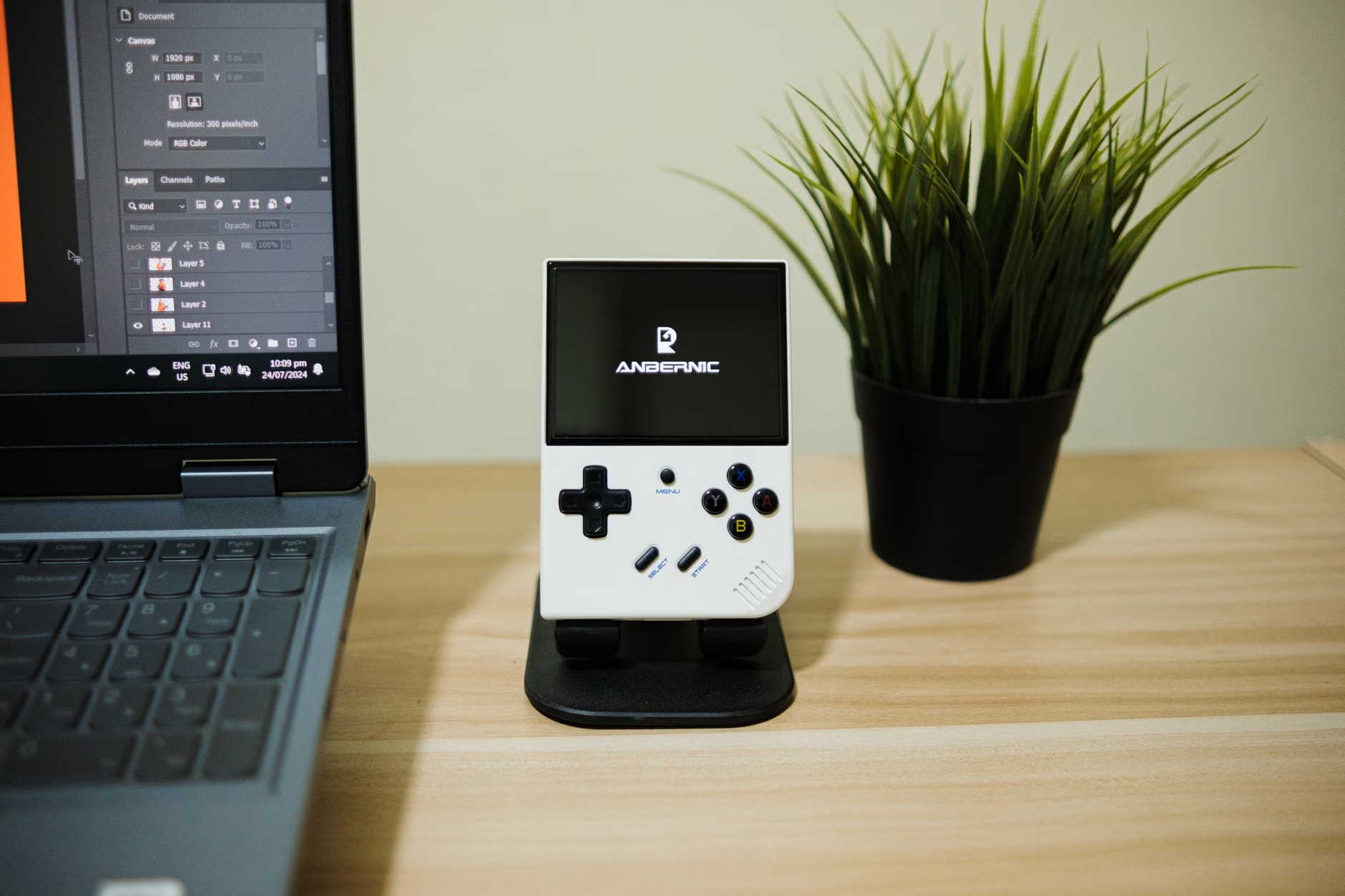
Anbernic RG CubeXX (White)
Best for: Entry-level retro console
Making its debut on the retro handheld scene in 2026, the RG CubeXX quickly garnered attention as a promising, affordable entry-level device for the UK market. Its unique form factor, reminiscent of classic Sega portables, immediately caught the eye. Costing between £65 and £95, this device offers an attractive initial proposition, particularly for fans of Game Boy and Game Boy Color. Yet, beneath the appealing price and comfortable design, some significant practical setup complexities have emerged, especially concerning consistent HDMI video output and functional audio over HDMI.
Mainstream appeal for an entry-level device hinges on ease of use. A true “gateway” handheld should simply plug in and function, offering a smooth path into the world of emulation. While capable in its core emulation, this device introduces enough friction with its external display capabilities that it risks alienating newer users rather than welcoming them. Community testing has illuminated these hurdles, making a clear verdict necessary for anyone considering a purchase in 2026. Buyers should consider these factors carefully before committing.
Our complete retro handheld hub provides a broader look at the market, but the RG CubeXX carves out its own niche, albeit with a few specific caveats. Its genuine strengths lie in pure portability and a focus on 8-bit and 16-bit classics. However, anyone hoping to easily dock it to a television for a simple couch gaming experience might find themselves spending more time troubleshooting than playing.
| Product | Price (UK) | Best For | Score | Buy |
|---|---|---|---|---|
| Anbernic RG CubeXX (White) | £65-85 | entry-level retro console | 7.1/10 | Buy → |
| Anbernic RG CubeXX (Transparent Purple) | £75-95 | unique style, balanced performance | 7.1/10 | Buy → |
| Anbernic RG CubeXX (Black) | £65-80 | budget-conscious GBC fans | 7.1/10 | Buy → |
Design and Build Quality: A Comfortable Fit for Longer Sessions
Known for solid build quality in its devices, Anbernic largely upholds this standard with the RG CubeXX. Its most distinctive feature is arguably its form factor, which has drawn comparisons to classic Sega handhelds. The horizontal layout feels comfortable in hand, especially during extended play sessions. Such a layout offers a significant ergonomic advantage over some of the smaller, vertically oriented devices that can lead to hand cramp after an hour of intense action. A horizontal device like this proves a better choice for players whose hands cramp with smaller units.
The device sports a Sega-style D-pad, a design choice that tends to be divisive but is often celebrated by those who prefer its specific feel for fighting games or precise platforming. Community feedback on r/SBCGaming suggests that whilst some find it softer than classic Nintendo D-pads, it offers satisfying accuracy for titles like Street Fighter II Turbo on SNES and Sonic the Hedgehog 2 on Mega Drive. The face buttons are responsive, and the shoulder buttons, whilst not premium, serve their purpose without major complaint. The overall plastic finish feels robust enough for daily use, standing up to the occasional knock or drop that a portable device inevitably encounters.
Measuring in at approximately 144mm x 78mm x 18mm, the RG CubeXX strikes a balance between portability and screen size. It’s small enough to slip into a jacket pocket or a small bag, yet substantial enough to feel like a proper gaming machine. The 3.5-inch IPS display sits flush with the casing, providing a clean aesthetic. The colour options available – white, black, and transparent purple – also offer a nod to retro aesthetics, with the transparent purple model proving particularly popular amongst enthusiasts for its nostalgic appeal. The subtle texturing on the rear casing helps with grip, preventing it from feeling slippery during intense moments.
Attention to detail remains a consistent theme for Anbernic, even in their more budget-focused devices. It includes dual speakers, which deliver adequate audio fidelity for a device in its price range. While a dedicated pair of headphones will naturally provide a richer sound, the onboard speakers are serviceable for casual play. The placement of the USB-C charging port, headphone jack, and micro SD card slots are all practical, avoiding awkward placements that could interfere with cables during play. Consequently, the physical design choices lean towards user comfort and a pragmatic approach to portable gaming, making it a compelling candidate for users who prioritise ergonomics for long gaming sessions.
The H700 Processor: Capabilities and Real-World Emulation Limits
Powering the Anbernic RG CubeXX is the Allwinner H700 SoC. It stands as a common processor for devices in this price bracket, designed to deliver solid performance for a wide range of older retro systems. Up to the 16-bit era, including the SNES, Mega Drive, Game Boy Advance, and even some PlayStation 1 titles, the H700 performs admirably. Players can expect a locked 60 frames per second (fps) for most games on these platforms without significant frame drops or audio stuttering. Running Super Mario World or The Legend of Zelda: A Link to the Past on SNES presents no issues, with smooth playback and responsive controls.
The H700 architecture, however, does show its limitations when pushing into more demanding platforms. Whilst Joey’s Retro Handhelds praised the RG CubeXX as an “emulation beast,” it’s crucial to contextualise this claim against the device’s actual capabilities for higher-end systems. PSP emulation, for example, is where the cracks begin to show. Games like God of War: Chains of Olympus or Grand Theft Auto: Liberty City Stories will struggle to maintain playable frame rates at anything beyond native PSP resolution. Running these titles often requires frame skipping or resolution scaling to even reach a barely acceptable 30fps, leading to a compromised experience. Side-by-side comparisons by Retro Game Corps have highlighted these performance ceilings, suggesting that expectations for PSP should be tempered.
Nintendo 64 emulation also falls into this category of ‘hit or miss’. Whilst lighter N64 titles such as Super Mario 64 might achieve playable frame rates, more graphically intensive games like GoldenEye 007 or Perfect Dark frequently experience significant slowdowns, especially in busy scenes. This isn’t unique to the RG CubeXX; it’s a characteristic of the H700 processor in similar devices. The community consensus suggests that for consistent N64 emulation, particularly for the more demanding library, a more powerful SoC is advisable. Dreamcast titles are a similar story, with many experiencing inconsistent frame rates, making them less enjoyable. Soulcalibur might be somewhat playable, but anything requiring smooth 3D rendering will often fall short.
The H700 excels at the sweet spot of retro gaming, covering the majority of popular consoles from the 8-bit, 16-bit, and even 32-bit generations with impressive accuracy. This means classic arcade titles, Neo Geo games, and handheld systems like the Game Boy and Game Boy Color are perfectly replicated. Running RetroArch cores for these systems provides a satisfying experience, with minimal configuration needed beyond initial setup. However, for those specifically targeting the later PlayStation Portable, Nintendo 64, or Sega Dreamcast libraries, managing expectations for the H700 is key. It’s a capable chip for its price point, but its ‘budget king’ status is earned through its performance on its core strengths, not by pushing the boundaries of more demanding console generations.
Screen Quality: 720P IPS and the 1:1 Aspect Ratio Question
Its 3.5-inch IPS display boasts a native resolution of 720P (1280×720 pixels). This screen offers a strong selling point for a device in its price bracket. IPS technology offers wide viewing angles and vibrant colours, which are both crucial for an enjoyable portable gaming experience. The display’s brightness is generally sufficient for indoor play, though direct sunlight can still pose challenges, as is common with most reflective screens.
One of the RG CubeXX’s most celebrated screen attributes, particularly highlighted by Joey’s Retro Handhelds, is its 1:1 aspect ratio. This specific configuration makes it “super nice” for emulating original Game Boy and Game Boy Color games, which natively run at a 1:1 aspect ratio (160×144 pixels). When these games are displayed on the RG CubeXX, they appear pixel-perfect without any scaling artefacts or distortion, filling the screen with crisp, authentic visuals. For purists who cherish the original look of these handheld classics, this is a significant advantage. The lack of scaling blur contributes greatly to the perceived sharpness, making games like Tetris or Pokémon Red feel genuinely faithful to their original hardware.
However, the 1:1 aspect ratio screen introduces trade-offs for other systems. While perfect for Game Boy, most other retro consoles used a 4:3 aspect ratio (e.g., SNES, Mega Drive, PS1) or a wider 16:9 ratio (PSP). When playing 4:3 content, the device will display black bars on the sides to maintain the correct aspect ratio, preventing stretching. This isn’t necessarily a negative, as it preserves the original geometry of the games, but it does mean the screen isn’t fully utilised. For example, Chrono Trigger on SNES will show its classic 4:3 image, but with vertical black borders. Screen uniformity matters more than resolution for most retro gaming use cases, and the RG CubeXX generally delivers good uniformity, avoiding distracting light bleed across the panel.
Where its 1:1 aspect ratio truly shows its impact is with 16:9 content, specifically PSP games. As PSP games are designed for a widescreen display, running them on the RG CubeXX’s square screen results in significant letterboxing – black bars both above and below the game image, as well as on the sides to maintain aspect ratio integrity. Such a setup can shrink the effective playable area considerably, diminishing the immersive quality of titles like Monster Hunter Freedom Unite. While the H700 processor already strains with many PSP titles, the screen’s aspect ratio further compounds the visual experience. Prioritising PSP emulation, a handheld with a native 16:9 display, such as the Anbernic RG Vita or Retroid Pocket 5, would offer a far superior visual experience.
HDMI Output: The Unseen Hurdles for a “Gateway” Device
A retro handheld’s promise often includes the convenience of connecting it to a larger screen for couch multiplayer or a more expansive solo experience. While the Anbernic RG CubeXX features an HDMI output, a seemingly standard inclusion, community discussion and troubleshooting forums reveal this feature is far from the plug-and-play experience one might expect from a true “gateway” device. This missing plug-and-play aspect is a critical point that much initial coverage misses, undermining its mainstream appeal.
Users consistently report that the RG CubeXX’s HDMI output is “rough” and unreliable without a specific workaround. To get video output working, the device typically needs to be restarted with the HDMI cable already plugged in. Attempting to connect the cable after the device has booted often results in no signal detected on the television. This isn’t a minor inconvenience; it’s a fundamental hurdle for a casual user. Imagine wanting to quickly switch from handheld play to TV play – instead of a quick cable insertion, you’re forced into a full reboot cycle. For someone new to retro handhelds, this immediately creates a barrier and a frustrating user experience, pushing them towards guides on our HDMI & Display Fix Hub, which they might not want to consult immediately.
The issues extend beyond just video. When HDMI output is eventually coaxed into working, sound over HDMI is frequently “busted.” This means audio either doesn’t transmit at all or comes through garbled and distorted. Fixing this often requires navigating into specific settings within RetroArch, the popular emulation frontend. Adjusting audio drivers, output devices, or buffering settings becomes a necessity, which is far from intuitive for anyone not already familiar with the intricacies of RetroArch. Such configuration demands a level of technical comfort that many first-time handheld owners simply do not possess, directly contradicting the idea of a “user-friendly” entry-level device.
Its persistent HDMI and sound configuration issues will likely impede the RG CubeXX’s role as a truly user-friendly “gateway” device for mainstream users. Like other manufacturers, Anbernic often ships devices with an initial firmware that can be somewhat unoptimised. While custom firmware options often address these kinds of bugs, relying on community-developed software for basic functionality further complicates the experience for a casual buyer. Hoping for an effortless transition between portable and docked play, users will find the RG CubeXX demands a degree of patience and technical fiddling that its attractive price point might not fully offset. Consequently, families or less technically inclined users might find this handheld more frustrating than fun when attempting to connect it to a television.
The community was right about this one; the HDMI experience on the RG CubeXX falls short of modern expectations. For comparison, devices like the Anbernic RG35XX H, whilst sometimes requiring minor adjustments, generally offer a more consistent and less problematic HDMI output. The reliance on specific boot orders and deep software settings means the RG CubeXX doesn’t just ask users to accept compromises in emulation performance, but also in core usability, particularly when stepping outside its handheld mode.
Battery Life and Charging: Practical Expectations for Portable Play
Equipped with a 3100mAh battery, the Anbernic RG CubeXX boasts a capacity fairly standard for a device of its size and power profile. Manufacturer-stated battery figures are often optimistic, and Anbernic’s published figures are typically 15–20% higher than real-world results under sustained emulation load. Community testing on forums like r/SBCGaming consistently places effective battery life closer to the 4-5 hour mark when running demanding 16-bit or PS1 titles. Its effective runtime can extend to 6-7 hours for lighter loads, such as Game Boy or NES emulation, offering a decent amount of playtime on a single charge.
A real-use battery observation that emerges from sustained play is the consistent drain even in standby mode, often more pronounced than on devices with more advanced power management. Users have noted that leaving the device on standby overnight can deplete a significant portion of the battery, meaning a quick pick-up-and-play session often requires a fresh charge. This behaviour isn’t ideal for a portable device intended for spontaneous gaming moments. Comparing this to the efficiency of some Miyoo devices, the RG CubeXX might require more diligent charging habits.
A common characteristic of budget-friendly retro handhelds, the RG CubeXX does not support fast charging. Such a detail is often overlooked but crucial for potential buyers. It charges from 10% to 100% in approximately two hours when using a 2.1A wall charger. While not lightning fast, this speed remains reasonable for a 3100mAh battery. The device uses a USB-C port for charging, a welcome modern convenience, meaning users won’t need to carry proprietary cables. However, connecting it to a higher wattage fast charger won’t reduce the charging time; its internal charging controller limits the input, protecting the battery from overcurrent.
Owners commonly report that using the device whilst charging, particularly when connected via HDMI, can generate a noticeable amount of heat, especially around the rear of the unit. Whilst this generally falls within safe operating temperatures, it does highlight the power demands placed on the internal components. For a device intended for portable use, the 4-5 hour real-world battery life is respectable, though not exceptional. It aligns with the expectations for its price point and processor. Buyers should simply adjust their expectations from the manufacturer’s claims and factor in the lack of fast charging for longer journeys or intense gaming sessions away from a power source. Carrying a small power bank, like the Anker PowerCore 10000, would be a sensible precaution for extended travel.
Operating Systems and Setup: Beyond the Factory Firmware
Shipped with a proprietary Linux-based operating system, the Anbernic RG CubeXX follows a common practice for many retro handhelds in this segment. Its factory firmware provides a basic user interface and pre-installed emulators, offering an immediate if somewhat unrefined, out-of-the-box experience. Initial user feedback often points to a desire for more control and customisation than the stock OS provides, leading many enthusiasts to explore alternative operating systems. The core question on community forums is often, “Which OS are compatible with it? Which is best in your opinion?”
For many Anbernic devices, custom firmware (CFW) such as ArkOS, Amberelec, or even a community-refined stock OS derivative, significantly enhances functionality. While the RG CubeXX is newer, the development community is actively working on optimising these custom firmwares for the H700 chipset. These typically offer improved emulator performance, better game scraping, more intuitive menu navigation, and crucial bug fixes for issues like the reported HDMI audio glitches. Installing CFW usually involves flashing a new image to a high-quality SD card, which then becomes the primary operating system for the device. The best SD card for Anbernic RG35XX H advice applies here too; a reliable card is essential for CFW stability.
For many, the “best” OS is subjective, often depending on priorities. ArkOS, for example, is often praised for its versatility and robust feature set, allowing for extensive customisation and support for a wide array of emulators and ports. Its frontend, EmulationStation, is highly configurable. Amberelec, by contrast, is known for its focus on ease of use and a more polished, appliance-like experience, often pre-configured for optimal performance on specific hardware. The choice between them often boils down to whether a user prefers extensive tweaking or a more streamlined, hands-off approach. For casual users, the stock OS, despite its limitations, might suffice, but those seeking to unlock the device’s full potential will inevitably gravitate towards CFW.
It’s important to acknowledge that whilst custom firmware improves the experience, it also adds a layer of setup complexity. Such setup often involves downloading images, flashing them to SD cards, and manually configuring settings, especially within RetroArch. Consequently, the RG CubeXX, whilst affordable, demands a greater investment of time and effort from its users compared to a console that offers a ready-to-play experience. Despite being touted as a “gateway” handheld, this additional setup work can be a significant barrier. Newcomers who are not comfortable with technical tasks might find themselves overwhelmed. However, users willing to engage with the community and follow online guides will find the reward to be a far more capable and enjoyable retro gaming device.
Connectivity and Peripherals: Bluetooth Controller Frustrations
Bluetooth 5.0 connectivity is included in the Anbernic RG CubeXX, a seemingly standard feature designed to allow for external controller support or wireless audio. In theory, this opens up possibilities for multiplayer gaming on a TV via HDMI, or simply enjoying games with a preferred gamepad. However, community reports paint a less optimistic picture regarding the practical application of this feature. Users have specifically noted issues with Bluetooth controllers, with many finding them “not usable” due to persistent connectivity problems, input lag, or outright failure to pair correctly.
A significant drawback for a device offering HDMI output is its inability to reliably connect a wireless controller, severely limiting utility for couch co-op or tabletop gaming. Imagine finally getting the HDMI video and audio working (after the aforementioned troubleshooting steps), only to find your Bluetooth gamepad refuses to maintain a stable connection or introduces noticeable input delay. Such an experience undermines the entire purpose of connecting to a larger screen. Multiplayer titles like Mario Kart 64 or Streets of Rage 2, which benefit from shared play, become frustrating due to unreliable Bluetooth.
The specifics of the Bluetooth issues vary, with some users reporting controllers dropping connection intermittently, whilst others struggle to get devices to pair at all. It’s unclear if this is a hardware limitation of the Bluetooth module itself, a driver issue within the stock firmware, or a combination of both. Custom firmware solutions often attempt to address these kinds of connectivity problems, but even with optimised software, the underlying hardware can sometimes present inherent limitations. Until a definitive fix or a widely adopted custom firmware update stabilises Bluetooth functionality, users should temper their expectations for external wireless controller support.
This means that for the time being, the RG CubeXX is best considered a strictly solo handheld device. If multiplayer is a priority for a portable retro gaming console, alternatives with more robust and proven Bluetooth connectivity might be a better investment. For example, some devices running more mature custom firmware or those with higher-end chipsets generally offer a more reliable experience with external gamepads. The current state of Bluetooth on the Anbernic RG CubeXX detracts from its overall value proposition, particularly for those hoping to extend its functionality beyond solo handheld play. It’s a key area where Anbernic could improve in future iterations, or where custom firmware developers might still find breakthroughs.
Value for Money in 2026 UK: Is the RG CubeXX a Worthy Purchase?
Assessing the value for money of the Anbernic RG CubeXX in the UK market in 2026 requires balancing its attractive price point against its practical limitations. Retailing around £65–£85 for the white and black models, and £75–£95 for the transparent purple or green variants, it certainly slots into the accessible end of the retro handheld spectrum. Joey’s Retro Handhelds’ assessment of it as a “budget king” and an “emulation beast” is true up to a point, specifically for 8-bit, 16-bit, and PlayStation 1 era games. For this core retro experience, the H700 processor delivers consistent 60fps performance on titles like Crash Bandicoot on PS1 or Street Fighter Alpha 3 on CPS2 arcade. This alone makes it a compelling option for many.
However, value isn’t just about raw power; it also encompasses user experience and versatility. Specific caveats regarding HDMI output – requiring a restart with the cable plugged in – and the frequent need to adjust RetroArch settings for sound over HDMI, significantly impact its “gateway” potential. Truly, a gateway device should be effortless, allowing casual users to jump straight into play without troubleshooting. This device, whilst affordable, asks its users for a notable investment of patience and technical understanding for what should be basic functionality. Unreliable Bluetooth controller connectivity further restricts its utility as a docked multiplayer console, a feature often desired by those looking to share their retro experience.
When considering alternatives for under £100, devices like the Anbernic RG35XX H or the Retroid Pocket 2S enter the conversation. The RG35XX H, often found for under £90, offers comparable emulation performance for its core strengths and a more straightforward HDMI experience, albeit with a vertical form factor some find less ergonomic. The Retroid Pocket 2S, while slightly more expensive, often comes with a more polished Android-based experience and more reliable external connectivity, making it a stronger contender for those seeking versatility. At around £65-95, the Anbernic RG CubeXX occupies a tight space.
Ultimately, the RG CubeXX offers good value for its specific strengths: comfortable handheld play of 8-bit to PS1 games, and an excellent screen for Game Boy titles. For buyers who primarily want a portable solo experience and are comfortable with potential firmware tweaking or simply don’t intend to use HDMI or Bluetooth controllers, it represents a decent purchase. However, for those seeking a truly frictionless “gateway” device that transitions effortlessly between handheld and TV play, or who value reliable multiplayer, the RG CubeXX’s setup complexities and connectivity issues make it a harder sell. It’s a handheld that rewards patience but penalises a desire for immediate, unproblematic functionality.
Who Should Buy This?
For a specific type of retro gaming enthusiast, the Anbernic RG CubeXX is a suitable choice. It particularly shines for those who prioritise a comfortable, horizontal form factor for extended portable play. When flawlessly emulating Game Boy, Game Boy Color, NES, SNES, Sega Mega Drive, and PlayStation 1 titles, the H700 processor inside the RG CubeXX handles these systems with excellent frame rates and accuracy. Its 1:1 aspect ratio screen is also a huge draw for purists who want pixel-perfect Game Boy experiences, making it ideal for classic titles like The Legend of Zelda: Link’s Awakening DX or Advance Wars.
This device is also for individuals who appreciate the value proposition of a sub-£100 handheld and are willing to engage with minor technical setup or custom firmware installation. If you’re familiar with flashing SD cards, navigating RetroArch menus, and potentially troubleshooting minor connectivity quirks, the RG CubeXX offers a rewarding experience once configured. It’s a good step up from smaller, less ergonomic devices for those seeking a more substantial feel without breaking the bank. Owners commonly report satisfaction if they understand its limitations from the outset and value its core performance for a focused set of older consoles.
Who Should Not Buy This?
Despite its attractive price, the Anbernic RG CubeXX is not for everyone. Mainstream users, particularly those seeking a truly “plug-and-play” experience with HDMI output, should probably look elsewhere. Documented issues with needing to restart the device with the HDMI cable already plugged in, and the necessity of adjusting RetroArch settings to get sound working over HDMI, are significant barriers. If a seamless transition from handheld to TV gaming for family multiplayer is expected, this device will likely lead to frustration. Bluetooth controller connectivity issues further compound this, making reliable external gamepad support a gamble.
If your primary interest extends to more demanding systems like PlayStation Portable, Nintendo 64, or Sega Dreamcast, the H700 processor will frequently disappoint. Whilst lighter titles might limp along, many popular games on these platforms will struggle with inconsistent frame rates, visual glitches, or require extensive performance tweaks that detract from the enjoyment. For these systems, a more powerful handheld like the Retroid Pocket 6 or AYN Odin 2 is a more appropriate, albeit pricier, investment. If you prefer a device that simply works out of the box without the need for community firmware or extensive settings adjustments, the RG CubeXX is not the ideal choice.
Verdict
✓ THE GOOD
- Excellent GBA/SNES/PS1 emulation for the price
- Comfortable horizontal form factor for long sessions
- Pixel-perfect 1:1 screen for Game Boy/Colour
- Good build quality for a budget device
✗ THE BAD
- HDMI output is temperamental, needs restart, audio issues
- Unreliable Bluetooth controller connectivity
- Limited performance for PSP, N64, Dreamcast
- No fast charging, battery drain in standby
While offering compelling core retro emulation at a low price, the Anbernic RG CubeXX’s HDMI and Bluetooth issues prevent it from being a truly user-friendly gateway device.
7.1/10 — Check price on Amazon UK →
Frequently Asked Questions
What are the general opinions on the RG CubeXX?
General community opinions highlight the RG CubeXX’s comfortable ergonomics and its excellent performance for 8-bit, 16-bit, and PS1 emulation. Many praise its 1:1 screen for perfect Game Boy experiences. However, a consistent point of contention revolves around its problematic HDMI output and unreliable Bluetooth connectivity, which temper expectations for its overall versatility as a docked or multiplayer device.
How is the charging situation? Can you use any USB-C fast charger on it?
RG CubeXX’s charging is convenient via USB-C, but it does not support fast charging. It typically takes about two hours to charge from 10% to 100% using a standard 2.1A wall charger. Even when plugged into a fast charger, the device’s internal circuitry limits the power input, meaning it won’t charge any faster. This limitation is important to remember for travel planning.
Which operating systems are compatible with the RG CubeXX? Which is best in your opinion?
A proprietary Linux-based OS ships with the RG CubeXX. Custom firmware options like ArkOS and Amberelec are actively being developed for the H700 chipset and are generally compatible. Ultimately, the “best” OS depends on user preference: ArkOS offers extensive customisation and versatility, ideal for tinkerers, while Amberelec provides a more streamlined and polished appliance-like experience for users who prefer ease of use. Both offer significant improvements over the stock firmware.
What are the real-world thoughts on the RG CubeXX in 2026?
In 2026, real-world thoughts on the RG CubeXX position it as a solid, budget-friendly handheld for dedicated retro enthusiasts focused on portable play of older systems. Its ergonomic design and strong performance for GBA, SNES, and PS1 emulation are highly valued. Yet, its persistent HDMI and Bluetooth issues prevent it from being a truly universal “gateway” device for mainstream users who expect seamless TV connectivity and wireless multiplayer without significant troubleshooting. It’s a capable handheld, provided buyers understand its specific limitations.
Does the 1:1 screen aspect ratio cause problems for most retro games?
The 1:1 screen aspect ratio is perfect for Game Boy and Game Boy Color games, displaying them pixel-perfectly without scaling artefacts. For 4:3 systems like SNES or PS1, it will display black bars on the sides, but the games appear correctly. The main “problem” arises with widescreen content, specifically PSP games, where the screen’s square aspect ratio leads to significant letterboxing both horizontally and vertically, greatly reducing the effective play area. This can make PSP titles feel cramped and less immersive.
How does the Anbernic RG CubeXX compare to other budget handhelds under £100 UK?
Anbernic RG CubeXX’s comfortable horizontal form factor and 1:1 screen for Game Boy titles make it stand out, offering excellent emulation for 8-bit, 16-bit, and PS1 at around £65-95. Compared to the Anbernic RG35XX H (under £90), it offers better ergonomics for some but suffers from more HDMI and Bluetooth issues. While slightly more expensive, the Retroid Pocket 2S generally provides a more refined Android experience and more reliable connectivity. Ultimately, this device is a strong contender for specific use cases but has notable drawbacks.
✓ Recommended by Ben Rawlinson
Recommended based on community testing data, benchmark results, and verified UK pricing — we only link products that earn it.
- Anbernic RG CubeXX (White)Best for: Entry-level retro console
- Anbernic RG CubeXX (Black)Best for: Budget-conscious GBC fans
- Anbernic RG CubeXX (Transparent Purple)Best for: Unique style, balanced performance
RetroInHand earns a small commission from qualifying Amazon UK and eBay purchases at no extra cost to you.
What to Read Next
If you found this useful, here are a few articles worth reading next:
- Anbernic RG35XX H Review: Best Starter Under £90 UK (2026) — This review offers a direct comparison to another popular budget Anbernic device, helping you weigh up alternatives.
- Retroid Pocket 2S Review: Best Value Under £100 in 2026 UK? — Discover how the Retroid Pocket 2S compares, particularly if you’re looking for a handheld with a different operating system experience.
- Best Retro Handheld Starter Kit Under £100 UK (2026) — This guide will help you understand what other budget options exist and what a complete beginner needs to get started without hassle.
In the 2026 retro handheld market, the Anbernic RG CubeXX presents a nuanced picture. Its comfortable design, capable H700 processor for core retro libraries, and excellent 1:1 screen for Game Boy titles make it an appealing choice for a focused segment of enthusiasts. At around £65–£95 in the UK, the device offers genuine value if its strengths align with your priorities for a dedicated portable experience.
However, the recurring HDMI output and audio configuration issues, coupled with unreliable Bluetooth controller connectivity, significantly temper its appeal as a truly user-friendly “gateway” device. For a handheld to genuinely open the door to retro gaming for a broader audience, it needs to perform basic functions like TV output and wireless controller support without demanding technical troubleshooting. Despite its affordability, the RG CubeXX requires a level of patience many new users simply won’t have.
Ultimately, the Anbernic RG CubeXX is a capable retro handheld that falls short of being a universally recommendable entry-level device due to its practical setup complexities. Despite these complexities, it offers a solid foundation for those willing to put in the effort. The next question for Anbernic, and the broader handheld market, is when we’ll see a truly accessible budget device that delivers a frictionless experience from the moment it’s unboxed.
This article was produced with AI assistance and reviewed by the editor. See our Editorial Standards.