Last updated: July 2026
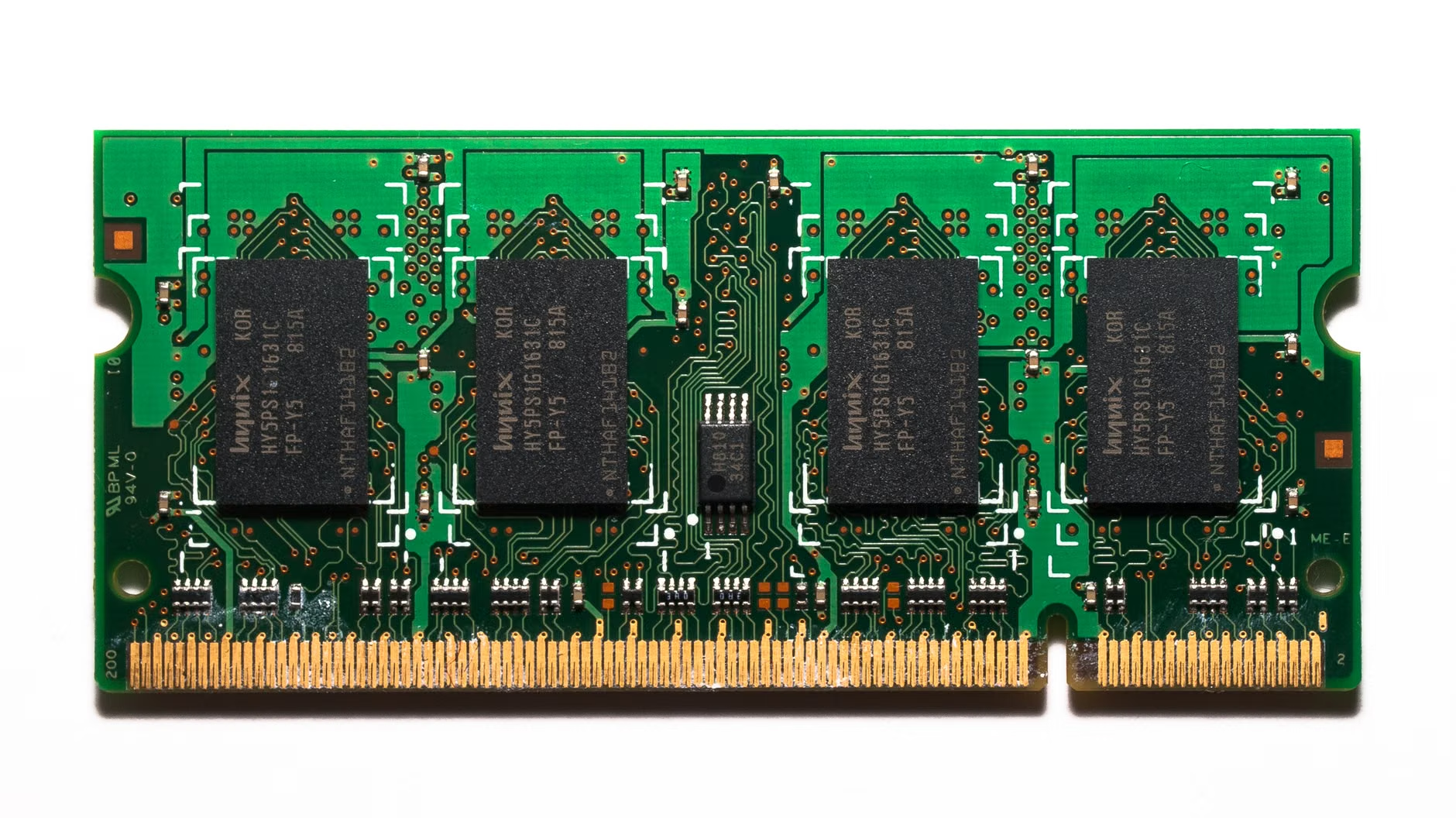
The retro handheld market has spent the last few years on an upward trajectory — more RAM, sharper screens, faster processors, more ambitious emulation targets. Devices that would have seemed extraordinary just five years ago are now mid-range. But that trend is running headlong into a supply-side problem that the community has started calling “Ramageddon”: a tightening of DRAM and LPDDR memory supply that is reshaping what manufacturers can promise, when they can ship, and at what price point.
This isn’t a niche electronics industry story that happens to brush against gaming. For anyone seriously considering a handheld purchase in 2026 — whether that’s an Anbernic, a Retroid, an Analogue device, or something else entirely — understanding the pressure on memory supply is genuinely useful. It explains why some announced devices are delayed, why specs sometimes shift between announcement and retail, and why the £150–£300 segment of the market is experiencing particular turbulence.
What follows is an honest look at the situation, what’s driving it, and how to think about a purchase in this environment. No sensationalism. Just the context you need to make a better decision.
What Is “Ramageddon” and Where Did the Term Come From?
The term “Ramageddon” emerged from enthusiast communities — forums, Discord servers, Reddit threads — as shorthand for a confluence of memory supply pressures. DRAM markets are historically cyclical: periods of oversupply drive prices down, periods of undersupply push them back up. The current squeeze appears to be driven by several overlapping forces: increased demand from AI accelerator hardware (which consumes enormous quantities of HBM and standard DRAM), automotive sector recovery, and geopolitical pressure on semiconductor supply chains.
LPDDR5 and LPDDR5X — the memory types that power the most capable modern handhelds — have been particularly affected. These are the same specs you’ll see cited in devices targeting PS2 and GameCube emulation, where raw memory bandwidth makes a real difference to performance. When supply of a specific DRAM grade tightens, smaller manufacturers feel it most acutely. A company like Samsung or Qualcomm has long-term supply agreements; a smaller handheld manufacturer ordering in batches of tens of thousands does not.
The result, community members have broadly reported, is longer lead times, occasional spec changes between announcement and shipping, and upward pressure on component costs that eventually shows up in retail pricing.
How This Affects Handheld Manufacturers Specifically
The handheld manufacturers most relevant to this community — Anbernic, Retroid, Powkiddy, and others — operate on relatively thin margins and modest production volumes compared to mainstream consumer electronics. They are, by definition, more exposed to spot-market memory pricing than a company like Nintendo or Sony, which lock in components at scale years in advance.
When memory costs rise or availability tightens, these manufacturers face a set of unpleasant choices:
- Absorb the cost increase and accept lower margins
- Pass the cost on through higher retail prices
- Substitute a lower-spec memory grade (which can affect performance)
- Delay production until supply stabilises
In practice, community observation suggests a mix of all four has occurred across the market at various points. Devices have shipped later than announced. Spec sheets have occasionally been revised quietly. Prices at launch have come in higher than early estimates suggested.
None of this means manufacturers are acting in bad faith. It reflects the reality of building hardware on a tight supply chain. But as a buyer, it does mean you should treat pre-announcement specs with some caution and check community forums for any late changes before committing.
If you’re weighing up higher-end devices like the Retroid Pocket 5 or Retroid Pocket 6, our reviews cover what actually shipped — which is always more useful than what was announced. See our Retroid Pocket 5 UK review and Retroid Pocket 6 review for the real-world picture.
The FPGA Exception: Why Analogue Devices Sit Outside This Problem
FPGA-based hardware — the Analogue Pocket being the most prominent example in this community — works differently. Rather than relying on a powerful SoC with large amounts of fast LPDDR memory to emulate legacy hardware in software, FPGA devices replicate the original hardware logic in silicon. The memory requirements are fundamentally different: smaller, slower, and far more stable in supply terms.
This is one reason the Analogue Pocket has remained available (if expensive at resale) while some software-emulation handhelds have experienced supply disruption. It’s also worth understanding when you compare the two approaches — cost, philosophy, and supply resilience all differ. Our comparison of the Analogue Pocket vs MiSTer FPGA covers this in detail if you’re weighing the two philosophies.
FPGA isn’t immune to component pressures, but it’s a different kind of exposure. Worth knowing if supply stability matters to you.
What This Means If You’re Buying Now
The honest answer is: probably less than the community panic suggests, but more than manufacturers’ marketing implies.
If a device is already in stock and available from a reputable UK retailer or direct from the manufacturer, the memory situation is largely baked in. You’re buying what exists. The question is whether the spec sheet that shipped is what you needed — which is a review question, not a supply chain question.
Where the supply picture genuinely matters is at the announcement stage. A device announced with LPDDR5X and 16GB RAM, due to ship in six months, is a speculative purchase in a way it wouldn’t have been in a more stable supply environment. Community consensus on forums like GBAtemp and the various handheld subreddits has increasingly settled on a simple heuristic: wait for reviews of the actual shipping unit before ordering anything that isn’t in stock.
This is especially true at the higher end of the market. A £250–£300 handheld is a serious purchase. The gap between announced specs and shipped reality — even if small — matters more at that price point.
For mid-range buyers in the £75–£120 bracket, the calculus is slightly different. Devices in this range typically use LPDDR4X, which has seen less acute supply pressure. Our Anbernic RG CubeXX review is a good reference point for what a well-specced mid-range device looks like right now.
The Longer View: Will This Resolve?
Memory supply cycles do resolve — historically, they always have. DRAM markets typically correct through a combination of new fab capacity coming online and demand normalisation. The AI compute boom that is currently consuming so much DRAM bandwidth will, eventually, either slow or drive enough new production capacity to ease general supply pressure.
But “eventually” is doing a lot of work in that sentence. Industry analysts have broadly suggested that meaningful capacity additions take two to four years from investment decision to production — which means near-term relief is not guaranteed. The more relevant question for handheld buyers is whether the devices currently on the market are sufficient for your needs.
The answer, for the vast majority of retro gaming use cases, is yes. Devices available now run 16-bit and 32-bit era content without strain. Even PS2 and GameCube emulation — the current high-water mark for handheld ambition — is achievable on hardware already in the market. You don’t need to wait for next year’s specced-up flagship to enjoy excellent retro gaming on a handheld today.
The supply constraint matters most to the people chasing peak specs. If that’s you, patience and pre-order caution are your best tools. If you’re buying to play the games you loved, the current market has plenty to offer right now.
For everything else you need to know about the handheld market, our Retro Handheld Hub is the place to start.
Frequently Asked Questions
What exactly is “Ramageddon”?
It’s a community shorthand — coined on enthusiast forums and social platforms — for the current tightening of DRAM and LPDDR memory supply, driven primarily by demand from AI hardware, automotive recovery, and geopolitical supply chain pressure. It’s not an official industry term, but the underlying supply pressure it describes is real.
Will handheld prices go up because of this?
Upward pressure on component costs does typically translate to higher retail prices over time, particularly for devices in the higher-spec brackets. Whether and when that feeds through depends on each manufacturer’s supply agreements, margins, and competitive positioning. Devices already in stock are priced based on existing component costs — the uncertainty applies mainly to future devices not yet shipping.
Should I delay buying a handheld until supply normalises?
Probably not, if you’re buying something currently in stock. Supply normalisation could be two or more years away based on broad industry commentary. Waiting that long for a handheld you’d enjoy today isn’t a sensible trade-off for most people. The caution applies to pre-ordering unshipped devices with ambitious specs.
Which handheld types are most affected by memory supply pressure?
Devices targeting LPDDR5 and LPDDR5X — primarily the higher-end Android handhelds in the £200+ range — face the most acute exposure. Mid-range devices using LPDDR4X have experienced less disruption. FPGA-based devices like the Analogue Pocket use a fundamentally different memory architecture and are largely insulated from this specific pressure.
Can manufacturers just swap to different memory to keep prices down?
In some cases, yes — but there are trade-offs. Substituting a lower-bandwidth memory grade can reduce performance, particularly for demanding emulation targets. Community members have reported noticing these changes in some devices where the memory specification was quietly revised between announcement and shipping. It’s one reason to read reviews of the actual shipped hardware.
Does this affect cartridge-based flash storage devices like EverDrives?
EverDrive-style flash cartridges use flash storage rather than DRAM, so they’re exposed to a different set of supply dynamics. NAND flash pricing has its own cycle, but it’s largely separate from the LPDDR market pressures discussed here. For context on what EverDrive hardware offers, our Everdrive 64 X7 review covers the high end of that category.
Is the Analogue Pocket genuinely unaffected by all this?
No device is entirely immune to component supply pressure, but the Analogue Pocket’s FPGA architecture means it isn’t competing for the LPDDR5 supply that’s under strain. Its challenges have historically been different: production volume, resale price inflation, and long wait times due to limited manufacturing runs. These are real issues, but they’re separate from the Ramageddon supply dynamic.
How can I stay informed about spec changes before buying?
GBAtemp forums, the Retro Handhelds subreddit, and manufacturer Discord servers are the most reliable sources for community-reported spec changes between announcement and shipping. Checking these immediately before purchasing a pre-order or newly released device takes five minutes and can save a significant amount of money and disappointment.
What to Read Next
- Analogue Pocket vs MiSTer FPGA UK: Which Is Better Value in 2026? — If the FPGA approach sounds appealing as a supply-stable alternative, this comparison breaks down the real cost and experience difference between the two leading options.
- Retroid Pocket 6 Review: Best for PS2/GC? Worth £250–300 UK — A look at what the current high-end Android handheld market actually delivers in the box, based on the shipping hardware rather than the announcement spec sheet.
- Retro Handheld Hub — The full overview of every handheld category we cover, from budget SNES-era devices to high-end PS2 emulation machines. The right place to start if you’re still deciding where to pitch your budget.



This article was produced with AI assistance and reviewed by the editor. See our Editorial Standards.